
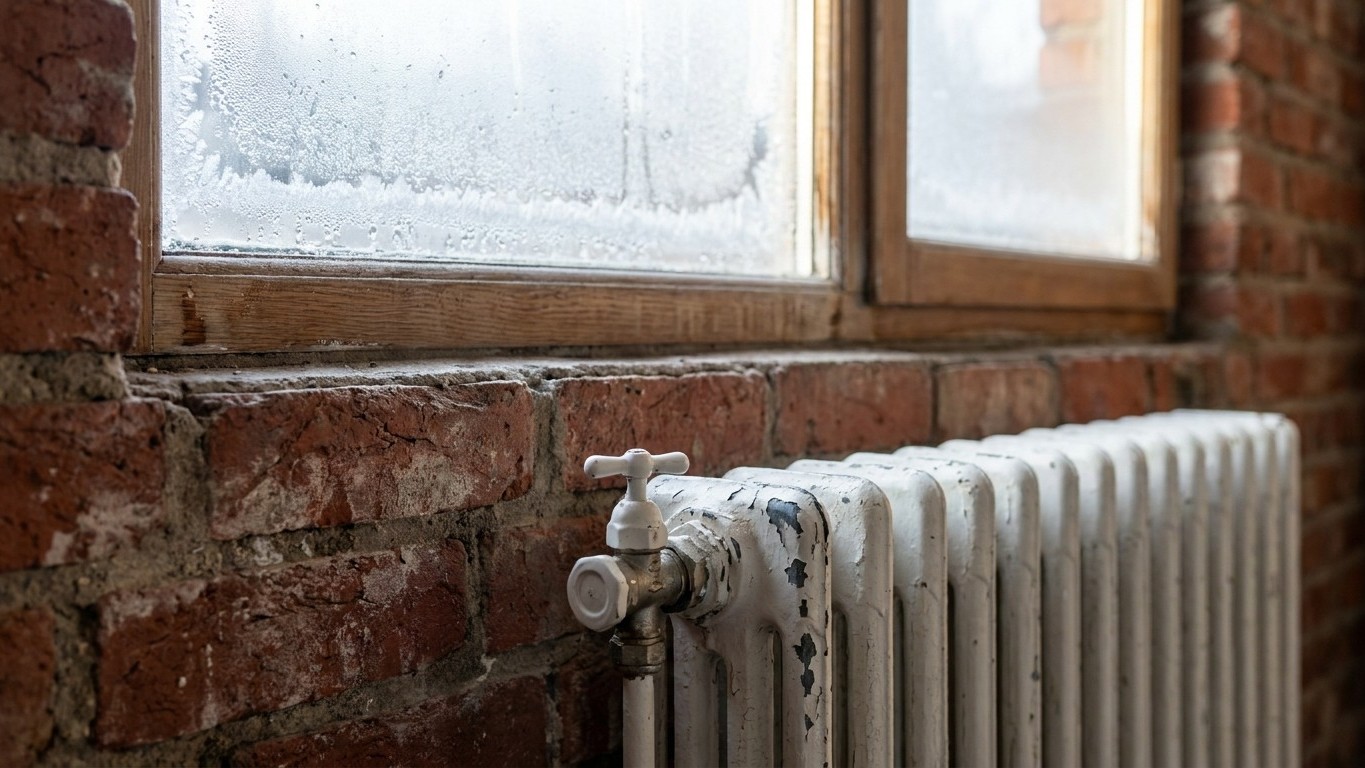
Cranking the dial up another notch does nothing to fix the real problem: an external wall with nothing behind the radiator to stop the heat sailing straight through the brickwork. Turn that radiator up on a cold wall and you’re not warming the room efficiently, you’re heating next door’s air gap, or worse, the great outdoors.
Here’s the physics nobody explains at the DIY shop counter. A radiator throws heat two ways: forwards into your living space, and backwards into whatever’s directly behind it. If that’s a solid, uninsulated external wall, a good chunk of that backward heat simply diffuses through the masonry and vanishes. Research has found reductions in overall room energy consumption of up to 6% simply from installing plain foil behind a radiator, while heat loss through the wall area immediately behind the radiator fell to less than 30% of the original value. That’s not a rounding error. That’s a third of the wasted heat, recovered, for the price of a roll of foil.
Key takeaways
- Why does your radiator feel hot but your room stays cold, even at maximum temperature?
- A single roll of reflector foil can reduce heat loss through external walls by 70% — but only works on certain wall types
- The exact annual saving isn’t glamorous, but multiply it across every external wall radiator in your home and the numbers start to matter
The missing layer that decides your heating bill
What’s actually missing behind that radiator, in most older British homes, is a reflective barrier or proper wall insulation. Radiator reflector panels are thin sheets made of foil or other reflective material, sometimes with a thin layer of insulating material, and reflect heat from the back of a radiator back into a room, stopping it from escaping through outside walls. Fit one, and instead of your boiler working overtime to compensate for heat leaking into the brick, that warmth gets bounced straight back into the room where you actually want it.
The numbers from proper testing back this up nicely. In a controlled trial using a small test room roughly the size of a bedroom, researchers found that for a radiator temperature of 43°C, heat flux through the wall behind the radiator reduced from 7.1 to 3.1 watts per square metre once foil was added. Across a full British winter, that same study estimated the total annual saving at around 60 kilowatt-hours for a single room, which sounds modest until you multiply it across every radiator sitting on an external wall in your house.
The Energy Saving Trust puts a pound figure on it too, and it’s worth knowing before you spend anything. Installing radiator panels on uninsulated external walls can save £18 a year on your energy bills in Great Britain, or £20 in Northern Ireland, and they also help cut your carbon footprint by 60kg a year in Great Britain, or 110kg in Northern Ireland. Not life-changing on its own, granted, but stack it alongside draughtproofing and a lagged hot water tank and the savings start adding up to something you’d actually notice.
Why the wall behind matters more than the wall itself
This is where most people get it backwards, quite literally. They assume any cold external wall automatically deserves a hotter radiator, when the deciding factor isn’t the wall’s temperature at all, it’s what’s sandwiched between the radiator and the brick. A cavity wall that’s already been filled with insulation behaves completely differently to a solid Victorian wall with nothing but plaster and air behind it.
Italian researchers studying this exact scenario confirmed what British forum users have suspected for years: the performance of a reflecting panel depends strictly on the insulation level of the external wall facing the radiator, with efficiency increasing when the thermal resistance decreases. Translated into plain English, that means foil works brilliantly on a poorly insulated solid wall and barely at all once cavity wall insulation is already doing its job. Fit reflector foil in a home with filled cavity walls and you might save a few pence a year, nothing to write home about. Fit it behind a radiator on an old solid wall in a Victorian terrace, and you’re looking at a genuinely worthwhile return on a very cheap bit of kit.
I’d say this is the bit that separates a sound investment from wasted effort: check your wall type before you buy anything. If you’re not sure whether your cavity’s been filled, a quick call to your local council’s home energy advice line, or a look at your EPC certificate, will usually tell you. There’s no point insulating behind a radiator that’s already backed by a well-filled cavity, save your money and your effort for the solid-wall rooms instead.
Fitting it properly, without wasting a penny
The mistake I see time and again is people reaching for ordinary kitchen foil, thinking foil is foil. It isn’t. Aluminium kitchen foil won’t work, it’s difficult to keep in place and won’t have the insulation or special design of proper radiator panels that help them work properly. You want purpose-made reflector panels, and they’re not dear, a roll costs around £25, which you can then cut to size so it fits snugly behind your radiator.
Fitting one is genuinely a job for a Sunday afternoon rather than a professional. Measure the radiator, cut the panel a touch smaller so the edges tuck neatly out of sight, then slide it down behind the radiator with the reflective face pointing towards you, not the wall, and press it flush so it sticks. If you’re mid-renovation and the radiator’s already off the wall, that’s the perfect moment to slip a panel in behind it while you’ve got easy access. Renters can do this too, clip-on versions go up and come down without leaving a mark, though it’s only polite to check with your landlord first.
One thing worth remembering before you fit anything: only bother with radiators actually sitting against an external wall. It’s not really worth adding radiator panels to internal walls, because if a radiator is on a wall between two rooms, it’ll warm that internal wall, and the heat stays inside your home anyway. Save the foil for the walls that face the weather, and you’ll get every penny of value out of that £25 roll.
Sources : slashgear.com | energysavingtrust.org.uk