
Every evening for months, out came the can. A quick blast over the sink before dinner, another halfway through the washing up, just to keep those maddening little flies from landing on the plates. It felt like winning a small battle each time. It wasn’t. It was treating a symptom while the actual cause sat quietly inside the pipe, multiplying by the day.
The flies in question weren’t fruit flies, though they’re often mistaken for them. They were almost certainly drain flies, sometimes called moth flies or sink flies: tiny, fuzzy, greyish insects that hover rather than dart, and tend to cling to walls and taps near the sink rather than buzzing off in a hurry. Drain flies (Psychodidae, also called moth flies, filter flies, sink flies, or sewer flies) are small dark winged insects, 1.5–5 mm long, that look like tiny fuzzy moths. Spraying them out of the air does nothing to the source, because the source was never in the air at all.
Key takeaways
- Spraying only kills adult flies visible above the sink—but the entire nursery keeps multiplying hidden inside the pipe
- A single female drain fly can lay 500 eggs that hatch in less than 48 hours, creating an overlapping assembly line of new generations
- One brush pushed down the drain revealed thick, dark, gelatinous biofilm teeming with tiny pale larvae—the real enemy all along
What was really being fed, night after night
The unpleasant truth is that a spray can only ever kills the adults you can see. Drain flies breed in the biofilm, the slimy microbial layer that coats the inside of drains and pipes, and killing adult flies with sprays or flushing drains with boiling water does not remove that biofilm, so new flies hatch within days. That biofilm isn’t a mysterious substance, either. It’s the main food source for drain fly larvae, and it’s made up of decomposing food particles, grease, hair, soap residue, and bacteria. Every scrap of veg peel that slipped past the plughole, every trace of washing-up liquid residue, every bit of grease from last Sunday’s roast: it all clings to the inside of the pipe and slowly builds up into a slick, organic film.
Female flies find that film irresistible. Female flies can lay up to 500 eggs at a time in this organic material, and the eggs hatch within 24-30 hours, with the larvae feeding on the biofilm for about a week before emerging as adult flies. Which means the “few flies” swatted away one evening were never a static population. Eggs hatch in about 32 to 48 hours, so a small buildup in one drain can produce a noticeable fly problem within a week. Spraying the adults each night was, in effect, thinning the herd just enough to make the problem tolerable, while an entire nursery kept ticking along beneath the plughole, safe from anything sprayed into the air above the sink.
It’s worth saying plainly: this isn’t a filthy-kitchen problem exclusively. Drain flies thrive in any environment with organic-rich biofilm and warm, moist conditions, and a sink used daily for cooking, tea-making and washing up is exactly the sort of environment they love, however clean the counters look. The mess isn’t on show. It’s inside the pipe, out of sight, which is precisely why it goes unnoticed for so long.
The moment the brush went down the plughole
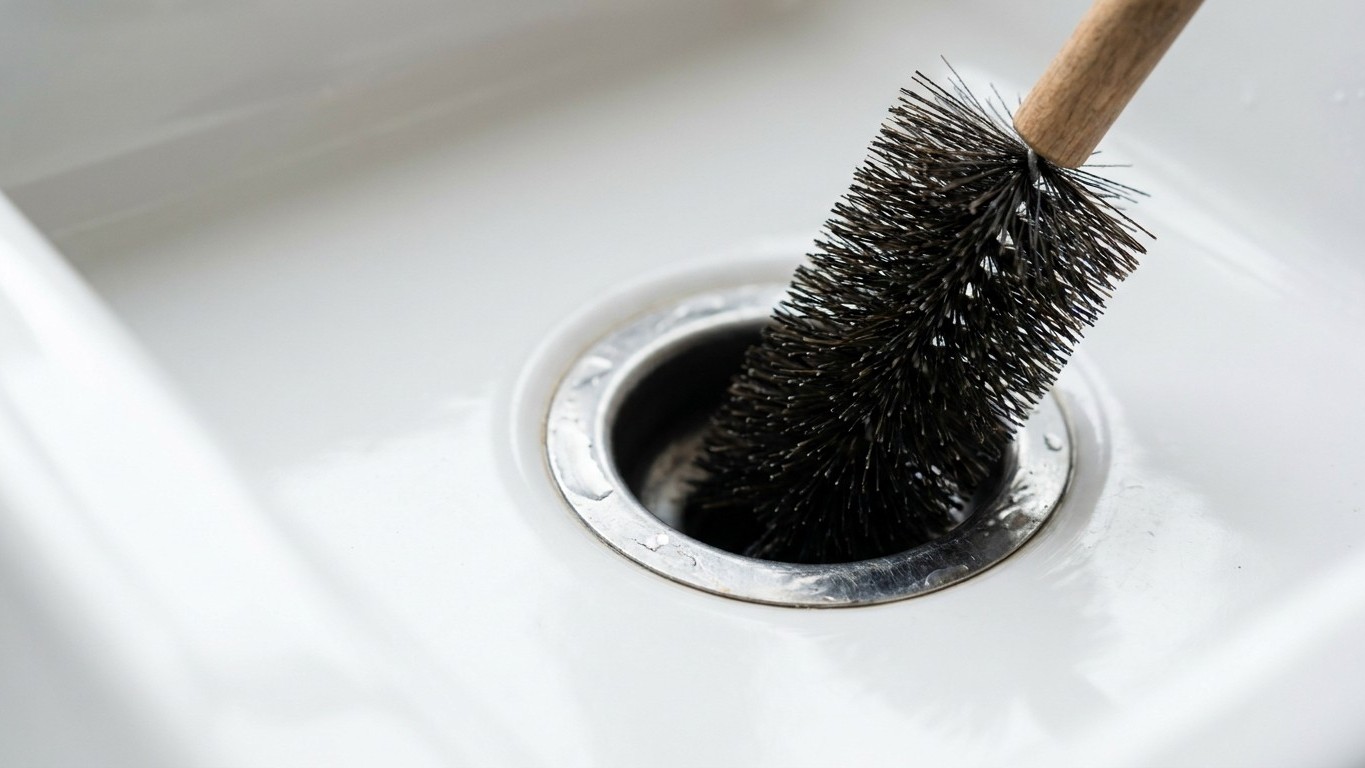
Pushing a stiff brush down into the drain that evening was the point everything became obvious. What came back up wasn’t the odd bit of grime; it was a thick, dark, gelatinous coating, exactly the kind of gunk described by pest specialists as the flies’ entire world. Checking drains by removing the drain plate, sink parts, and trap, then scraping the slimy biofilm from the inside of the drainpipe using a knife and stiff brush, allows you to examine the collected slime for live larvae. Anyone who does this and looks closely often finds tiny pale larvae wriggling in the sludge, which is a genuinely unsettling thing to discover in your own kitchen sink after months of thinking the problem was simply “a few flies that come in through the window.”
The lifecycle explains why the infestation never seemed to end despite nightly spraying. Because the life cycle takes about three to four weeks, a breeding colony can establish itself silently inside pipes before a single adult is noticed; eggs hatch in less than 48 hours, the larval stage lasts one to three weeks feeding on biofilm hidden inside the drain, and the pupal stage takes only 24 to 48 hours before a new adult emerges. Every generation overlaps the next, so there’s rarely a clean gap between one wave of flies and the following one. It looks, from the outside, like the exact same handful of flies simply won’t die. In truth, it’s an entire assembly line, and a can of insect spray was never going to touch the machinery.
Clearing the pipe properly, without wrecking it
The fix, thankfully, doesn’t need anything fancy or expensive, and it doesn’t need a plumber unless things have got seriously out of hand. Physically removing the biofilm is what matters, because bleach can kill adult drain flies on contact but cannot penetrate the biofilm layer where drain fly larvae live and feed, which protects the eggs and larvae from chemical treatments. A stiff nylon or wire pipe brush, worked gently up and down inside the drain opening and as far into the pipe as it will reach, does the physical job that no amount of spraying ever could.
Once the worst of the gunk is out, a simple kitchen-cupboard treatment finishes the work. The solution should consist of ½ cup of baking soda, 1 cup of vinegar, and ½ cup of salt, poured down the drain and left to sit overnight before flushing through with hot water in the morning. The salt adds a bit of gritty abrasion, the vinegar and bicarbonate fizz up and loosen what’s left clinging to the pipe walls, and the hot water carries it all away. Do bear in mind, though, that using hot rather than boiling water is sensible for PVC pipes, to avoid damage, since older plastic fittings don’t take kindly to a full kettle straight from the boil.
This isn’t a one-off job, sadly, because the same daily habits that fed the biofilm in the first place will simply build it up again. A weekly scrub with the brush, followed by the vinegar and bicarbonate treatment, keeps the pipe walls clear enough that flies never get a foothold. It’s a five-minute habit, costs pennies, and does more good than an entire shelf of spray cans ever managed. The can of insecticide can stay in the cupboard from now on; the brush is doing the actual work.
Sources : aol.com | southlandorganics.com