
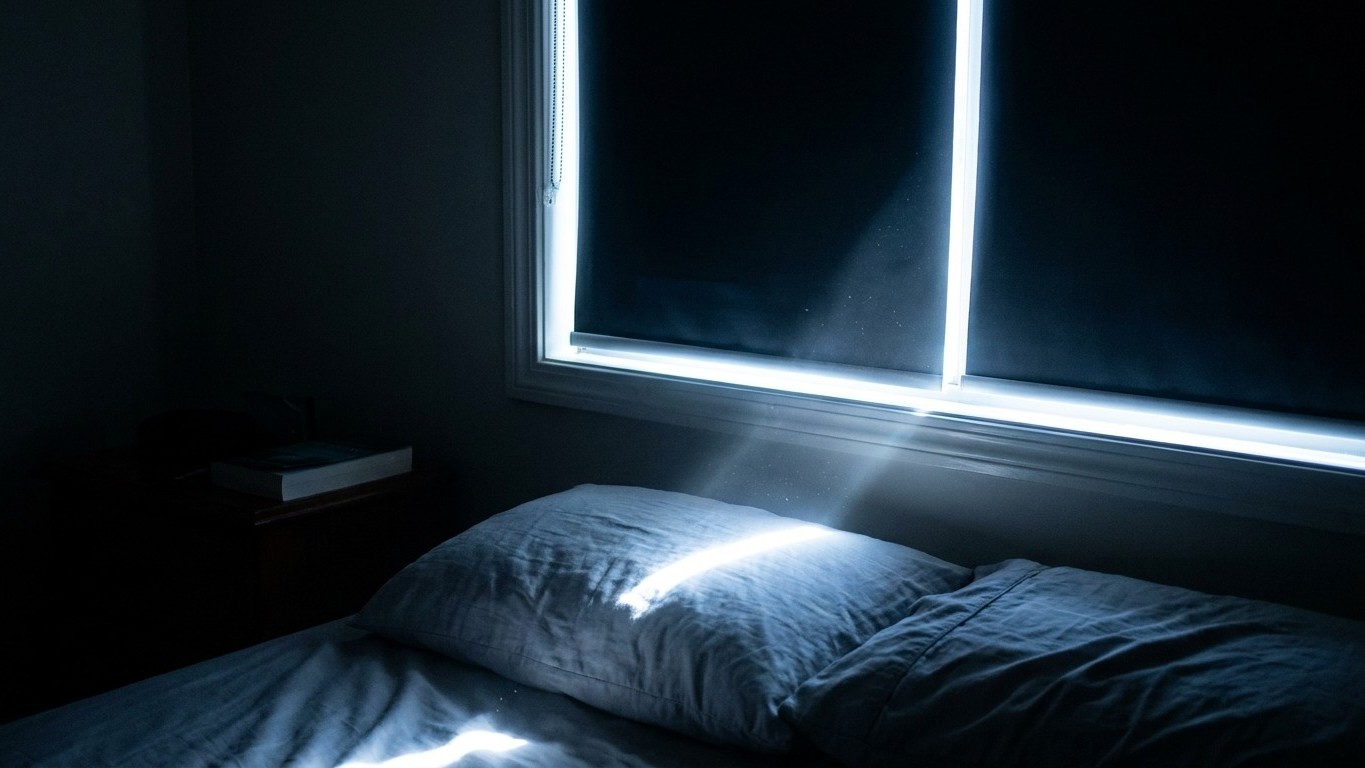
Three years of broken sleep taught me something no interior design magazine ever mentioned: blackout blinds are brilliant at stopping the sun, hopeless against a 500-watt security floodlight aimed straight through a gap in the curtains. I’d spent £180 on a proper made-to-measure set, thick enough to make my bedroom feel like a submarine at midday, and still woke at 2am bathed in white light every time next door’s cat, a passing fox, or apparently the wind itself tripped their sensor. It wasn’t until an environmental health officer stood in my bedroom with a light meter that I finally understood who should have been footing that bill all along.
The officer’s visit came after months of me assuming this was simply the price of modern suburban living, something to be endured with a stiff upper lip and thicker curtains. I was wrong. Sitting in my darkened room, watching the readings spike every time the sensor caught a moth, she explained something I Wish I’d Known from the very first sleepless night: excessive artificial light spilling from next door isn’t just annoying, it can be a legal matter with a clear process behind it.
Key takeaways
- Excessive artificial lighting from a neighbour’s property can be classified as a statutory nuisance under UK law—but most people don’t know this
- An environmental health officer’s visit revealed a legal process the homeowner had never heard of, complete with enforcement powers
- The real culprit wasn’t inadequate blinds but an improperly angled and calibrated security light—and the law puts responsibility squarely on the source
Why blinds alone were never going to fix this
Blackout blinds work by blocking ambient light, the gentle glow of streetlamps or a rising sun. A modern PIR-triggered floodlight is a different beast entirely: a sudden, intense burst designed to startle intruders, not sit politely outside a window. Even the tiniest gap at the blind’s edge, or light bouncing off a wall and through curtain seams, was enough to flood my room. No amount of fabric was going to solve a problem that was really about the fitting, angle, and power of my neighbour’s light rather than the coverage of my windows.
What the officer pointed out, gently but firmly, is that for artificial light to count as a statutory nuisance it must be excessive or produce an unreasonable level of light for the area, and it doesn’t take into account an individual’s sensitivity to light or insufficient window coverings. That last part stung a little. My £180 blinds were never going to be judged relevant to whether this counted as a nuisance in law, because the fault sat entirely with the fitting next door.
The law most of us have never heard of
Statutory light nuisance claims in England are governed by the Environmental Protection Act 1990 and the common law principle of nuisance, which provides statutory powers to local authorities to take action against light that causes a nuisance. This isn’t some obscure clause either. The first UK law tackling light pollution came into force in 2006 under Section 102 of the Clean Neighbourhoods and Environment Act 2005, adding exterior lighting to the list of things treated as a Statutory Nuisance alongside noise and smells, making exterior light prejudicial to health or a nuisance a criminal offence.
There’s no simple formula involving lux readings or a magic number that tips a light from “irritating” into “illegal”. There are no set levels of light above which a statutory nuisance occurs, which is precisely why the officer’s judgement mattered so much, standing there in my room at midnight watching how the light actually behaved against my walls and pillow. A typical example given by councils is a security light that shines into a neighbour’s bedroom window and stops them from sleeping properly, which, embarrassingly, was almost word for word my own situation.
Worth knowing too: not every bright light qualifies, however maddening it feels. Domestic and commercial security lights, sports facilities including floodlit football pitches, and decorative lighting of buildings can all cause artificial light nuisance if not maintained or used properly, but genuinely public infrastructure is excluded. Councils cannot take action if normal levels of artificial light shine onto your property, such as from street lighting. So if it’s the streetlamp outside bothering you, the blinds really are your best (and only) defence. If it’s next door’s floodlight, you have options.
What actually happens once you complain
Every council I’ve since checked on this recommends the same first step, and it’s the one I skipped for far too long out of sheer British politeness anxiety: talk to your neighbour first. In the first instance, it’s recommended to talk to your neighbour about any light complaint, as often they may not be aware of the problem and can quickly resolve it. Mine genuinely hadn’t a clue their sensor was set so sensitively, or angled quite so high.
When that conversation doesn’t resolve things, the council steps in with real teeth. You can make a formal complaint to your local council’s environmental health department, which has a duty to investigate complaints of statutory nuisance, and if they agree that the light is a nuisance, they can serve an Abatement Notice on your neighbour requiring them to stop it. This is the bit that felt genuinely satisfying to learn after months of feeling like a nuisance myself for even mentioning it. Failure to comply with an Abatement Notice can result in a significant fine, so most neighbours, once they understand the stakes, sort it out swiftly with a shield or a redirected fitting rather than risk council action.
If matters do escalate, councils have further powers still. If the person responsible for the nuisance fails to comply with the abatement notice served by the council, the local authority may pursue legal proceedings in court to seek a remedy, including a court order requiring the person to abate the nuisance, as well as financial penalties for non-compliance. Keep a simple diary before you ever pick up the phone: dates, times, how long the light stayed on, and roughly what triggered it. Officers love evidence, and it makes their visit (and their light meter readings) far more conclusive.
My neighbour, once politely informed by the council rather than by me at the garden fence, fitted a hood and repositioned the sensor within a fortnight, at their own cost. The blinds still do their proper job now, keeping out the June dawn rather than fighting a losing battle against next door’s security system, and I finally feel I got real value from that £180 after all.
Sources : lexisnexis.co.uk | thebarristersinc.com