
Wood screws are what come in almost every hasp and staple box you’ll buy from a garden centre or DIY shed, and that’s precisely the trouble. Simple wood screws are just not strong enough so the whole locking mechanism can simply be ripped out of the wood with a crowbar anyway. The padlock might be gleaming and expensive, the hasp might look chunky and reassuring, but none of it matters a jot if the fixing behind that door is nothing more than a bit of threaded metal biting into softwood.
Here’s what Nobody Tells You when you unpack that shiny new hasp and staple set: the screws supplied are there to hold things straight while you work, not to stop a determined thief. Round the back of your shed door, out of sight, is where the real decision gets made about whether your mower, bikes and power tools stay put or vanish overnight. And the fix is one most people have never heard of, despite it costing pennies more than doing the job the “normal” way.
Key takeaways
- The wood screws that come in every hasp box are actually just temporary holding devices—not security
- A simple nut and washer on the hidden side of your door does more security work than the padlock ever will
- Thieves exploit hinges and weak wood grain just as much as the lock itself—and most people overlook this entirely
The nut and washer nobody sees is doing all the work
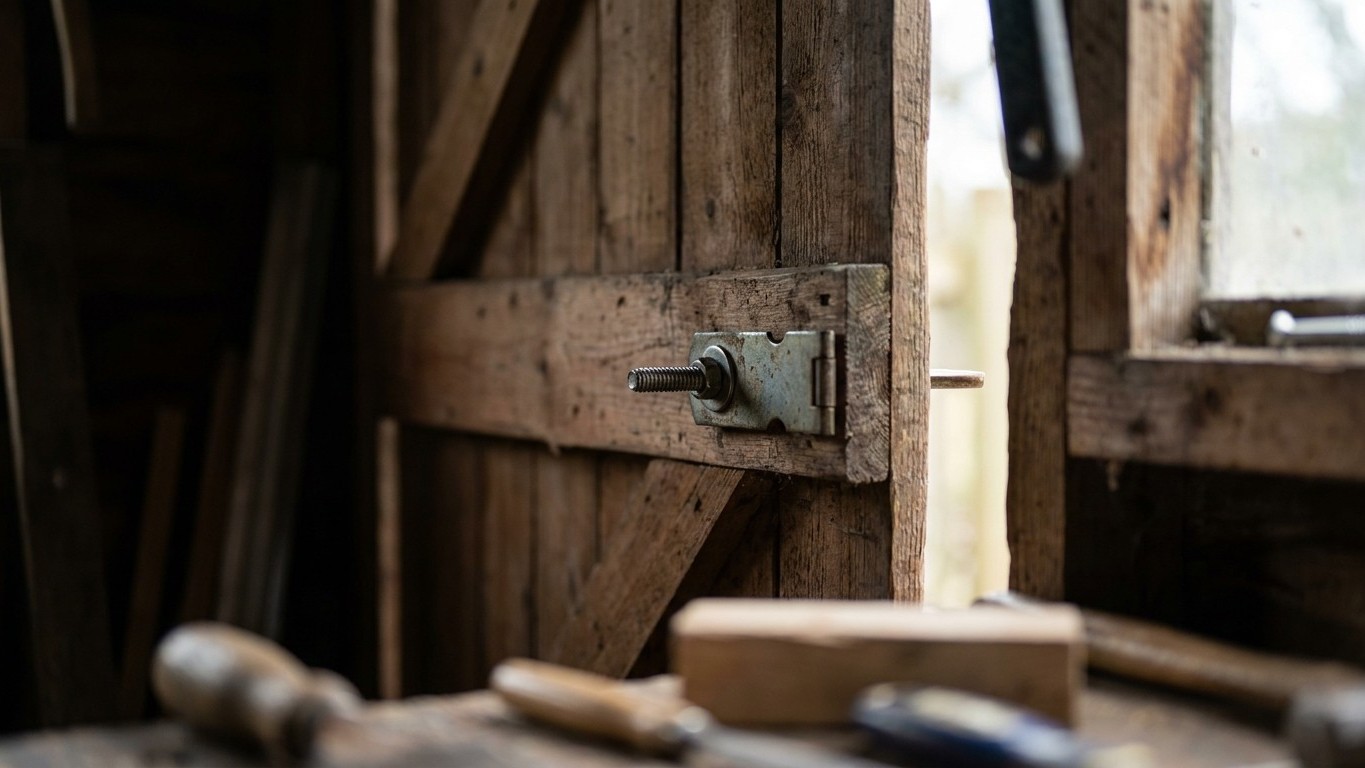
Swap those wood screws for coach bolts (sometimes called carriage bolts) and you change the whole physics of the problem. The answer is to replace those wood screws with carriage or coach bolts which go all the way through the wood and are secured with a nut and a washer on the other side; carriage bolts have smooth heads, impossible to unscrew. That’s the one thing behind the door I’m talking about: a simple nut and washer, sitting quietly on the inside face of your shed timber, invisible from the outside, doing more security work than the padlock ever will.
The logic is refreshingly simple once you see it. A screw only has to overcome the friction of the wood grain to be pulled straight out, and a crowbar gives a thief all the leverage he needs. A bolt, by contrast, has a wide flat washer and a nut clamped against the inner face of the door. The nut can’t be readily pulled through the wood; it doesn’t particularly need to be tight, providing it is there, your security is much improved. You’re not relying on grip anymore, you’re relying on the sheer physical size of that washer refusing to pass back through a hole barely wider than the bolt shaft.
I’ll admit I found this a bit counterintuitive myself the first time someone explained it to me over the garden fence. Surely a fatter screw would do the same job? Not quite, and this is where the anti-tamper screw sets sold as “security upgrades” rather let people down. As one security guide puts it bluntly, an item originally fitted with anti-tamper wood screws illustrates a common misconception that they really make much difference, because thieves don’t tamper with them, they just rip them out with a crowbar, and it is the coach bolt on each side providing the security, not the anti-tamper wood screws, which just hold the thing straight. Tamper-resistant heads solve a problem that barely exists. Pulling power is the real enemy, and only a through-bolt with a nut on the other side defeats it.
Hinges deserve the same treatment, not just the lock
Fit coach bolts to your hasp and forget the hinges, and you’ve simply moved the weak point to the other side of the door. Use coach bolts to secure external hinges and hinge bolts, or dog bolts, to help prevent the door from being prized open on the hinge side. Thieves know that a shed door often opens more easily from the “wrong” side than the locked side, because homeowners lavish attention on the padlock and hasp while leaving three cheap screws holding each hinge in place. Lincolnshire Police’s own advice on outbuilding security backs this up directly, recommending coach bolts on hinges alongside the hasp itself, and even suggests installing a piece of ply board to the inside, using coach bolts to fix it through the shed frame for doors where the timber itself feels a bit flimsy.
That last point is worth dwelling on, because it’s the sort of thing my own father used to do without any fancy name for it. A sheet of ply or a scrap of steel plate bolted to the inside face of the door spreads the load of the fixing across a much wider area of timber, so even if someone does manage to lever at the hasp, there’s no single weak point of wood grain for the bolt to tear through. It’s cheap, it’s not visible from outside, and it turns a door that might otherwise flex and split under a crowbar into something considerably more stubborn.
Getting it right without overspending
None of this needs to cost a fortune, and that’s the bit I always want people to hear before they panic and start pricing up alarm systems. A handful of M6 coach bolts, nuts and washers from any hardware shop will do the hasp, the staple and both hinges for a few pounds, replacing what came in the box rather than adding to it. Position matters too: use good quality security hasp and staples that hide the fixings when closed, and use two, one fitted one-third up and one fitted one-third down the door, so there’s no single point where a lever can do all the damage at once.
Do check the direction you fit the hasp, because I’ve genuinely seen this go wrong on brand new sheds straight from the manufacturer. Make sure you fit the hasp and staple the right way round whereby the hasp, when closed, conceals the fixings underneath it. Get that orientation backwards and even the best coach bolts in the world won’t save you, because the screws holding the staple sit there in plain sight, ready for anyone with a screwdriver and thirty seconds to spare.
One small thing worth knowing before you buy: many bolt sizes sold as “coach bolts” for fencing are M8 or M10, rather too chunky for the thin metal plates on most hasps, so check the fixing holes first and buy M6 unless your hasp is genuinely heavy-duty ironmongery. Getting the bolt diameter matched to the hole saves a wasted trip back to the shop, and it’s the sort of small detail that separates a job done properly from one done in a hurry on a Sunday afternoon.
Sources : thebestbikelock.com | gardenbuildingsdirect.co.uk