
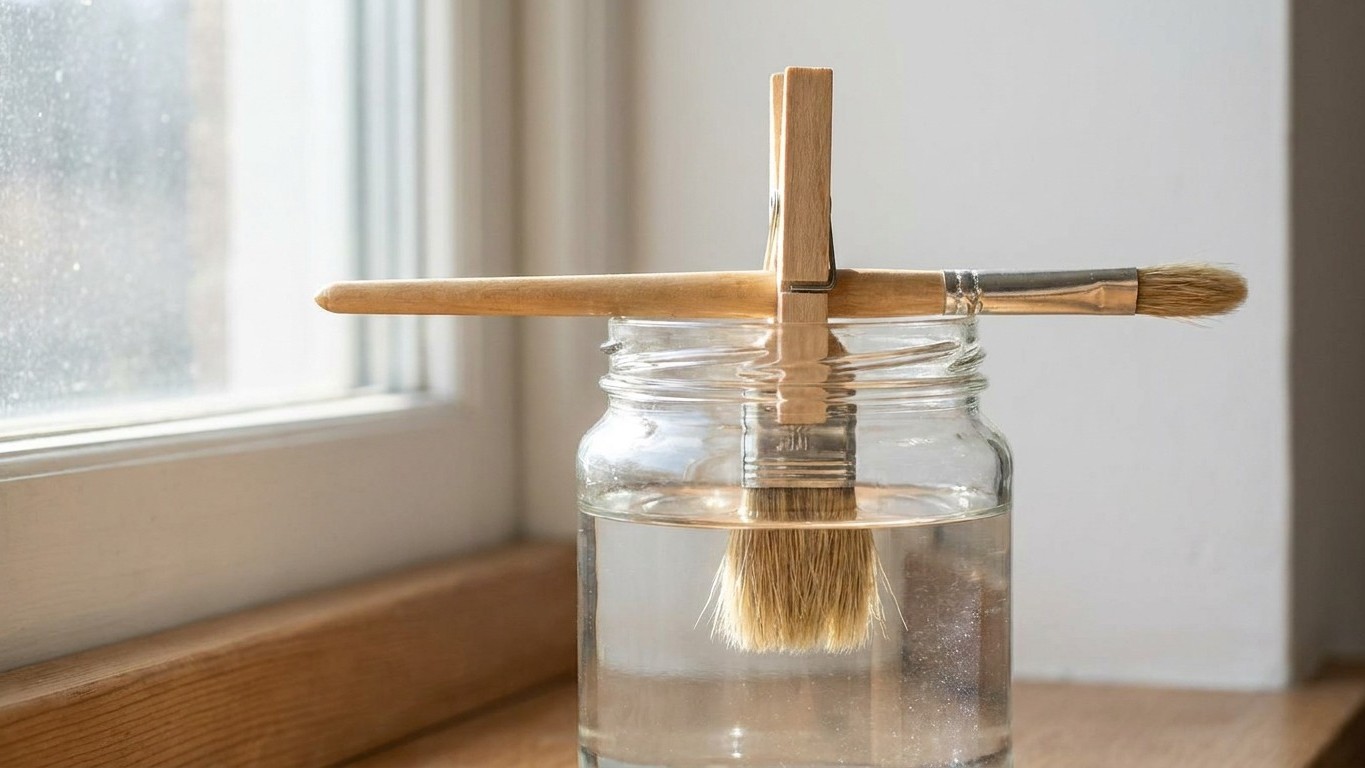
Stand a paintbrush bristles-down in a jam jar of water overnight and you’re not “soaking” it, you’re slowly murdering it. Be sure your brushes are suspended above the bottom of your jar or container, because if the bristles rest on the bottom they’ll sit in all the dust and rubbish that’s got into the container and could also take up a permanent bend. The fix has been sitting in painters’ and decorators’ toolboxes for generations, and it costs nothing: a wooden peg, a pencil, or an old clothes peg laid across the rim so the brush hangs from its handle instead of resting on its hairs.
I learned this the hard way, ruining a perfectly good pastry brush by leaving it stood in a mug of soapy water for a weekend. By Monday the bristles had set into a curve like a tiny hockey stick, and no amount of coaxing brought them back straight.
Key takeaways
- What painters do that destroys expensive brushes in a single weekend
- Why that innocent-looking jam jar is slowly bending your bristles permanently
- The decades-old decorator’s secret that hardware stores don’t want you to know
Why standing them bristle-down is such a false economy
The instinct to pop a wet brush upright in a jar feels tidy, but it works against the very materials that make a brush useful. Brushes should not be left standing upright while wet since this can cause the water trapped in the bristles to leak out from beneath the ferrule and damage the brush’s handle and hair. That metal band, the ferrule, is doing more work than most of us realise. It’s the metal band that connects the bristles to the handle, and it’s important because it holds the brush shape. Push bristles against the base of a jar for hours on end and resting the bottom of the brush against the bottom of the container for a prolonged period can cause a damaging permanent deformation of the bristle region of the brush.
There’s a second, sneakier problem too. Painters and decorators who leave brushes soaking for the sake of convenience often do more harm than good, because it is common for painters to drop their brushes in a bucket filled with solvent so that paint may be dissolved from bristles, but the bristles, bearing the weight of the associated brushes, tend to become permanently set in a bent or flattened condition. Water is patient and unforgiving in equal measure. Water is a “universal solvent” because it has a way of breaking down materials over time, and if you leave your brushes in water for three hours per week that would equal 156 hours per year. Add solvent or soapy water to the mix and the glue holding everything together starts to give up the fight: soaking the ferrule in water or solvent can cause the wooden handle to swell, the glue to fail, and the bristles to become loose or permanently bent. A brush that cost you a few pounds from the local hardware shop deserves better than a slow drowning.
The peg trick, step by step
The remedy that decorators have quietly relied on for decades is simple suspension, keeping the bristles in the liquid but off the base and sides entirely. One forum thread from a working boat painter put it plainly: nice oval brushes are suspended by the handle into linseed oil, a hole drilled in the neck with a nail would do the trick for a single brush. You don’t need to drill anything, though. Here’s the version that costs you nothing but a rummage in the kitchen drawer:
- Take an ordinary wooden peg, a pencil, or even a chopstick, something slightly longer than the width of your jar’s mouth.
- Lay it across the rim so it sits flat and steady.
- Rest the brush handle against the peg (or slot the handle through the peg’s spring if you’re using a clothes peg) so the whole brush tilts and hangs at an angle.
- Check that the bristle tips dangle freely in the water or solvent, never touching the glass base.
That’s the entire trick, and it takes about a second once you’ve got the peg in place. Commercial versions of exactly this idea have existed for years. Patent filings for brush suspension devices describe the same logic dressed up in slats and elastic bands: a support “for suspending one or more paint brushes within a container out of contact with the bottom of the container.” Your kitchen peg does the identical job for free.
What to do once the brush comes out
Suspension solves the soaking problem, but drying matters just as much. The optimal drying position is lying flat, away from any heat sources, though most people keep their brushes up in a jar or other holder, which is fine, but only if they are fully dry. Never be tempted to prop a wet brush bristle-down “just for a minute”, because as one restoration guide notes, laying brushes flat on a towel or using a brush hanger or clothespin to hang them lets gravity remove moisture from both the ferrule and handle areas. If you’ve got a pegboard in the shed, hanging by the handle keeps the hairs free of pressure entirely, which is even better than flat storage for brushes you use often.
Heat is the other trap. Reaching for a hairdryer to speed things along feels sensible on a cold February afternoon, but it is important to steer clear of direct heat sources such as hair dryers, because exposing brushes to heat can damage the bristles, causing them to become brittle or deformed. Patience wins here, as it so often does with anything you want to last.
One last nuance worth tucking away: synthetic bristles behave differently from natural hog or badger hair when they do bend. Synthetic bristles made of nylon or polyester are particularly prone to bending if exposed to high heat, but synthetic filaments have a “memory”, and gentle heat can help them return to their original, straight form. So if you’ve already ruined a cheap synthetic decorating brush by standing it bristle-down, a brief dip in hot (never boiling) water followed by careful combing can sometimes coax it back to life, something that simply doesn’t work on natural bristle brushes once the shape has set. Worth remembering before you toss one in the bin.
Sources : drawandpaintforfun.com | harrisbrushes.com