
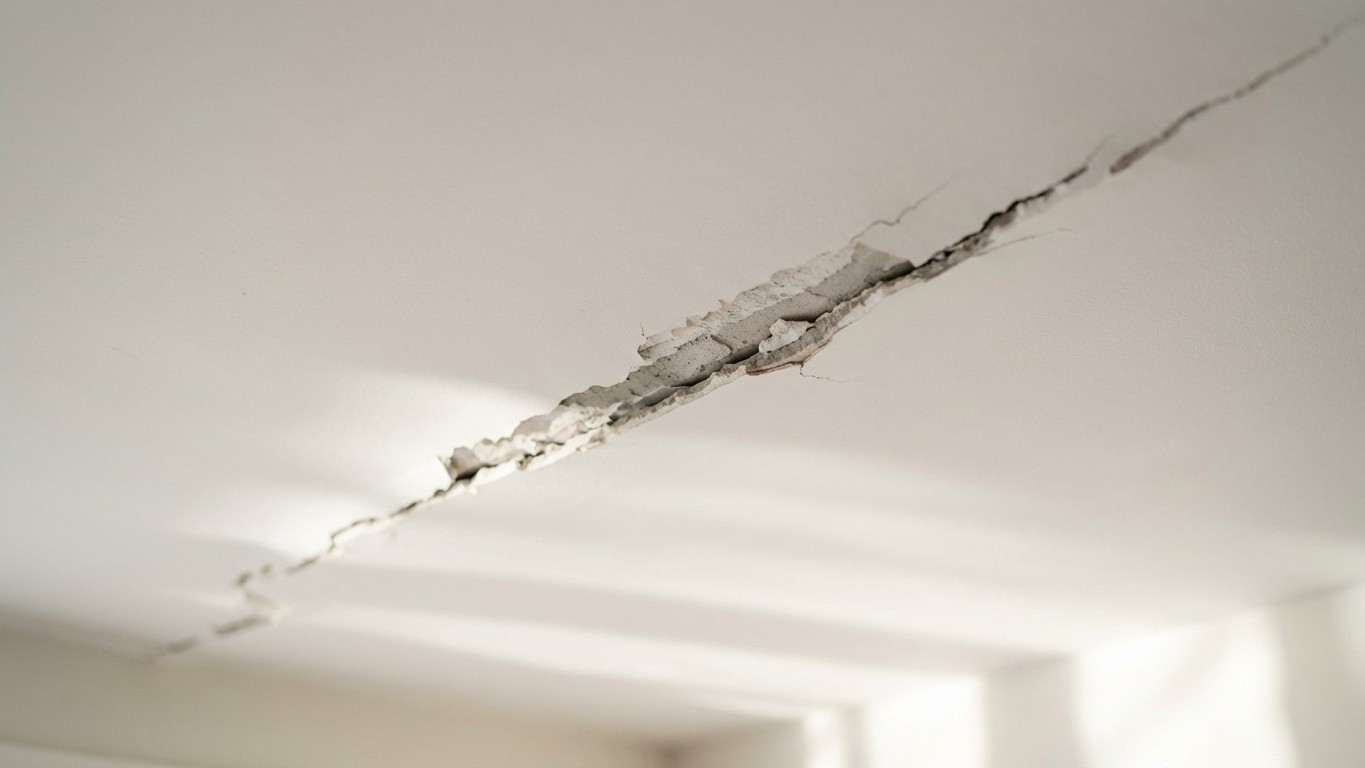
You fill the crack, smooth it over, slap on a coat of paint, and stand back feeling rather pleased with yourself. Six months later, there it is again, that same jagged line across the ceiling, possibly worse than before. The culprit isn’t bad luck or a particularly vindictive house. The culprit is almost always the same mistake: filling a ceiling crack without addressing why it appeared in the first place, and using the wrong filler material to boot.
Key takeaways
- Most people use the wrong filler material, causing cracks to reappear within weeks
- Your house is literally moving—and ignoring the root cause guarantees failure
- Wide cracks and diagonal steps might signal serious structural problems that need professional assessment
Why Ceiling Cracks Keep Coming Back
Most ceiling cracks aren’t simply cosmetic. They’re the surface expression of something moving, and buildings move more than most people realise. Seasonal temperature changes cause timber joists to expand and contract. Old houses settle gradually over decades. Plasterboard joints shift when the floor above gets heavy foot traffic. Painting over a crack or dabbing in a bit of ready-mixed filler without understanding what’s driving the movement is a bit like putting a plaster on a wound that hasn’t stopped bleeding.
The single most common mistake is reaching for a tub of ready-mixed filler (sometimes called all-purpose or decorator’s filler) and pressing it straight into the crack. These products are designed for shallow surface imperfections, not for cracks that have any depth or movement. Ready-mixed filler shrinks as it dries. Fill a crack even a few millimetres deep, and you’ll find a fine hairline reappearing in the centre of your repair within weeks, sometimes days. Do it in a bathroom or kitchen and the moisture makes things worse still.
There’s also the question of preparation, which most of us rush through. Tapping along a crack with a screwdriver handle or the handle of a knife tells you a great deal. A hollow sound suggests the surrounding plaster has lost its key to the substrate beneath, it’s no longer firmly bonded. No amount of surface filling will hold if the plaster around the crack is loose. That plaster needs to come away before any repair begins, which feels drastic but saves an enormous amount of bother later.
The Right Way to Approach It (Yes, There’s More Than One Step)
Start by widening the crack slightly with a scraper or a multi-tool. This sounds counterintuitive, but a wider, cleanly cut channel gives the filler something to grip. A hairline crack repaired as-is has almost no surface area for the filler to bond to, which is why it pops out so readily. You’re aiming for a shape that’s slightly wider at the back than at the surface, a technique plasterers call “undercutting”, so the repair is mechanically locked in rather than just resting on top.
Dust out the crack thoroughly and dampen it with a little water before filling. Dry plaster and bare masonry are remarkably thirsty; they’ll suck the moisture out of your filler too quickly, preventing it from curing properly and weakening adhesion. This one small step makes a meaningful difference to how long the repair lasts.
For any crack wider than a hairline, a powder-based filler mixed to a firm consistency (like cream cheese, not like yoghurt) will serve far better than a ready-mixed product. Powder fillers shrink considerably less and can be built up in thin layers for deeper repairs. Let each layer dry fully before applying the next, rushing this is another classic mistake. If the crack is particularly wide or runs along a plasterboard joint, self-adhesive fibreglass mesh tape applied over the filled crack before skim coating adds meaningful reinforcement against future movement.
When the Crack Is Telling You Something More Serious
A word of caution here, because not all ceiling cracks are equal. Fine, straight hairlines running with the plasterboard joints, or small spider-web patterns in old lime plaster, are generally the house breathing. Cracks that are wider than about three millimetres, that step diagonally, or that have different levels on each side (you can feel this by running a finger across), deserve a closer look before you do anything at all.
These can indicate movement in the structure itself, subsidence, a lintel failing above a door or window, or in older properties, a wall that’s taken on water and begun to deteriorate. Filling over structural cracks is genuinely futile; they will return, wider and more insistent. A builder or structural surveyor can usually identify the cause fairly quickly, and in many cases the underlying issue is less alarming than the crack suggests. Old houses in particular develop all manner of historical cracks that stabilised decades ago and simply need a proper cosmetic repair.
Finishing So It Actually Stays Finished
Once the repair has cured completely (give it at least 24 hours in a warm, dry room, longer in winter), sand it back gently with fine-grit paper and apply a mist coat before painting. A mist coat is simply your topcoat paint diluted with roughly 10% water, brushed over the repair area. Bare filler is porous; applying full-strength emulsion directly onto it can cause the paint to pull away or dry unevenly, leaving a visible patch that catches the light at every opportunity.
Two thin coats of ceiling paint, feathered out beyond the repair, will blend the area in far more convincingly than one thick coat applied right to the edges. Ceiling paint is generally flatter in finish than wall paint, which matters, any sheen will highlight texture variations mercilessly.
The crack that keeps coming back is rarely a sign that you’re bad at DIY. More often it’s a sign that the first repair was treated as a five-minute job rather than a small process with a specific logic to it. Get the preparation right, choose the appropriate materials, let each stage dry properly, and there’s a reasonable chance you’ll be looking at a clean, unbroken ceiling for years rather than months. Whether the house has other opinions about that is, admittedly, a different matter entirely.