
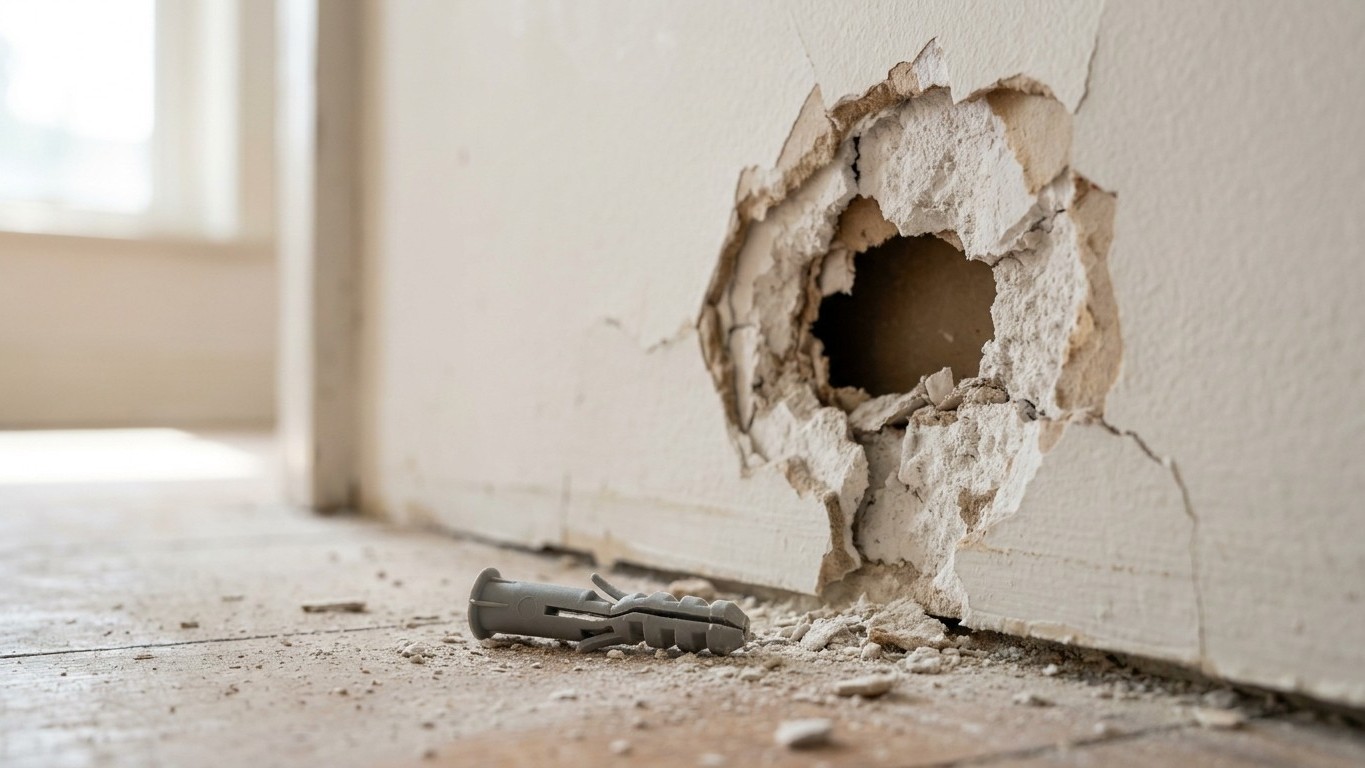
Coats are heavier than they look. A wool overcoat with a scarf tucked in its pocket, an umbrella hanging from the hook, a school bag draped over the end, and you’ve easily got four or five kilos pulling on a single fixing point every single day. That’s precisely what happened to me, and it’s why a chunk of my hallway plaster ended up on the doormat one wet Tuesday morning, coats and all.
Key takeaways
- Those free plastic anchors in the box are designed for the manufacturer’s profit, not your wall’s safety
- A loaded coat rack pulls harder than most people realize—and plasterboard is softer than it looks
- Metal anchors and spring toggles offer real holding power, but only if you match them to your wall type first
Why plastic anchors let you down
Those little white or clear plastic plugs that come free in the box with flat-pack coat racks are designed for one thing: getting the product out the door cheaply. They’re not lying to you exactly, but they’re not being honest either. These anchors consist of a plastic sleeve that expands when a screw is driven into it, pressing against the back side of the drywall, and are typically rated for loads between 10 and 25 pounds when properly installed in standard drywall. That’s roughly 4.5 to 11 kilograms, split across two or three anchors, holding not just the rack itself but everything you hang on it.
The real trouble is how they fail. Plastic anchors are not recommended for ceiling installations because gravity works against their friction-based holding mechanism, nor should they be used for items that experience frequent handling or vibration. A coat rack gets exactly that: someone yanking a sleeve free, a bag swinging as the door slams, a toddler using it as a climbing frame (don’t ask). Every tug loosens the grip a fraction more, until one day the plaster simply gives up. My neighbour on a DIY forum put it rather bluntly: “those will rip out of the wall i hate em.” Harsh, but fair.
And here’s the bit that really annoyed me once I understood it: my wall wasn’t even solid masonry. Trying to hang a heavy coat on a hook pushed into plasterboard is like hanging it on a digestive biscuit, it’s just going to crumble, because when you drive a normal screw into plasterboard, the threads have nothing substantial to grip, and the soft gypsum core will simply pull the screw straight out, leaving a messy hole behind. No wonder my anchors gave up. They were fighting a losing battle from day one.
What actually holds a coat rack up
Once I’d swept up the debris (and apologised to the coats, which were fine, if a little dusty), I did my homework properly instead of grabbing whatever was nearest on the shelf. The fixing world for hollow walls breaks down into a rough hierarchy, and it’s worth knowing where your rack sits on it.
Self-drilling nylon anchors are the next step up from the free plastic ones, and honestly not much better for a coat rack. Nylon versions are cheaper and fine for lighter loads such as picture frames, small hooks, cable clips, smoke alarms, and light decorative items, holding roughly 5 to 15 kilograms per fixing depending on the brand and plasterboard thickness. Fine for a single hook by the door. Not fine for a rack carrying four coats and an umbrella.
Metal hollow wall anchors, sometimes called Molly bolts, are a proper upgrade. Hollow wall anchors use a metal sleeve that expands behind the plasterboard when you tighten the bolt, with the expanded metal arms gripping the back of the board to create a strong anchor point well-suited for medium to heavy loads including bathroom cabinets, kitchen wall units, and coat racks, with a load capacity typically 15 to 25 kilograms per fixing. That’s the sort of margin you actually want when the whole family is piling coats on at once.
For anything approaching serious weight, though, the spring toggle is the one tradespeople reach for. Spring toggles are the heavy-hitter of plasterboard fixings, consisting of a bolt threaded through a pair of spring-loaded metal wings that you push through a pre-drilled hole, and which spring open behind the board, spreading the load across a wide area. One supplier’s guide put a single spring toggle’s capacity in 12.5mm board at a genuinely reassuring figure, and a well-known buying guide backs this up: “a bolt can hold up to 30kg or more,” depending on the size chosen.
Getting it right without overspending
You don’t need to buy the most expensive fixing on the shelf, but you do need to match the fixing to the wall type and the load, and that means a five-minute check before you touch the drill. Tap the wall. A hollow, slightly papery sound means plasterboard; a dead, solid thud usually means masonry or a stud is hiding behind it. If you can find that stud with a detector or by tapping along the skirting line, screwing straight into timber will always beat any anchor going, hollow or otherwise.
For a standard coat rack carrying the usual family clutter, I’d now suggest:
- Metal hollow wall anchors (Molly-bolt style) for a secure, everyday fixing on plasterboard
- Spring or gravity toggles if the rack will carry several heavy coats, bags, or a mirror alongside it
- A stud fixing wherever one happens to line up with your bracket holes, because nothing beats solid timber
Plasterboard construction varies more than most people realise, too. The most common thickness in UK homes is 12.5mm, but you’ll also find 9.5mm boards, and knowing your specific standard plasterboard thickness is vital because many fixings are designed to work with a specific depth. Buying a toggle rated for the thicker board and fitting it into a thinner one is a classic way to end up disappointed, so check the packaging against your wall before you commit to drilling.
One last thing worth remembering: cavity walls aren’t a modern quirk you can ignore. Most modern internal walls are cavity walls, meaning there’s a gap between the plasterboard and whatever is behind it, and this empty space is exactly what allows toggle and winged anchors to expand and do their job. That gap is your friend, not an obstacle, once you’re using a fixing designed to make the most of it. My rack has been back up for months now, loaded with everything the household can throw at it, and it hasn’t budged an inch. The wall, sadly, still bears a faint patch where the old repair went in, a little reminder every morning not to cut corners on something holding up half the family’s outerwear.
Sources : build-construct.com | albanycountyfasteners.com