
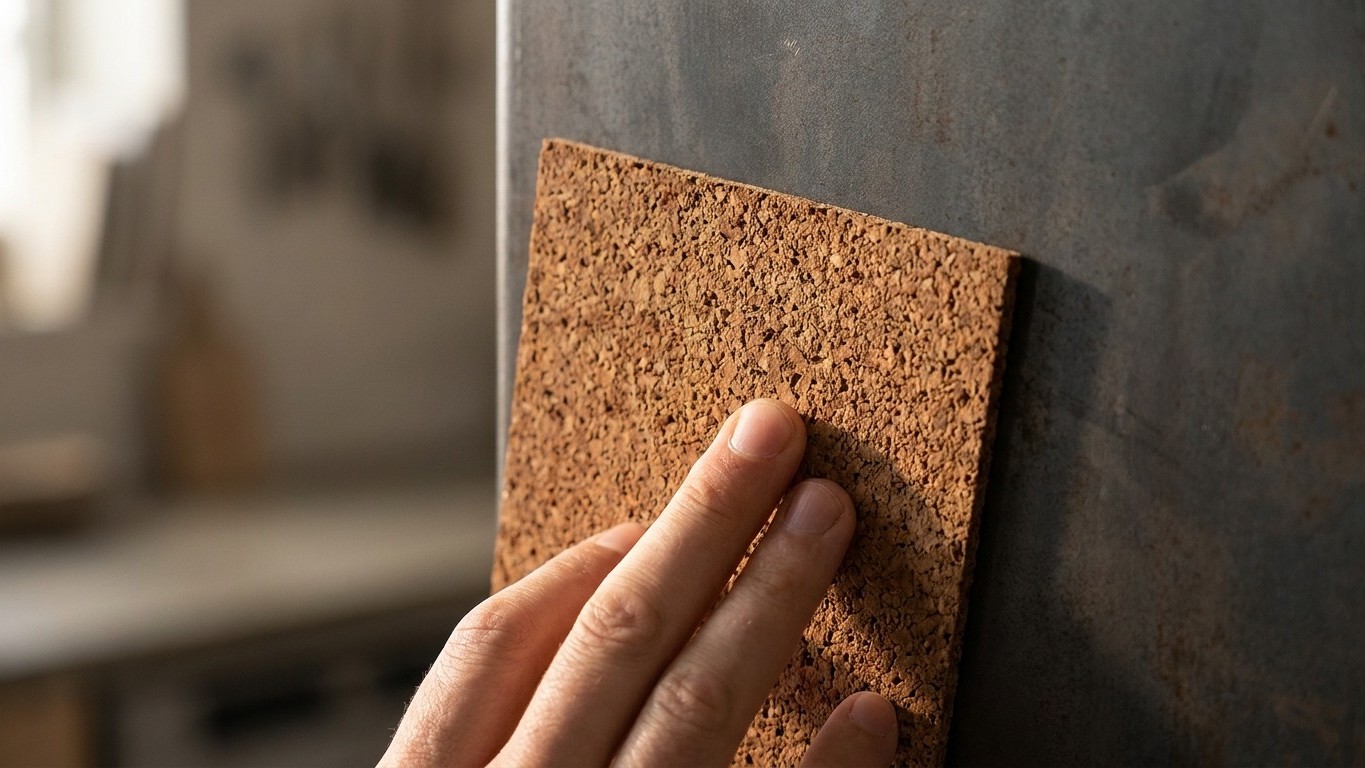
Three millimetres doesn’t sound like much, does it? Yet stick a thin sheet of cork behind a bare steel garage door and you’ve done something cleverer than muffling the clatter of the mechanism. You’ve broken one of the laziest heat highways in the whole house.
A steel garage door left to its own devices behaves less like a door and more like a radiator working in reverse. An uninsulated steel or aluminium garage door in direct sun acts like a radiator. Metal has almost no Resistance to heat flow, so whatever the sun deposits on the outside skin marches straight through to the inside within minutes. Clopay’s own research into hot-climate doors puts a number on it: metal and basic panel doors act as conductors, transferring exterior heat straight inside, and temperatures in the garage can climb 20°F or more above outside temps, which in old money is a good 11°C on top of whatever the thermometer already says in the drive. Add a dark-painted door, which soaks up far more sunlight than a pale one, and you’ve built yourself a small oven with a car parked in it.
Key takeaways
- Steel garage doors act like radiators, letting heat march straight through to create ovens 20°F hotter than outside
- Cork’s cellular structure contains 40 million air pockets per cubic centimetre—each one a tiny heat barrier
- Even 3mm of cork can reduce the temperature difference by a third, transforming a sweltering garage into a bearable workspace
Why a Sheet of Bark Beats a Slab of Steel
Cork looks unassuming, all soft brown texture and cork-board memories from school noticeboards, but its structure is genuinely odd in a useful way. The secret to cork’s performance lies in its cellular structure: each cubic centimetre contains about 40 million tiny air pockets, which act as thermal and acoustic insulators. Trapped air is a poor conductor of heat, so all those microscopic pockets act like a crowd of tiny bodyguards, slowing down anything trying to pass through. That’s why cork does two jobs at once, deadening the sound of the door and the wind rattling it, while also putting the brakes on heat transfer.
In pure numbers, expanded cork sits at roughly a thermal conductivity of 0.038 W/m·K, which is very close to fibreglass and streets ahead of bare steel, which barely counts as an insulator at all. Cork won’t perform miracles at 3 mm, nobody installing a sheet that thin should expect their garage to become an ice house, but even a modest layer changes the physics of the door. It’s no longer a single sheet of solid conductor; it’s a conductor with a buffer glued to its back, and that buffer is exactly where the heat gets slowed down before it reaches the air inside.
What Actually Happens Once You Glue It On
The garage guides that track this sort of DIY fix are fairly consistent about the scale of improvement. A foam insulation kit cuts heat transfer through the door by 50 to 70 percent. Cork on its own, especially at a slim 3 mm, won’t reach the top of that range, but it’s working the same mechanism, and paired with the fact that an uninsulated garage can be 10 to 18 degrees hotter than outside air temperature, knocking even a third or half off that gap is the difference between a garage you can bear to stand in at 2pm and one that chases you back indoors by midday, which sounds exactly like the problem being solved here.
There’s a second factor working alongside the cork that’s easy to overlook: colour. A dark-coloured garage door absorbs up to 90 percent of solar radiation, while a light-coloured door reflects 50 to 70 percent. If your door happens to be a deep green, black or navy, repainting it a lighter shade alongside the cork lining would compound the effect rather nicely, since repainting a dark door white, beige, or light gray can reduce the door surface temperature by 20 to 40 degrees on a sunny day. Two cheap fixes, one from the ironmonger’s paint tins and one from a roll of cork underlay, working the same problem from opposite ends.
The Bit Nobody Mentions: Sealing the Gaps
Here’s where I’ll be the slightly stern grandmother for a moment. A cork panel glued to the door skin does nothing for the gaps around the edges, and those gaps matter more than most people assume. Check the bottom seal, side seals, and top seal of your garage door; if you see daylight around the edges, hot air is pouring in. A fresh rubber seal is a cheap job, typically a new bottom seal costs $15 to $40 and a complete weatherstripping kit costs $20 to $50, and doing it the same weekend as the cork lining means you’re not leaving a back door open on the very draught you’ve just spent an afternoon trying to shut out.
Worth knowing too, since garages are notoriously badly ventilated spaces: garages trap heat because they have poor ventilation, minimal or no insulation, and large metal surfaces that absorb solar radiation, and the concrete slab also stores heat during the day and releases it slowly. That slab is its own quiet radiator long after the sun has moved round, which is why a garage can still feel stuffy well into the evening even once the door itself has cooled. Cork tackles the door, not the floor, so don’t be surprised if the space still holds a little warmth after teatime; that’s the concrete talking, not a failure of your afternoon’s handiwork.
For contact adhesive, cork specialists tend to recommend proper contact-bond glues over anything improvised, since a contact adhesive gives the best results, and the surface needs to be clean, dry, and level before applying. Skip that prep and the cork will eventually sag or lift in the heat it’s meant to be blocking, which rather defeats the point of the whole exercise.
Sources : americansteelinc.com | bobvila.com