
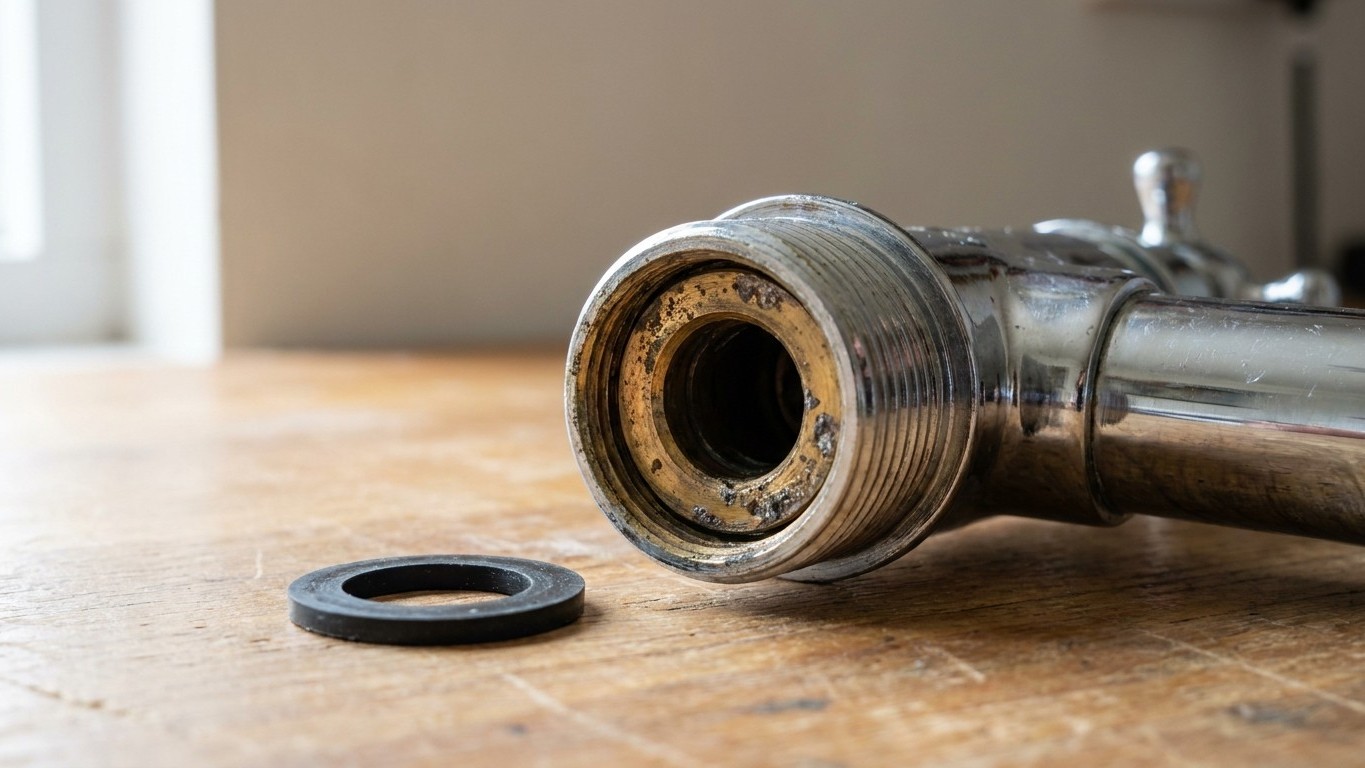
Half the taps in Britain get a brand-new washer fitted every year, and a good number of them carry on dripping regardless. The washer was never the problem in those cases. Underneath it sits a small brass ring called the valve seat, and once that surface pits or scores, no washer on earth will make a watertight seal against it.
The mechanics are simple once you picture them. The valve seat is the brass ring inside the tap body that the washer presses against, and over years of use it develops pitting, corrosion or scoring, so the surface gets rough. Press a soft rubber washer down onto a smooth ring and you get a perfect seal, the same way a jam jar lid seals against a clean rim. Press it onto a ring with tiny grooves cut into it, and water finds its way through those grooves no matter how hard you tighten the tap. A new washer against a damaged seat can’t seal properly and water sneaks through the imperfections.
What actually causes the damage is worth understanding, because it explains why some households fight this battle far more than others. The pressure of the water under the washer tries to force itself between the seat and washer, and over time the water erodes the brass seat, forming little channels that allow water to pass between the washer and seat, causing the tap to drip. Grit in the mains supply, decades of the spindle grinding down slightly off-centre, or simply the age of the fitting all play a part. But the single biggest factor is what’s actually flowing through the pipe. This can be worse in areas with hard water. If you’re in London, Cambridge, Hull or anywhere across Anglian Water’s patch, your kettle probably scales up within weeks and your tap seats are working against the same mineral load. The South East and East of England sit on chalk and limestone aquifers that dissolve into the water supply, producing some of the hardest tap water in Europe, with London, Hull, Cambridge, and Luton all exceeding 300 mg/L CaCO₃. Households in Glasgow, Manchester or Liverpool, drawing from granite uplands, tend to get a much easier ride from their brass fittings.
Key takeaways
- Half of Britain’s leaking taps aren’t actually washer problems—something far more deceptive is at work
- Hard water regions face a hidden disadvantage that makes tap seats deteriorate faster than you’d expect
- There’s a forgotten repair method that costs pennies and takes minutes, but plumbers rarely mention it
Spotting a seat problem before you buy another washer
There are a couple of tells that save you a wasted trip to the DIY shop. If the tap was fine for years, drips started, and a fresh washer cured it in five minutes, that’s a normal washer replacement and nothing more sinister. The seat is the suspect when the pattern looks different. A washer that should last a couple of years wears through in a few months because it’s being chewed up by a rough seat. Listen too, while you’re turning the tap off. A grinding or chattering noise when you turn the tap off is the rubber catching on a burred edge rather than settling smoothly into place. And of course the clearest sign is the one that sends most people searching in the first place: changing the tap washer isn’t always the cause of a dripping tap, and this remains one of the most misleading assumptions, precisely because a brand-new washer against a scarred seat behaves exactly like an old, worn one.
Ceramic disc taps, the quarter-turn lever type found in most kitchens fitted since the late 1990s, sidestep this entire issue. Modern lever and quarter-turn taps don’t use traditional rubber washers, instead fitted with internal ceramic disc cartridges that are durable, though not indestructible, since microscopic grit or mineral buildup from hard water can eventually scratch the smooth ceramic plates. If you’ve got the old-fashioned crutch-handled taps with a separate hot and cold, the brass seat is very much still in play.
Reseating the tap: the fix nobody tells you about
The proper repair is called reseating, and it’s less alarming than it sounds. Reseating a tap involves smoothing the inside surface known as the seat, the part that presses against the washer to form a watertight seal, because over time this seat can become rough or corroded, causing water to leak even if the washer has been replaced. A small hand tool, sold cheaply in most hardware shops, does the job. A seat grinder is a simple tool, normally supplied with different sized serrated cutters and screwed location bushes to position the cutter central on the tap seat, with the correct size cutter being the one that just fits through the opening. You fit the bush into the thread that used to hold the tap valve, press down and twist. Remove the grinder periodically and look at the seat, since any imperfections will stand out as dark areas, and keep grinding until the complete circle of the seat is a bright brass colour, finishing with a few full revolutions of light pressure for a final polish. Flush out the metal filings thoroughly before you refit everything, because leftover swarf under a new washer causes exactly the same drip you were trying to cure.
Some seats are too far gone for grinding, particularly on older taps where decades of erosion have left deep grooves rather than a shallow scratch. There, a seat insert kit is the sensible next step. These packs fit a seat insert, typically supplied with two seat inserts, two jumpers and an insertion tool, giving the washer an entirely fresh brass or plastic surface to close against rather than the worn original. It’s a five-minute job for anyone who’s already comfortable taking a tap apart, and it costs a fraction of calling out a plumber or replacing the whole fitting.
None of this is wasted effort, either. A dripping tap wastes around 5,500 litres per year, which on a metered supply translates into a genuine, if modest, annual cost that keeps accumulating for as long as the seat stays damaged. Worth the price of a reseating tool, by any measure, especially given you’ll likely need it again on the next tap that starts its slow, maddening drip.
Sources : diydata.com | taiirwin.com.au