
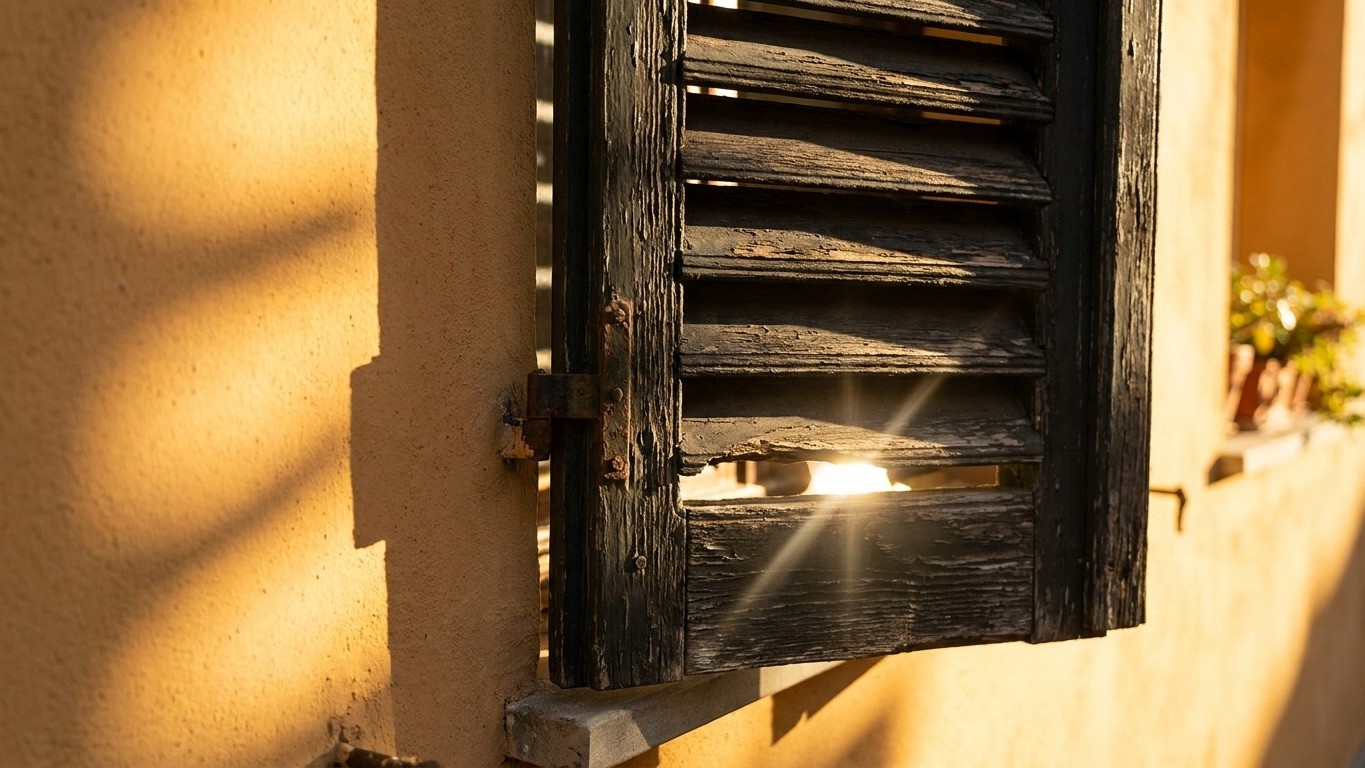
Closing the shutters completely felt like common sense: block the sun, keep the room dark, keep the heat out. For years, that’s exactly what I did every time the forecast turned nasty. Then one sweltering afternoon, rushing to get the washing in, I left a two-inch gap at the bottom of one set of shutters while the others stayed sealed tight. By evening, that one room was noticeably cooler than its neighbours. It turns out those dark slats had been quietly cooking themselves in the sun, and passing every degree of it straight through to my glass.
Key takeaways
- Dark slats absorb and trap heat between the window and shutter, turning your blinds into a miniature oven
- A small gap at the bottom lets superheated air escape instead of pressing against your glass all afternoon
- Timing matters more than most realize—close shutters with the sun’s movement, not when you feel uncomfortable
The hidden oven behind fully closed shutters
Here’s what nobody tells you about sealing shutters shut on a scorching day: you create a tiny, trapped pocket of air between the slats and the windowpane, and that pocket has nowhere to go. When the sun protection is completely closed, a closed air space is created between the window and the roller shutter curtain, and the sun’s rays heat this gap without the warm air being able to escape. The result is heat build-up that then releases heat inwards, heats up the living area and worsens the indoor climate. Rather counterproductive, when you think you’ve done everything right.
This isn’t just a hunch from window manufacturers trying to sell you something new. Even old patent literature on shutter design describes precisely this convection loop: air in the space between the window glass and the closed slats is heated by contact with the absorptive faces, rises and leaves through vent holes, while cooler air from the room enters through narrow passages that exist between adjacent slats even in the closed position. even shutters that look sealed usually aren’t, not entirely, and that small bit of natural airflow is doing you a favour rather than letting the heat in.
A gap at the bottom works because it lets that superheated air escape instead of pressing against your window all afternoon. A small opening in the sun shading is enough to counteract heat build-up, since ventilation slits allow fresh air in over the entire surface of the blind and prevent it forming. My own accidental discovery was really just this principle in action, minus the fancy vocabulary.
Colour, timing, and why dark slats are the real culprit
Dark-coloured shutters don’t just look smart on the front of a cottage, they behave rather differently in July sunshine than pale ones do. A light-coloured shutter (white, cream, beige) reflects the sun’s rays, whereas a dark one absorbs them and turns into something close to a hotplate, which is why official energy guidance recommends pale tones for shutters and blinds. If your slats are anthracite or dark green, that trapped air pocket I mentioned earlier heats up faster and stays hotter for longer, because the slat itself is busy soaking up radiation instead of bouncing it back outside.
Timing matters just as much as colour, and this is where I’d been getting it wrong for years without realising. Most of us wait until we’re already uncomfortable before reaching for the shutter cord, but by then the damage is done. The better approach follows the sun around the house: an east-facing façade should be closed at sunrise, since it takes the first wave of morning heat; a south-facing one before 10am, when the sun starts hitting hard; a west-facing one before 2pm without fail, as it bears the brunt of the afternoon furnace; while a north-facing façade, barely exposed to direct sun, can often be left to breathe. It’s a bit like closing the stable door before the horse bolts, not after.
Once the sun does get through the glass, the room behaves like a greenhouse. The rays cross the glazing, heat the floor, the walls and the furniture, and that warmth then gets trapped inside, so a pleasant living room at nine in the morning can become stifling by three in the afternoon. No amount of gap-adjusting afterwards fixes that; you’re simply managing the fallout.
Getting the balance right without overthinking it
The clever bit, and the part I now swear by, is treating a thermometer as your decision-maker rather than your instincts. The simple rule for managing shutters during a heatwave relies on one tool: the thermometer. If the outside air is hotter than the inside air, you close windows and shutters with no gaps; if it’s cooler outside, you open everything wide. It sounds almost too basic to be useful, but it removes all the guesswork my grandmother never had a gadget for.
During the hottest stretch of the day, typically between midday and 6pm, exposed rooms should stay in the shade with shutters and windows closed if the outside air remains warmer, and that’s when a deliberate small gap at the bottom, rather than a fully airtight seal, lets accumulated heat vent rather than radiate inward. Come evening, the strategy flips entirely: once the sun has set and outside air turns cooler than inside, you open windows and shutters wide on the shaded side to flush out the accumulated heat and let the walls recharge with coolness. That night-time flush is the bit people skip, yet it decides how bearable your house feels the following afternoon.
None of this costs a penny, which is the part I find most satisfying after decades of assuming a proper cooling fix meant an electric bill. Old stone farmhouses with thick walls and wooden shutters have coped with baking summers for a century using nothing more sophisticated than closed slats by day and flung-open windows by night. My one small gap didn’t reinvent the wheel; it simply reminded me that a dark slat left to bake in a sealed pocket of air is still, in its own quiet way, a little radiator pointed straight at your glass.
Sources : spacegroup.no | roma.eu