
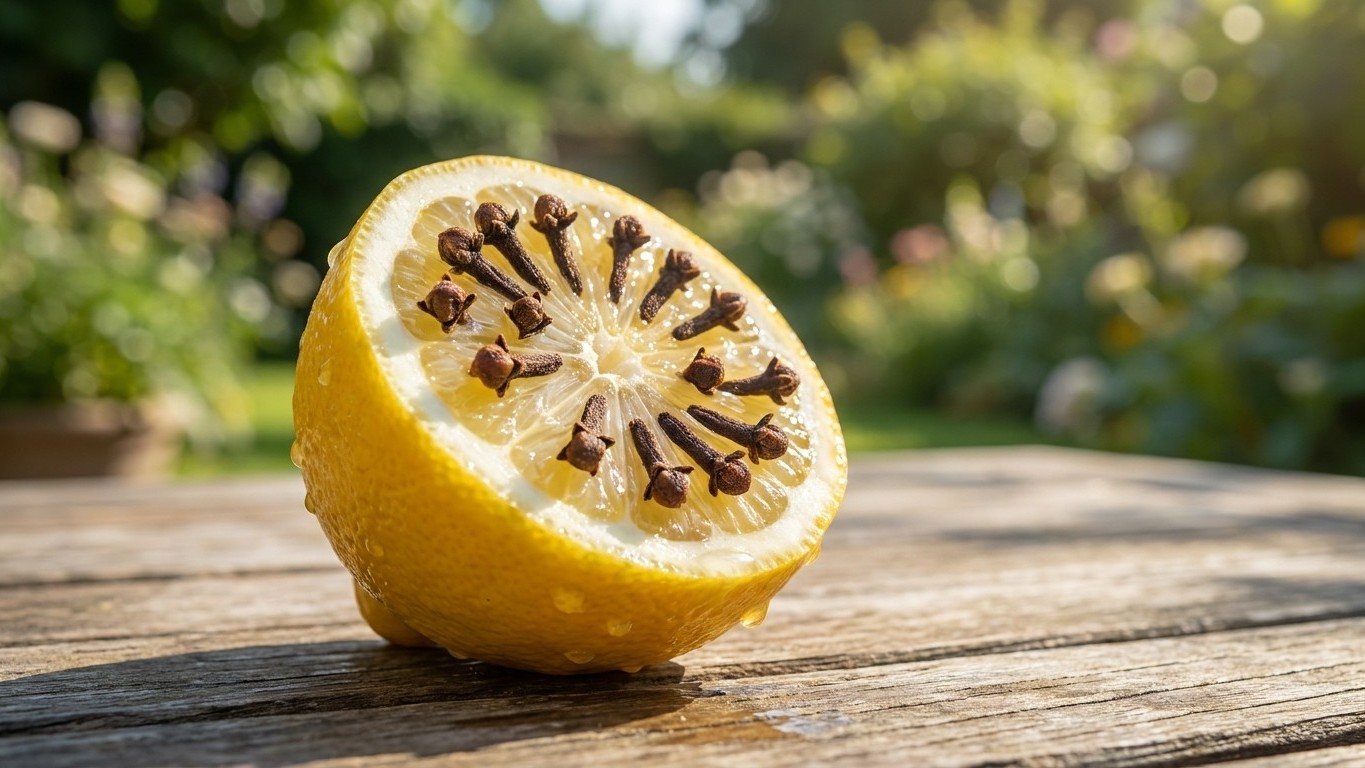
Half a lemon studded with cloves does exactly what it looks like it might do: it fills the air with a scent flies find utterly disagreeable, and within a day or two, they tend to clear off. It’s not folklore dressed up as fact, either. There’s real chemistry behind why this little pomander turns your patio table into a fly-free zone, and it costs pennies compared to a can of aerosol spray.
The magic lies in two compounds working together. Citrus peel releases limonene, and cloves contain eugenol, two volatile oils that flies can’t stand due to their sensitive smellers, as they use odor to help navigate. Flies don’t hunt for food the way we do, by sight mostly, they follow their noses, and when you flood the air around your table with two overpowering scents at once, you’re essentially jamming their signal. Together, they form an aromatic miasma that overloads and short-circuits the tiny olfactory hairs insects rely on to find food. To your nose it smells fresh and a bit festive, like Christmas crept into July. To a fly, it’s chaos.
An interior designer explained it rather nicely when asked about the trend: “Flies are incredibly sensitive to scent,” explains interior designer at JD Elite interiors, Keely Smith. “Lemons release limonene, which is a strong citrus compound that interferes with the way flies find food. And when you add the cloves into the mix, you’re adding eugenol, which has a sharp, almost spicy scent that flies dislike even more.” She put it plainly too: “The combination of lemon and cloves throws off their senses and makes the area smell too intense and confusing for them to stick around.” I do love when a bit of kitchen-cupboard wisdom gets backed up by someone who studies these things properly.
Key takeaways
- A medieval remedy for flies is actually backed by modern science and two powerful volatile oils
- This penny-cheap trick outperforms expensive sprays—but there’s a timing trick most people miss
- Your great-grandmother knew something researchers only recently proved about how flies navigate by scent alone
Where this old trick actually comes from
This isn’t a new discovery dreamt up on social media, whatever the algorithms would have you believe. Recipes for clove-studded fruit, called pomanders, appear in European manuscripts from the Middle Ages, when folks pressed cloves into oranges or lemons to perfume clothing and ward off illness. Our ancestors didn’t know a molecule called eugenol from a hole in the ground, but they noticed that a spiced orange kept the air sweeter and the bugs at bay, so they kept doing it, generation after generation. That’s traditional wisdom for you: it often gets to the right answer decades, sometimes centuries, before the laboratory catches up.
And the laboratory has caught up rather thoroughly on cloves specifically. Research has clearly indicated that clove, citronella and lemongrass oil were the most promising for repellency against mosquito species, and these oils could be used to develop new formulations to control mosquitoes. Eugenol has been studied well beyond the kitchen table, too. Eugenol, also known as clove oil, works as a larvicide for a longer period in successive generations without initiating rapid resistance, which is why it’s been suggested for vector control against disease-carrying mosquitoes. One researcher involved in that work noted that eugenol has proven effectiveness in controlling a wide range of pests and is a good antimicrobial and antioxidant. That’s a fair bit of scientific muscle behind something your great-grandmother might have made without a second thought.
Getting the most from your lemon and cloves
Making one couldn’t be simpler, but there are a few tricks that separate a pomander that works from one that just sits there looking pretty. Slice a firm, juicy lemon in half and press whole cloves into the cut flesh, packing them in reasonably close together rather than scattering just a few. The lemon needs to stay slightly moist for the cloves to keep releasing their oil, so a plump, fresh fruit will outlast a soft or bruised one by a good margin.
A few things worth keeping in mind as the summer wears on:
- Replace the lemon every few days, or sooner in hot weather, since heat and sun can shorten the life of the fruit, and on a patio it might not last more than a day or two.
- Watch for the moment it turns from ally to liability: once it dries out or starts to rot, you’re not repelling flies anymore, you’re actually inviting them in.
- For a bigger table or a full garden gathering, don’t rely on one lonely half. A few dotted around the eating area work far better than a single specimen doing all the heavy lifting.
If you fancy giving the scent an extra boost on a warm day, roll the cloves gently between your fingers before pressing them in. It bruises them slightly and releases more of the eugenol straight away, which is handy if flies are already circling and you need results now rather than in an hour.
A pleasant scent with a genuine job to do
What I find rather charming about this trick is that it never feels like a chore. You’re not spraying anything, you’re not swatting anything, you’re simply placing a small, handsome object on the table and letting chemistry get on with its work quietly in the background. It smells like a spice cupboard crossed with a fruit bowl, which is no bad thing to have wafting over a summer lunch.
Do bear in mind the limits of any natural remedy, mine included. It won’t clear an existing swarm the way a proper trap might, and it works best as prevention rather than a cure for an infestation that’s already taken hold. Pair it with the usual good sense, bins emptied, crumbs wiped, food covered, and you’ll find your patio stays far more pleasant company all summer long. One more thing worth knowing: the cloves themselves can often be fished out and reused in a fresh lemon once the old one’s given up the ghost, so that little jar of cloves in your cupboard will see you through the whole season for the price of a bag of lemons.
Sources : idealhome.co.uk | tastingtable.com