
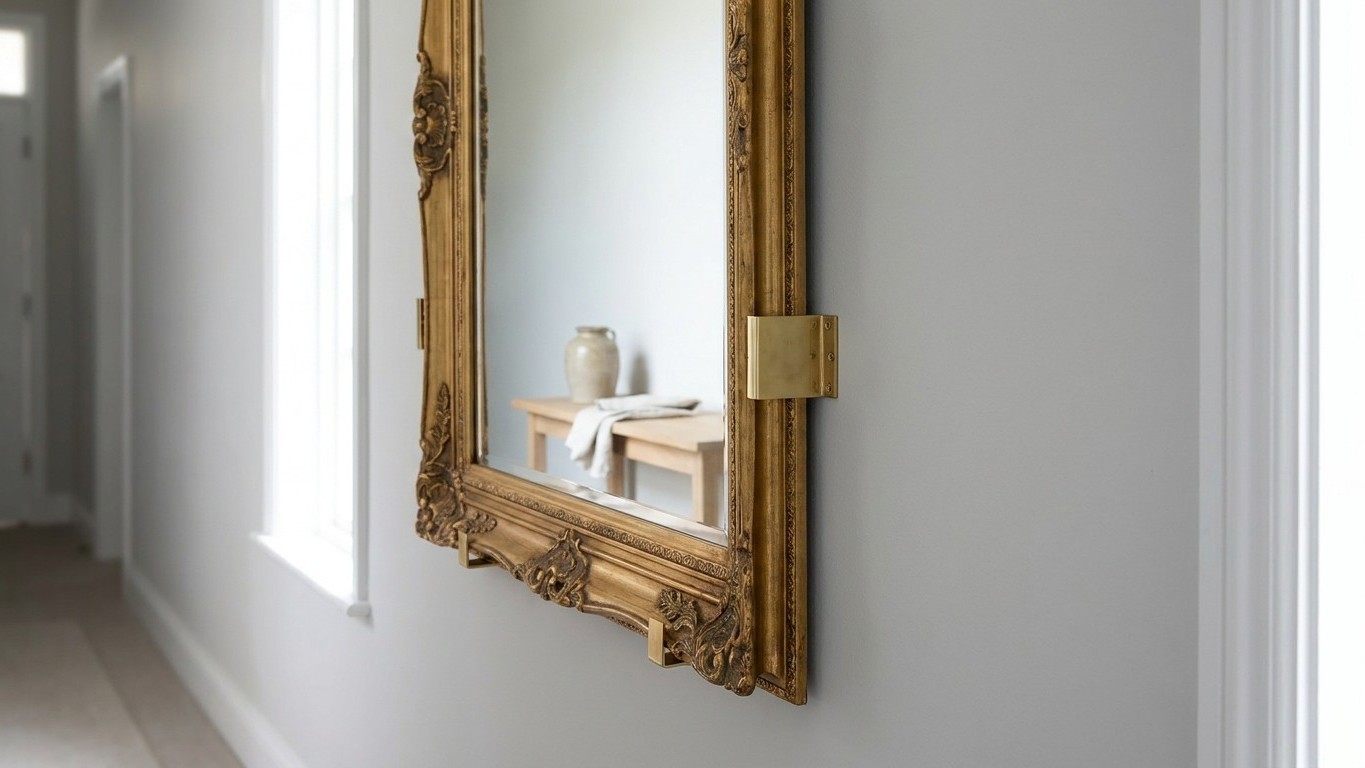
A heavy mirror on a single nail is one of those domestic arrangements that feels perfectly fine until the day it isn’t. Mine lived above the hallway console for the better part of a decade, slightly crooked roughly half that time, and I simply kept reaching up to straighten it as if that were a normal part of housekeeping. The handyman who came to fix a skirting board one afternoon watched me do this and, with admirable restraint, asked if he might take a look at how it was hung. What followed was a five-minute education I wish I’d had years earlier.
Key takeaways
- A single nail acts as a pivot point, and gravity gradually works your mirror into a permanent tilt
- Most standard nails aren’t designed to hold mirrors, and the real problem is rotational force, not just weight
- Two D-rings, picture wire, and proper wall fixings create a load-bearing system that stops movement entirely
Why a single nail is never really enough
The physics are straightforward once someone explains them. A single fixing point acts as a pivot. Gravity doesn’t pull the mirror straight down when the wire or cord is looped over one nail; it pulls each side of the wire downward at an angle, which creates a rotational force that steadily works the mirror into a tilt. The heavier the mirror, the more pronounced this effect becomes over time. My handyman demonstrated it with a pencil and a loop of string in about thirty seconds, and I felt mildly foolish for never having worked it out myself.
There’s also the question of what a single nail can actually hold. Standard oval wire nails, the kind most of us reach for instinctively, are designed for joinery work, not load-bearing hanging. A mirror weighing five kilograms exerts a downward pull but also a slight outward pull on whatever is supporting it, particularly if the mirror is positioned away from the wall at the bottom (which it always is, owing to skirting boards). Over years, that combined force works the nail loose. You may not notice until the mirror shifts dramatically or, in a worst case, comes down entirely.
The two-point fixing that actually holds
The solution my handyman showed me costs almost nothing and takes perhaps fifteen minutes. Two D-ring picture hooks, screwed directly into the back of the mirror frame at equal distances from the centre, connected by a length of picture wire twisted and secured at each ring. Then, two mirror plates or two proper picture hooks on the wall, spaced to match. With two fixing points, the rotational problem disappears entirely: there’s no single pivot, and both sides of the wire bear the load evenly.
The choice of wall fixing matters more than people realise. On a solid brick or stone wall, a masonry screw into a rawlplug is the right answer. A standard 5mm rawlplug paired with a 4mm screw will hold a modest mirror; anything over roughly eight kilograms deserves a 7mm rawlplug and a longer, chunkier screw. Plasterboard walls are trickier and catch many people out, because a screw driven straight into plasterboard has almost no holding strength. Hollow wall anchors, the kind that expand behind the board when you tighten the screw, are what you need here. They’re widely available at any hardware shop and genuinely make the difference between a mirror that stays put and one that doesn’t.
For very heavy mirrors, the safest approach is to locate the timber studs behind the plasterboard (a cheap stud finder does this, or you can tap along the wall listening for the change in tone) and drive screws directly into the wood. A fixing into a stud can hold considerably more weight than any plasterboard anchor, and that peace of mind is worth the extra few minutes of hunting.
Getting the height and level right before you commit
This is where most people rush and then regret it. Banging a nail in, hanging the mirror, standing back, and discovering it’s at an odd height accounts for a remarkable number of unnecessary holes in walls up and down the country. A small investment of time before drilling saves considerable patching afterwards.
Cut a paper template the same size as the mirror and hold it against the wall with masking tape. Live with it for a few minutes. Check it at the height you’d actually look at the mirror rather than where it happens to sit on the tape. For hallway mirrors, the centre of the glass typically looks best at around eye level, which for most adults falls somewhere between 155cm and 165cm from the floor. That said, if your household includes children or shorter family members who use the mirror regularly, a slightly lower centre point is worth considering.
Once you’re happy with the position, use a spirit level to mark both fixing points. A spirit level needn’t be expensive; even a small torpedo level from a pound shop will give you a reliable reading. Mark both points with a pencil, check the distance between them against the spacing of your D-rings, and only then reach for the drill. My handyman told me the number of times he’s been called out specifically to fill and replaster walls peppered with trial holes is, in his words, “quite depressing.”
One thing worth checking on older frames
Before any of this, examine the frame itself. Older mirrors, particularly those with ornate plaster or gilt frames, sometimes have degraded backing boards or loose corner joints that make them genuinely unsafe to hang regardless of how good the wall fixing is. If the frame flexes when you pick the mirror up, or if the backing board feels soft or crumbly, address that first. A local picture framer can usually reinforce a backing board and fit proper D-rings for a modest sum, and it’s worth every penny before you commit the mirror to your best wall.
One last detail my handyman mentioned as he left: if you want the mirror to sit flush against the wall rather than tilting outward at the bottom, stick small self-adhesive felt pads to the lower back corners of the frame. They hold the bottom of the mirror gently away from the wall, which naturally tips the top back and brings the glass perfectly vertical. I’d been nudging mine straight for years. Two felt pads from a packet I already had for the chair legs, and it hasn’t moved since.