
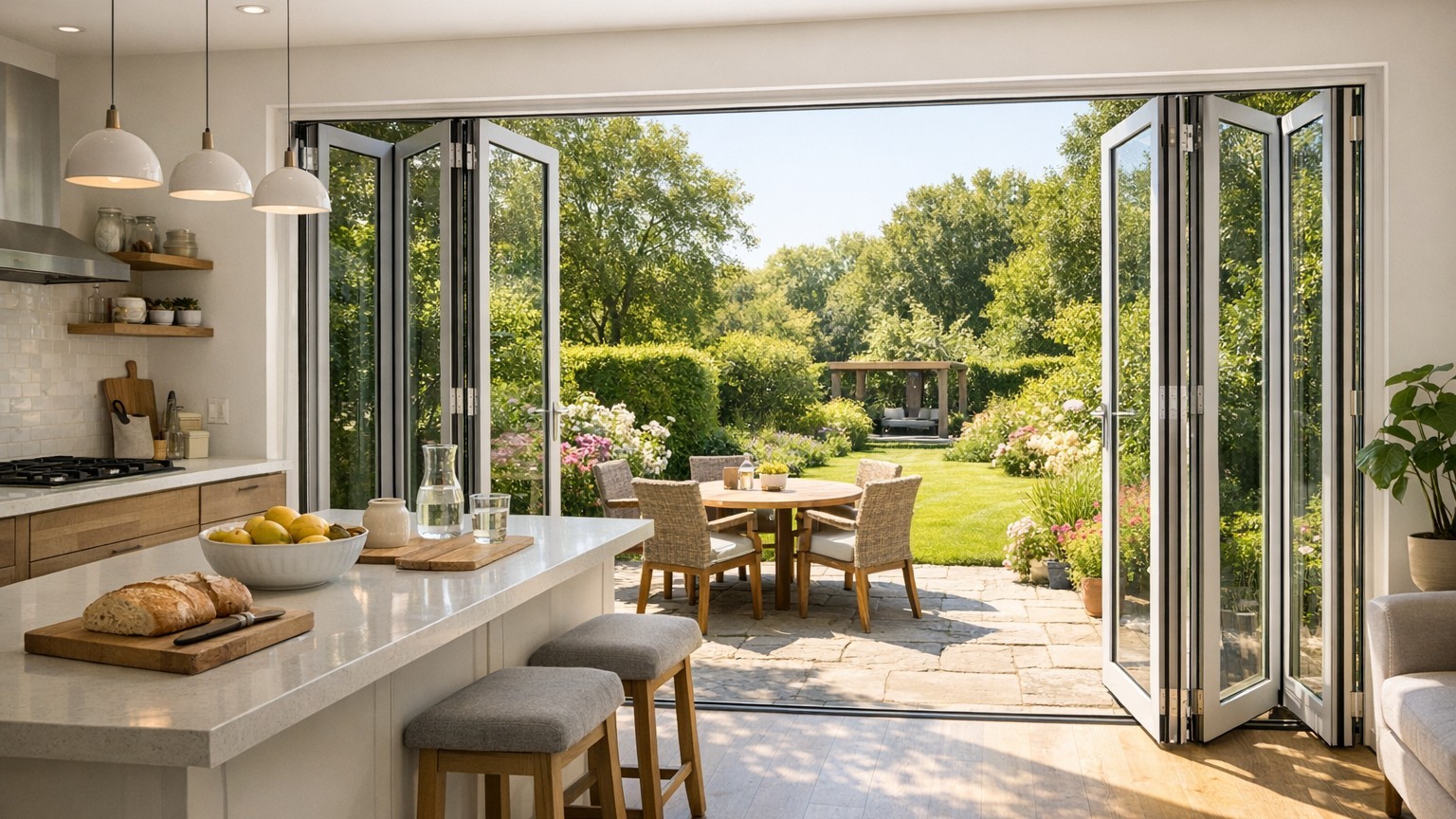
Solar control glass coating, applied directly to the panes of glazed doors, is quietly replacing the old habit of hanging heavy curtains across every sun-facing room. Architects across the UK have spent the past couple of years specifying it as standard, and for good reason: it keeps the heat out without blocking the light, the view, or the sense of space that big glass doors were installed to provide in the first place.
Key takeaways
- Windows account for 40% of unwanted heat gain, but one invisible coating could change everything
- A nanometre-thin layer of metallic oxide does what heavy curtains do—but actually lets you enjoy your glass doors
- Retrofit films can slash cooling costs by 20-30%, but not all coatings work equally well depending on which way your home faces
Why glass doors became the problem, and the solution
Windows are responsible for up to 40% of unwanted heat gain in commercial and residential buildings. Glass doors, which are essentially floor-to-ceiling windows, are the worst offenders of the lot. South-facing bifold doors on a kitchen extension can turn a perfectly pleasant room into something resembling a greenhouse by mid-morning in July. The traditional fix, thick lined curtains or roller blinds, simply undoes everything the architect was trying to achieve. You get the doors, then you close them off.
According to the Climate Change Committee, around 20% of homes, that’s 4.5 million properties, currently overheat even in cool summers. That figure is only going to climb as British summers grow hotter and more erratic. The demand for a smarter answer than “close the blinds” has driven a serious shift in how glazing is designed and specified.
Solar control glass is a type of high-Performance glazing that reduces the amount of solar heat entering a building. Filtering infrared radiation and reflecting excessive heat ensures comfortable indoor temperatures while maintaining optimal light transmission, achieved through advanced coatings, often metallic oxides, applied to the glass surface, which act as a selective barrier, blocking heat while allowing natural daylight to brighten the space. The coating itself is extraordinarily thin, often measured in nanometres, yet the low-E coating is only nanometres thick but dramatically impacts glass performance.
How the coating actually works
Solar control glass works through a combination of reflection, absorption, and transmission to regulate solar heat and light entering a building, with a portion of solar radiation reflected outright, some absorbed and then reradiated, and an amount of visible light allowed to pass through for optimal natural light. Think of it like a pair of good-quality sunglasses for your house: you can still see everything clearly, but the glare and heat are largely gone before they reach you.
There are two main technologies doing the heavy lifting here. Low-emissivity glass, universally known as Low-E, uses a thin metallic layer to slow radiant heat transfer. Low-emissivity glass is coated with a thin metallic layer that reflects infrared light, effectively reducing heat loss in winter and minimising heat gain in summer. The second option is solar control Low-E glass, which combines both functions. The low-E coating blocks UV radiation, while the solar control coating blocks infrared radiation from entering the room, only visible light is allowed to pass through the glass. This combined product is sometimes called spectrally selective glass, and it is increasingly what architects reach for when specifying large glazed doors.
Ordinary untreated glass does none of this. Ordinary clear glass has high emissivity of approximately 0.84, allowing heat to pass readily. High-Performance solar control glazing can cut that dramatically. Solar control Low-E glass can cut up to 60% of solar heat entering the room while also providing thermal insulation. And crucially, during colder months, certain types of solar control glass can retain heat, further reducing energy needs, making it a genuinely year-round benefit rather than just a summer fix.
The retrofit alternative: solar control film
New-build and full renovation projects are being glazed with solar control glass as standard, but what about the millions of homeowners who already have clear glass doors and don’t want the upheaval of replacing the whole unit? This is where solar control window film steps in, and it is having quite a moment.
Energy costs continue to climb in 2026, putting pressure on homeowners and business operators searching for practical solutions. While HVAC upgrades and insulation improvements require significant capital investment, solar control window film offers a faster, more affordable path to measurable energy reduction. The market figures reflect the demand: the global solar control window films market was valued at USD 8.17 billion in 2025 and is projected to grow to USD 14.03 billion by 2034.
The performance numbers are genuinely impressive. Quality films can reduce solar heat gain by 54–78%, which means air conditioning doesn’t have to work nearly as hard to keep a home cool. The technology delivers 20–30% reductions in cooling costs, complete UV protection that prevents interior fading, and improved comfort throughout a property. For anyone whose sofa faces a glass door, that last point is no small thing, ultraviolet light can be attributed to approximately 50% of interior furnishing and fittings fading.
Two types of film dominate the home market. Metallic films use layers of reflective metal to bounce solar energy back outward, while ceramic films use non-metallic nano-particles that provide heat rejection without interfering with electronic signals. Ceramic window tint blocks more total heat than metalized alternatives in most applications, with ceramic films rejecting up to 80% of infrared radiation. The downside is cost, ceramic films sit at the premium end of the market. For a budget-conscious approach, clear films typically reject 40–60% of solar heat while allowing 60–80% of natural light to pass through, which for most British homes is more than sufficient.
Application is straightforward enough for a confident DIYer. Static-cling films require only clean glass and a spray of water to position, peeling off without residue if you change your mind. Permanent adhesive films are best left to a professional installer, who will also ensure the film does not void any warranty on double-glazed units, something worth checking before you start.
What architects are specifying now, and why it matters for your home
The design direction in 2026 is clean, utilitarian, and efficient, bigger windows letting more natural light in. Low-E and solar control coatings work to regulate heating while maintaining bright interiors. The logic is simple: you cannot justify large expanses of glass in a planning application, or on an energy performance certificate, if that glass is going to cook the occupants every summer. The coating makes the glass viable.
Oversized solar control glass provides opportunities for designers to create unique, striking designs, with large panels helping to minimise structural elements while creating a seamless façade that allows more natural daylight into buildings. In a rear extension context, the garden-facing kitchen that has become the default ambition for so many British households — this means you can have the wall of glass without sacrificing the room to heat or curtains.
A 2026 peer-reviewed study on engineered cool windows demonstrates that spectrally optimised glazing systems can reduce indoor air temperature by up to 3.8°C by enhancing infrared and ultraviolet reflection while maintaining high visible transparency. Nearly four degrees cooler without touching the thermostat, without closing a blind, and without darkening the room. That is the version of summer many of us would happily sign up for.
One detail worth knowing: solar control coatings do reduce a small amount of visible light compared to plain glass, which can make south-facing rooms feel fractionally less luminous on overcast winter days. For north-facing glazed doors, which receive little direct sun anyway, a standard Low-E unit without the full solar control coating is generally the better specification, so it is always worth discussing orientation with a glazier before ordering. The coating is a tool, not a universal prescription, and matching it to your home’s particular geometry is what turns a good product into a genuinely smart one.
Sources : ecohomegenius.com | mcdowellglass.com