
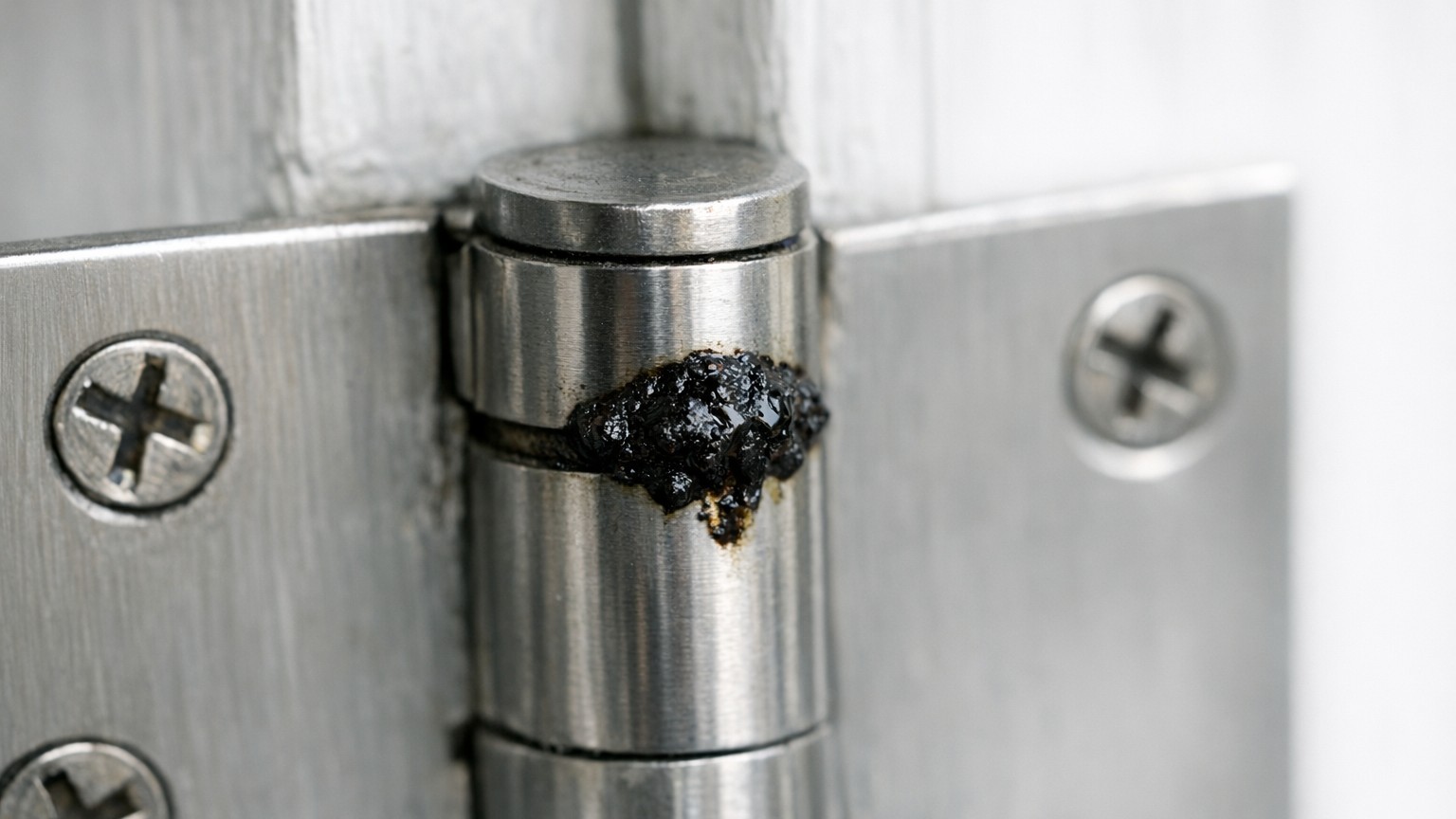
Cooking oil on a squeaky hinge feels like such sensible logic. It’s slippery, it’s always in the cupboard, and for about forty seconds after you apply it, the door swings beautifully silent. The problem reveals itself weeks later, when that same hinge has collected every speck of dust, every flake of paint, and every stray fibre from the hallway carpet into a thick, dark, gummy paste that grinds against the pin worse than before you started.
Key takeaways
- Cooking oil oxidises and becomes tacky, turning hinges into dust magnets within weeks
- That trapped gunk creates metal-on-grit friction that’s actually more abrasive than the original squeak
- The real solution isn’t fancy products—it’s proper cleaning first, then white lithium grease or petroleum jelly
Why cooking oil makes the problem worse over time
Any oil derived from food, sunflower, vegetable, olive, contains organic compounds that oxidise when exposed to air. This is the same process that makes a chip pan smell stale or a bottle of linseed oil thicken in the garage. On a hinge, oxidation turns a thin, clear film into a tacky residue. That tackiness then acts like flypaper for airborne particles: skin cells, fabric fluff, fine grit tracked in from outside. Within a few months, the gap between the hinge knuckle and the pin is packed with a substance that has roughly the consistency of old axle grease, only much less useful.
The creaking returns because metal-on-metal contact is now metal-on-grit contact, which is actively abrasive. Each time you open the door, the pin scores microscopic scratches into the barrel of the hinge, and those scratches create more surface area for the next layer of muck to cling to. It becomes self-reinforcing. I noticed this on the kitchen door of my old cottage, a door I had been “fixing” with olive oil for the better part of three years. The day I finally removed the hinge pin and cleaned it properly, the gunk that came off looked like something you’d drain from a very neglected sump.
What actually works, and why
The products that lubricate hinges reliably long-term are those that either repel dust or dry to a slippery film that doesn’t attract it. White lithium grease, available in small tubes from any hardware or motor accessory shop, is probably the most practical choice for a household hinge. It stays where you put it, resists moisture, and doesn’t oxidise the way vegetable oils do. A tiny amount on the pin and inside the knuckle is genuinely sufficient, you don’t need to slather it.
Petroleum jelly (plain Vaseline from the chemist) is another solid option that most people already own. It’s stable, it doesn’t dry out, and because it’s a mineral product rather than an organic one, it doesn’t go rancid or tacky with age. It’s slightly messier to apply than a spray, but on a hinge that needs occasional attention rather than constant maintenance, it performs very well. A matchstick or an old cotton bud makes a reasonable applicator if you want to be precise about it.
WD-40 is worth discussing here because it’s the first thing most people reach for, and there’s a widespread misunderstanding about what it actually does. The letters stand for “Water Displacement, 40th formula”, it was designed to displace moisture and prevent rust, not to provide lasting lubrication. It will silence a hinge for a short while, but it evaporates relatively quickly, and can actually strip away any remaining factory lubrication from the hinge barrel. If you use WD-40 to clean out old gunk (which it does reasonably well), follow it with a proper lubricant once the hinge has dried.
Getting the old gunk out first
Applying fresh lubricant over a dirty hinge is a bit like painting over damp wallpaper, it looks fine briefly, then fails. The proper approach takes perhaps ten minutes per hinge. Tap the pin out upward with a flathead screwdriver and a hammer (protect the door frame with a folded cloth). Wipe the pin clean with a rag, and use a cotton bud or a strip of cloth pulled through the barrel to clear out the inside. If the residue is stubborn, a small amount of methylated spirits on the cloth will shift it. Once everything is clean and dry, apply your chosen lubricant sparingly before replacing the pin.
The hinges that squeak for different reasons
A door that creaks despite a clean, well-lubricated hinge is telling you something else entirely. Seasonal movement is very common in British homes, timber doors swell with damp in autumn and winter, causing the hinge to bind against the frame rather than squeak from the pin. In these cases, no amount of lubrication helps, because friction isn’t the true culprit. The fix is usually adjusting the hinge screws or, in persistent cases, planing a small amount from the door edge.
Loose hinge screws cause a surprising amount of noise too. When the screw holes have worn and can no longer grip properly, the hinge shifts slightly under load, and that movement creates a creak that sounds identical to a lubrication problem. The old remedy, packing the hole with a wooden matchstick dipped in wood glue before re-driving the screw — still works as well as anything more modern.
One thing worth knowing about brass hinges specifically: they’re softer than steel, so they wear faster, and the pin-to-barrel tolerance opens up more quickly with use. An older brass hinge on a heavy door may squeak simply because the pin has become slightly loose in the barrel through years of wear. Replacing the hinge entirely is often cheaper than it sounds, a pair of good quality steel hinges from a builders’ merchant costs very little and will outlast the door.