
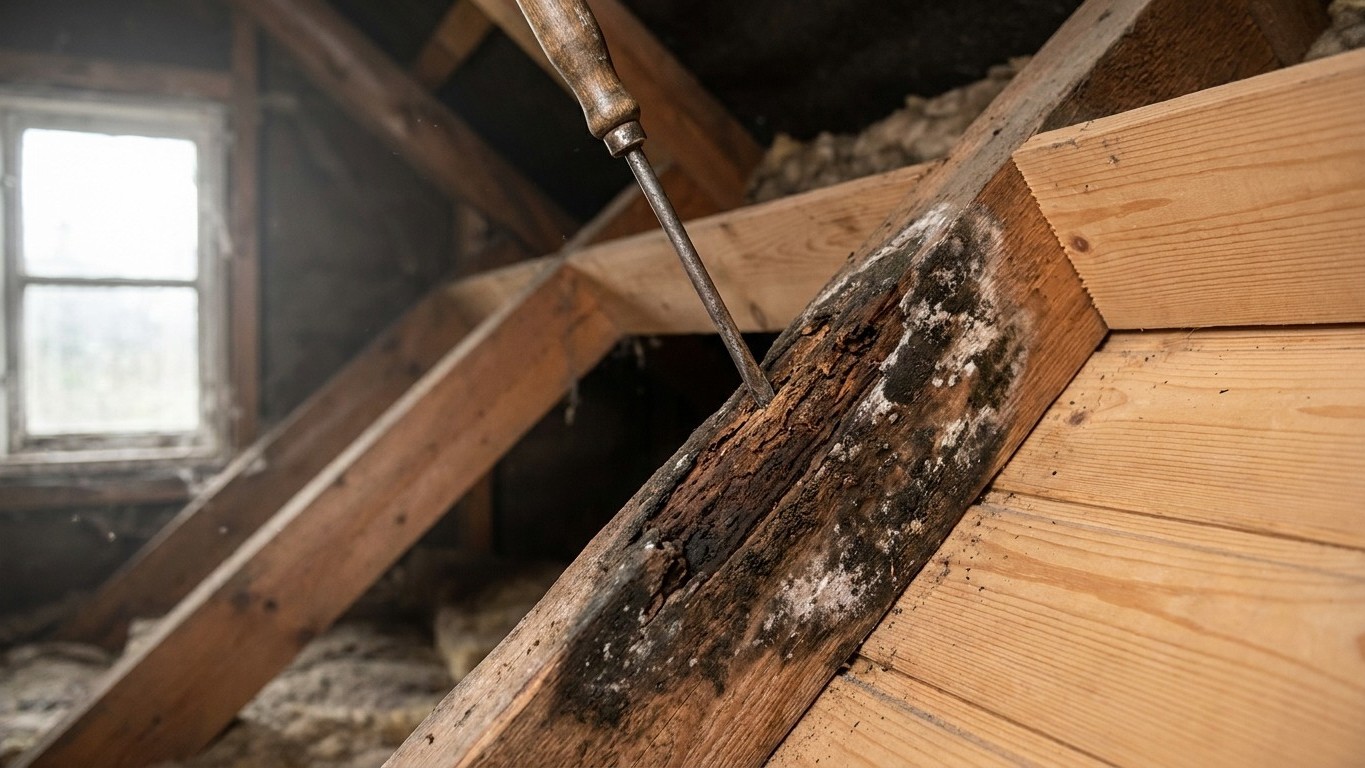
Eight years is a long time to leave a loft unchecked, and what one homeowner found up there serves as a stark reminder of what can quietly go wrong above our heads. The rafters directly above the bathroom were black, softened by rot, and had been silently deteriorating for years, all because of one invisible culprit: warm, moisture-laden air rising from below and finding nowhere to go.
Key takeaways
- Eight years of undetected deterioration can happen silently above your head—but there are telltale warning signs
- The culprit isn’t just time; it’s where your bathroom extractor fan actually vents to
- One simple screwdriver test reveals if your rafters are compromised—and what to do next
Why bathrooms are the worst offenders in the roof space
A hot bath or shower releases an enormous amount of water vapour into a small space. If your extractor fan vents into the loft rather than through the eaves or roof to the outside (which, sadly, is more common than you’d think in older British homes), that warm, damp air simply sits among the timbers. Wood is hygroscopic, meaning it absorbs moisture from the surrounding air almost as readily as a sponge absorbs water. Over months and years, the moisture content of the timber rises above the critical threshold of roughly 20%, and that is when wood-rotting fungi begin their slow, destructive work.
The blackening you see on affected timber is often a combination of mould and the early stages of wet rot. Touch the surface and it feels soft, almost spongy, because the fungi have broken down the cellulose structure that gives wood its strength. By the time discolouration is visible to the naked eye and softness is detectable to the touch, the process has typically been underway for several years. The timber’s load-bearing capacity is already compromised.
Poor or absent insulation at the eaves compounds the problem considerably. Cold air coming in at the eaves meets the warm, damp air rising from the bathroom below, and condensation forms directly on the coldest surfaces, which are almost always the rafters. This is a different mechanism from the extractor fan problem, but the result on the timber is identical.
Assessing the damage honestly before you do anything else
The first step when you find blackened, soft timber is to prod every rafter in the affected area with a flat-head screwdriver. Sound timber resists pressure firmly. Rotted timber will crumble, indent, or feel hollow. Work systematically from the ridge board down toward the eaves, because rot often travels further than the visible staining suggests. Mark each affected length with chalk so you have a clear picture of the scope before anyone starts pricing up repairs.
Check whether the rot is wet rot or dry rot. Wet rot tends to stay localised to the area that gets wet, and the timber looks dark and feels soft but does not produce the distinctive white or grey branching strands (mycelium) associated with dry rot. Dry rot is a far more serious matter: it can spread through masonry and across dry timber, and it requires specialist treatment. If you see those tell-tale white cobwebby growths, or a mushroom-like fruiting body, do not delay in getting a specialist out. Wet rot, if caught before structural failure, is more manageable as a DIY or straightforward trade job.
Take photographs of everything, with a tape measure in shot to give scale. Your buildings insurance policy may cover rot damage if it stems from a sudden and unforeseen event, though gradual deterioration is usually excluded. The photographs and a clear timeline will matter when you speak to your insurer or a building surveyor.
Fixing the timbers and stopping it from happening again
For wet rot that has not spread to more than a section or two of rafter, a carpenter can often sister new timber alongside the damaged rafter, bolting or screwing it securely to restore structural integrity. The rotted section does not always need to be removed entirely, but any timber remaining must be treated with a wet rot consolidant and hardener, widely available at builders’ merchants, before any new wood goes up. These consolidants are brush-applied and soak into the degraded fibres, effectively petrifying the soft wood so it can no longer deteriorate further.
If the ridge board or a purlin (the horizontal timbers that support the rafters mid-span) has been affected, this moves into structural territory and a builder or structural engineer should assess it before any remedial work begins. Replacing a ridge board on a terraced house is a significant job requiring scaffolding and temporary support to the roof covering.
Once the timber is dealt with, address the cause with the same urgency. Check where your bathroom extractor fan actually terminates. Run it and go into the loft with a torch to find the outlet: it should exit through the soffit, the eaves, or a tile vent, never simply blow into the loft space. Flexible ducting can be rerouted relatively cheaply by a competent handyperson or plumber, and a proper tile vent or soffit vent will cost far less than a second round of timber repairs. The extractor fan itself should run for at least 15 minutes after you leave the bathroom; a timer-overrun unit costs very little and can be fitted as a straightforward like-for-like swap.
Loft ventilation matters too. Building Regulations guidance recommends a gap equivalent to 25mm at the eaves around the full perimeter of a pitched roof, and many older houses fall short of this. Fitting additional proprietary eaves vents and ensuring insulation does not block the airflow path at the junction between ceiling and rafter can make a measurable difference to how quickly moisture disperses.
One detail worth knowing: untreated softwood timbers in a well-ventilated loft can last centuries, as evidenced by the original oak rafters still doing their job in medieval buildings across this country. The enemy is not age. The enemy is trapped moisture, and removing that source is the only repair that truly lasts.