
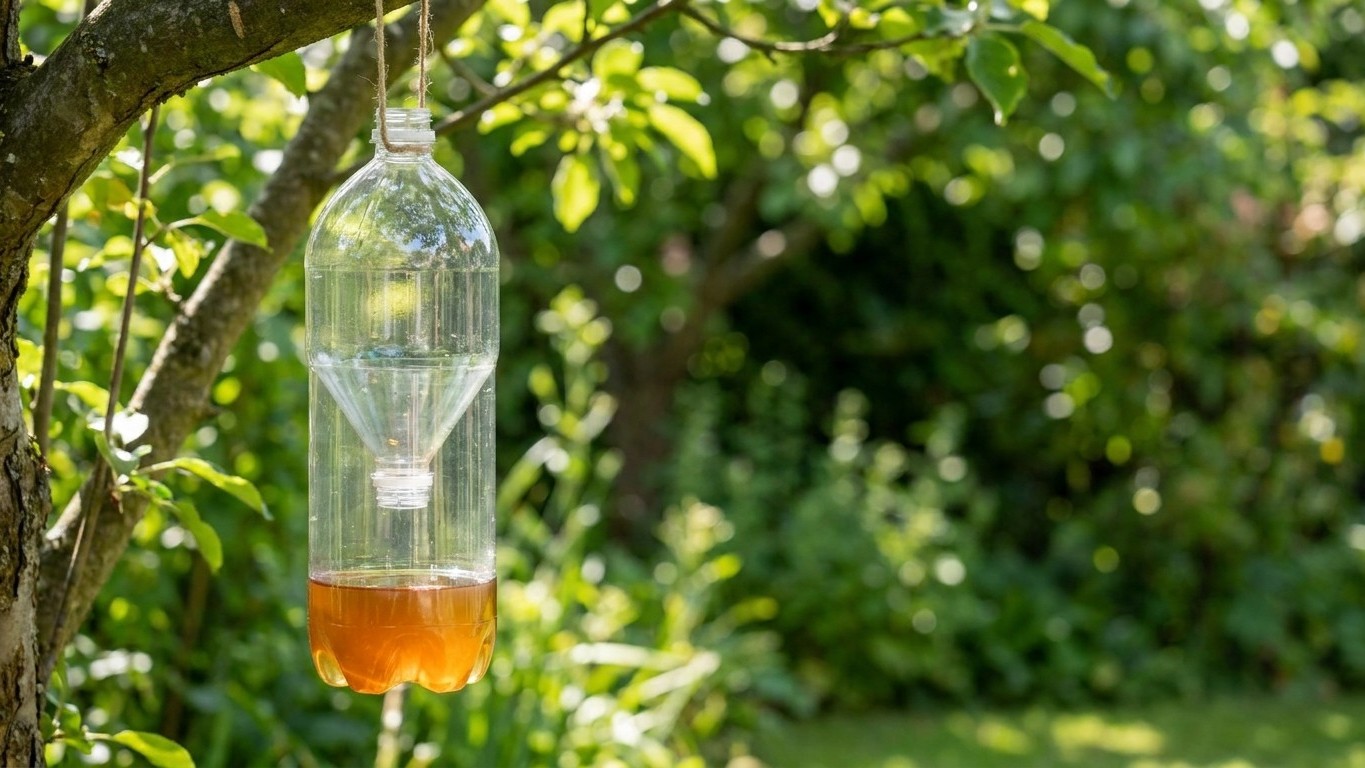
A plastic bottle from the recycling bin, a splash of flat beer, a spoonful of jam, and a length of garden twine, that is all it takes to build a trap that could genuinely help Keep Asian Hornets away from your garden this summer. With 544 credible yellow-legged hornet sightings recorded across the UK in 2025 and 163 nests found throughout the same year, this is no longer a distant threat. The Asian hornet has, quietly and rather determinedly, been making itself at home on our shores.
Key takeaways
- UK Asian hornet sightings have surged to 544 confirmed cases in 2025, with queens surviving British winters for the first time
- A single queen can travel 60 kilometres and establish new nests; one nest consumes 11kg of insects annually and kills 50 bees per day
- A foolproof £3 trap made from a plastic bottle, beer or vinegar, and garden twine can be hung from branches to catch hornets responsibly
Why This Summer Is Different
The insects, first detected in the UK in 2016, have shown worrying signs of becoming established, with the first confirmed evidence of queens successfully overwintering between 2023 and 2024. That matters enormously. A queen that survives a British winter can disperse as far as 60 kilometres and establish a new nest. One nest. Sixty kilometres. Think about that for a moment.
A single nest can consume about 11 kilograms of insects in a season, and these hornets are particularly dangerous to honey bees, with a single hornet able to kill up to 50 bees daily through a hunting technique called “hawking”, hovering outside beehives to catch returning foragers. Since the Asian hornet’s accidental arrival in France, it has spread to 15 countries, with France alone hosting over 500,000 nests and suffering estimated annual losses of €30.8 million due to reduced honey production and colony collapses. France is, a cautionary tale playing out in slow motion across the Channel.
Beyond the south-east, nests have been found in other areas outside of Kent and the coastal counties, confirming the hornets’ expanding range across Britain. This year was the first time the species crossed from England into Wales, an uncomfortable reminder that these creatures are travelling further than ever.
How to Build Your Kitchen-Scrap Trap for Under £3
The principle is straightforward. An inverted funnel design allows hornets to enter easily, attracted by the scent of the bait, but disorients them when looking for the exit, which increases the retention rate. You almost certainly have Everything you need already.
Take a clean 1.5 or 2-litre plastic fizzy drink bottle. Cut the top third off the bottle, then turn that cut part upside down and put it neck-downwards into the bottom part to create a funnel. Secure the two halves with a strip of tape or simply press them firmly together, the snugger the fit, the better. Punch a couple of holes through the sides so you can thread a length of string through and hang the trap up. A piece of garden twine costs virtually nothing. A roll from the pound shop will see you through the entire summer and several summers beyond.
Now for the bait. The Somerset Beekeepers Association suggests a simple spring recipe: 1 tablespoon of sugar, 160ml of water, and 80ml of cider vinegar. That vinegar is doing two jobs at once, it attracts the hornets and, crucially, helps deter honeybees, which dislike the sour smell. For later in the season, when worker hornets are out in force hunting protein, mashed prawns, fish, or cat food are also highly effective, though they can smell rather pungent. A darker, fermented brew works well too: half a litre of dark beer mixed with two tablespoons of sugar, or dark beer combined with a cup of blackcurrant cordial. The blackcurrant version, in particular, is said to be irresistible to foraging hornets and is wonderfully cheap to make from kitchen leftovers.
Fill the bottom of your bottle to about 5cm depth, enough to trap but not so deep you drown anything the moment it enters. Position the trap in a sunny spot, roughly 1 to 1.5 metres above ground (about chest height). Hung from a branch is ideal: the slight movement seems to catch the attention of passing hornets, and it keeps the trap away from pets and curious small hands. Apply a ring of Vaseline around any post or support to keep ants out, as they will consume your bait within days if they find the trap.
The Bycatch Problem (and How to Manage It)
Here is the snag that nobody much likes to talk about: a bait trap captures insects and requires you to release them or freeze them if an Asian hornet is caught, and the disadvantage is that it can trap other insects as well. A homemade bottle trap is not selective by nature. Native hornets, common wasps, the odd bumble bee, all can end up inside.
To make the trap as selective as possible, drill or melt small escape holes at the very bottom of the bottle to let smaller insects crawl out, and use bait mixtures with vinegar or specialised commercial formulas, which are less attractive to bees. Checking the trap daily, or at least every couple of days, is not optional if you want to act responsibly. Traps should be visited and emptied regularly, ideally daily, and it is very important that damage to native hornets, wasps, and any other insects is kept to an absolute minimum. Release anything that is not an Asian hornet, and refresh the bait roughly every week. If the bait is not replaced when necessary and becomes too full of insects, the decomposing bodies change the initial sugary scent into an odour that attracts flies instead.
Asian hornets are identifiable by their yellow legs, dark thorax, and a distinctive orange or yellow band on the abdomen. They are considerably larger than our native wasps. If you are in any doubt, photograph it before doing anything else.
If You Think You’ve Caught One
This is where the legal side comes in, and it is important. It is illegal to trap and release an Asian hornet. If you suspect you have one, do not simply open the trap and let it go. Upload the details using the Asian Hornet Watch app, seal the entrance, bag the trap, and place it in a freezer. The National Bee Unit will take it from there. In 2025 alone, the NBU deployed 350 traps and carried out a total of 5,500 trap checks, so your sighting, properly reported, genuinely feeds into a national effort.
Asian hornets are mostly a problem between March and November, which means your trap has real work to do across most of the warmer months. The advice from beekeepers is to trap through April and May for queens, remove traps at the end of May once queens have come out of hibernation, and then put traps out again in August to target worker hornets. A three-week stint in August, according to beekeeping groups, is particularly worthwhile during peak foraging season.
One thing that surprises most people: experience in France has shown that a trap already containing some Asian hornets is even more attractive to other Asian hornets, while other insects are deterred from entering. once your trap gets its first catch, it becomes considerably more effective on its own, a rather neat trick of nature working in your favour for once.
Sources : southampton.ac.uk | gov.uk