
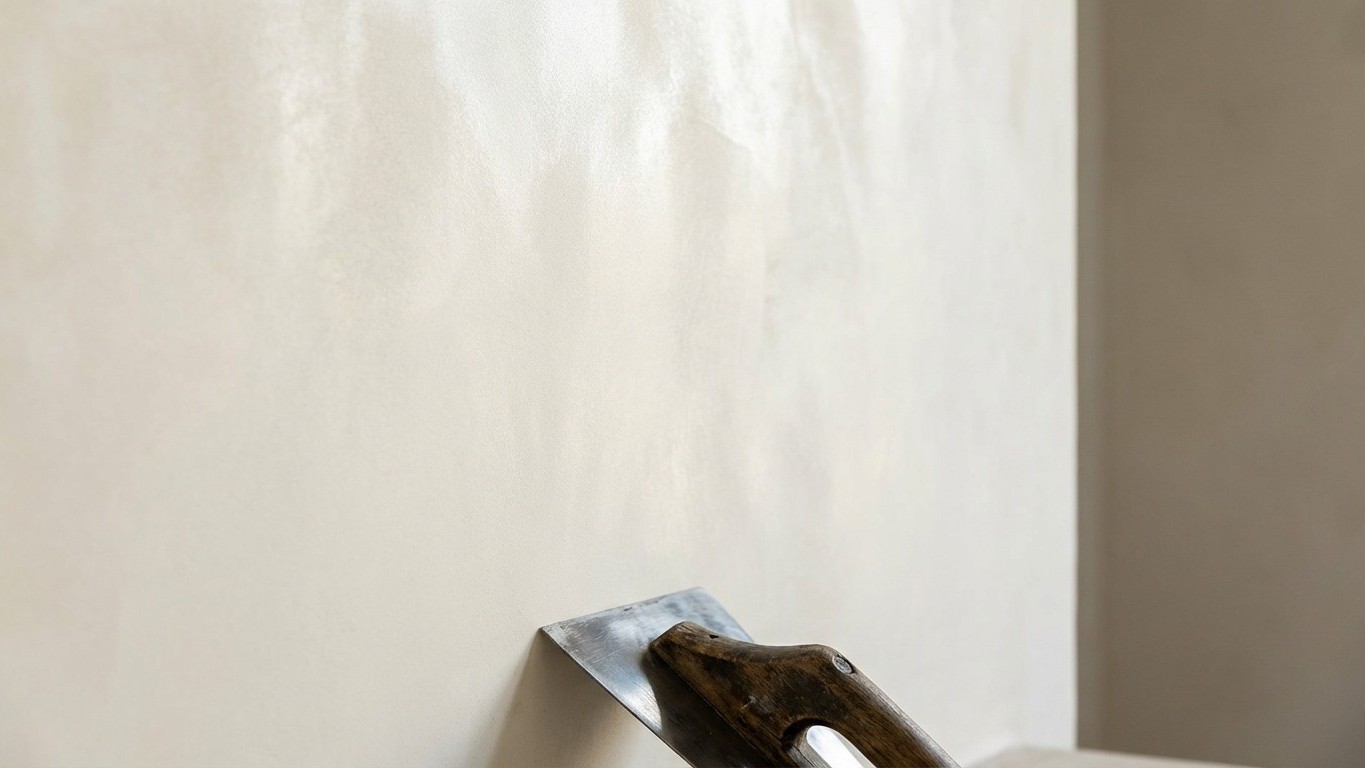
Forget the paint tin and the roller tray. The Japanese technique known as sakan — the centuries-old craft of hand-trowelling natural plaster onto walls, produces a finish so quietly beautiful that architects today specify it for luxury hotels and private residences across Europe. No brush strokes, no roller stipple, no fumes. Just a steel trowel, natural materials, and a skill old enough to have built castles.
Key takeaways
- A single steel trowel is the only tool needed to create walls so perfectly smooth they become reflective mirrors
- Natural shikkui plaster made from lime, seaweed, and eggshells actively improves air quality and regulates humidity
- No two sakan walls are identical—each one bears the subtle signature of the artisan’s hand
What Sakan Actually Is
Sakan refers to the work of applying plaster or mortar to exterior walls or earthen walls using a trowel, as well as the artisans who perform this task. The word itself is worth pausing over: in Japanese, the same term describes both the craft and the craftsman, which tells you something about how seriously the trade is taken. The title “sakan” is said to have first been given to carpenters by the Emperor at the Taika Era Reforms in the 7th century, and since then the trowel has been the main tool of the sakan, with an equally long history of over 1,000 years.
The origins of sakan can be traced back to the Jomon period, where people primarily lived in pit dwellings and stacked soil to create earthen walls. By the time the great tea houses of the 16th century were being built, sakan craftsmen played a significant role in the construction of tea rooms. These were not plain walls. They were the backdrop to one of Japan’s most rigorous cultural rituals, and the plaster had to express serenity through texture and material alone.
Traditional Japanese plastering techniques include “Kyo-kabe” (ancient-style Kyoto walls), which finish the surface with soil, and “Shikkui” walls, which are finished with plaster. Shikkui, in particular, is the one now drawing attention beyond Japan’s borders. Shikkui plaster is a traditional Japanese lime plaster made of slaked lime of high calcium purity with additives including seaweed extracts to help stability, soybean oil to improve workability, and natural plant fibres to aid anti-cracking. Some formulations even incorporate eggshells. Some blends of shikkui plasters have 50% added eggshells, making it a truly eco-friendly product.
The Trowel Is the Whole Point
Sakan artisans finish walls by hand with a steel trowel called a kote. Materials are typically shikkui (lime plaster), clay and earth mixes, or diatomaceous earth, breathable, low-odour, and repairable. The trowel is not simply a spreader; it is the instrument through which every nuance of the finished wall is expressed. With over 100 different types of trowels developed alongside the spread of natural plastering in Japan, the country probably hosts the largest variety of trowels on the planet.
Each trowel type serves a different purpose in the layering process. Originating from the culture of sword-making, forging metal in Japan is a fine art. Trowels are produced from steel of various temperaments, ranging from “soft” iron known as jigane to “hard” high-carbon steel known as honyaki. Between these two extremes are a variety of steels including hanyaki and aburayaki. The harder the steel, the more it compresses the plaster surface and the higher the sheen it produces, which brings us to one of the technique’s most arresting results.
Polished Tosa shikkui plaster is a weather-resistant lime plaster made by fermenting a mix of slaked lime and straw fibres. Amazingly, it is so finely polished that the finished surface is reflective. No varnish. No glaze. Just lime, straw, seaweed glue, and the pressure of a trowel wielded by a trained hand. The wall becomes its own mirror.
Why It’s Gaining Ground in British Homes
Walls and floors finished with sakan offer a pleasing texture and beauty. Also, help regulate indoor humidity, absorbing excess moisture when it’s humid and releasing it when it’s dry — creating a comfortable environment less affected by the seasons or weather. For anyone who has dealt with a damp British winter and a house that holds condensation like a sponge, that is not a small thing.
The health credentials add up quickly. Shikkui coatings are highly porous and naturally antiseptic, so indoor air quality is actively improved for healthier spaces. They are also said to be humidity-regulating, fire-resistant, antistatic (preventing dust accumulation), hypoallergenic, antifungal and mould resistant. Compare that to standard emulsion paint, which typically off-gasses volatile organic compounds for weeks after application.
Sakan plaster walls, utilising earth or shikkui lime plaster, impart a natural texture to modern, colour-restrained spaces. The subtle traces left by the artisan’s trowel introduce a gentle fluctuation to otherwise uniform walls, creating visual softness. That is precisely why these finishes are appearing in the “quiet luxury” interiors that dominate design coverage right now, spaces where the material itself is the statement, not the colour chart.
A skilled sakan craftsman carefully mixes natural ingredients, seaweed paste, clay, straw, and sand, to create a unique plaster blend that serves as the foundation of his work. Each batch is slightly different, which means no two walls are truly identical. In an age of mass-produced everything, that singularity is worth something.
How to Approach It at Home
Full professional sakan demands years of training. It takes at least five years to gain solid competency around producing the right brown coat under any circumstances, the layer before the thin finish, which must be applied as perfectly as the finish will be. That said, pre-mixed versions of shikkui and earthen plasters are now reaching the UK market, intended for application by trowel over primed plasterboard. Wara Juraku, for example, is natural, non-toxic and odourless, and is applied by skim coat using a hand trowel for a smooth finish.
The practical approach for a British homeowner is to use the technique on a single feature wall first, a chimney breast, a bedroom headboard wall, or an alcove. Prepare the surface with the manufacturer’s recommended primer, mix your plaster to the stated consistency, and work in sections of roughly one square metre at a time to keep a wet edge. The trowel angle matters: held at a shallower angle it spreads material, held more steeply it compresses and polishes. Two thin coats outperform one thick one every time. The application method entails applying two very thin coats, nearly back to back, working quickly and efficiently without lingering on any one small section for too long.
One detail worth knowing: the art of Japanese plastering and the thick earthen walls which the plaster often covers has made it possible for traditional Japanese houses, walls, and warehouses to remain intact over the centuries against many natural disasters such as fires, floods, and earthquakes. A wall finished with shikkui is not merely decorative. It is, in a very old and well-tested sense, protective, which gives any room it graces a quality that paint, however fashionable the shade, simply cannot replicate.
Sources : orientaltradingmediation.com | orientaltradingmediation.com