
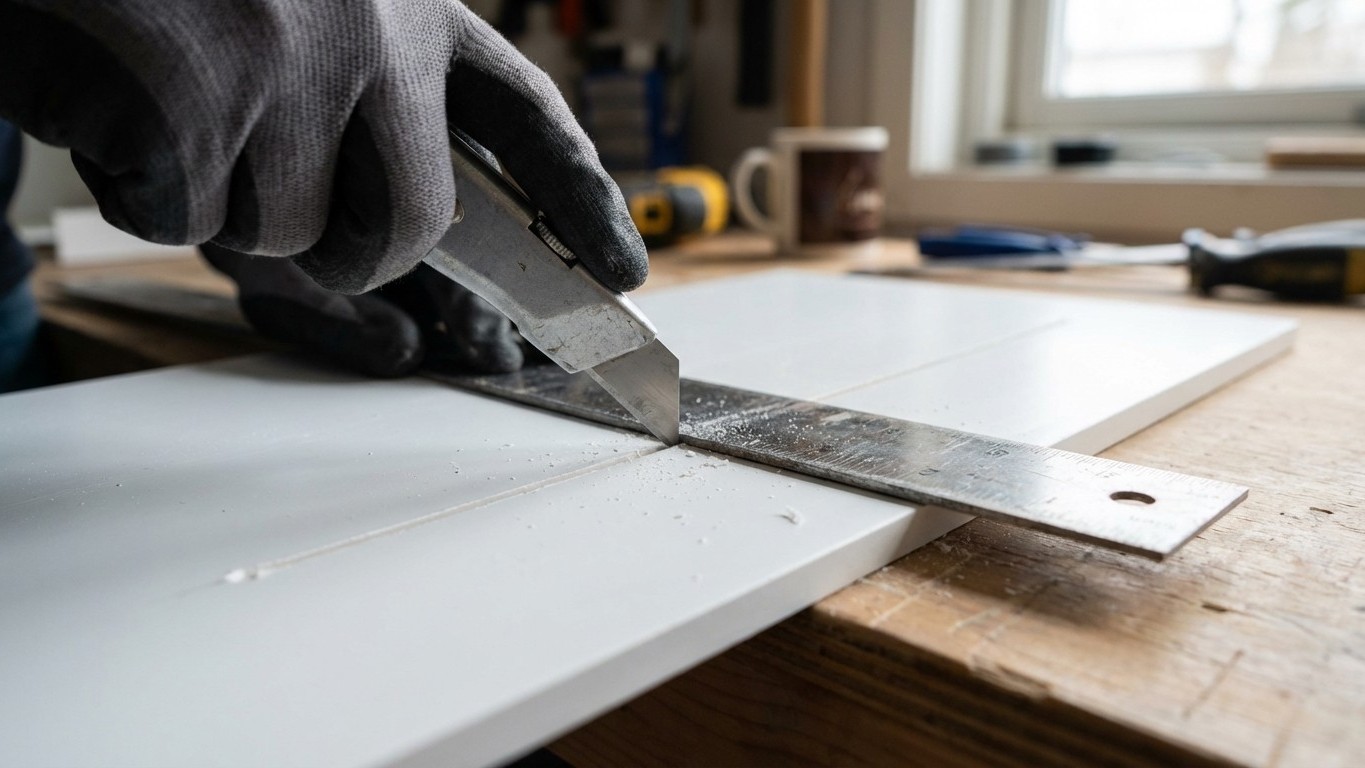
PVC panels crack at the cut because most people reach for the wrong tool entirely. A circular saw, a jigsaw, even a fine-tooth handsaw, all of them generate heat and vibration, and PVC, for all its toughness as a finished material, responds to that combination with spidery fractures that travel back along the panel’s length. The fix isn’t a sharper blade. It’s a completely different approach to the cut itself.
Key takeaways
- Why every power saw you own is making the cracking problem worse, not better
- The surprising reason cold weather turns a simple cut into a shattered panel
- A humble utility knife does what expensive tools cannot—and costs pennies
Why PVC behaves so differently from timber
Wood is fibrous. It splinters when cut badly, but the fibres absorb a good deal of the stress. PVC is a thermoplastic, which means heat softens it and rapid temperature changes, like friction from a fast-moving blade, create localised stress points that the material simply cannot accommodate. The crack you see running from the cut line isn’t a sign of poor-quality cladding; it’s the panel telling you the heat reached the wrong place too quickly.
There’s also the question of blade speed. Most of us have our power tools set to whatever speed we used last, often high, because high feels efficient. With PVC, a high blade speed generates enough friction heat to partially melt the material at the cutting edge, then allow it to resolidify under tension as it cools. That tension is what cracks the panel. Slowing the blade helps considerably, but it still doesn’t address the root problem.
The tool that actually works: a scoring knife and a straight edge
The answer, particularly for thinner tongue-and-groove PVC cladding and ceiling panels (the sort widely sold for bathrooms and kitchens), is score-and-snap. The same principle used to cut ceramic tiles and glass, no heat, no vibration, just controlled stress applied to a precise line.
You’ll need a sturdy straight edge (a metal ruler or a proper aluminium cutting guide is ideal), a sharp utility knife with a fresh blade, and a firm flat surface. Clamp or hold your straight edge along the cut line, then draw the knife firmly toward you three or four times, following exactly the same groove each pass. You’re not trying to cut all the way through; you’re scoring a channel roughly a third of the way into the panel’s thickness. Once the score is deep enough, align the groove over the edge of a workbench or a length of timber, hold the panel flat on one side, and apply firm downward pressure to the overhanging section. The panel snaps cleanly along the score line, no cracking, no splintering, no dust.
For thicker PVC boards (10mm or above), score-and-snap becomes harder to control, and that’s where a fine-tooth saw can still be used, but with one adjustment: keep the cut slow and steady, and if the panel is cold (as it often is when delivered in winter), bring it indoors and let it reach room temperature before cutting. Cold PVC is significantly more brittle, and a panel that cuts without drama in July may shatter in January if you work with it straight from the van.
Getting a perfectly straight cut without a guide rail
One practical difficulty with score-and-snap is keeping your straight edge from slipping mid-cut. A trick that saves a great deal of frustration: run a strip of masking tape along the cut line before you score. The tape gives your straight edge a slightly grippier surface to press against, and it also protects the panel’s surface finish from scratches made by the edge of your ruler. Mark your measurement directly onto the tape in pencil rather than onto the panel itself, and the pencil line wipes away cleanly when you remove the tape afterward.
For angled cuts, around a light fitting, say, or at a sloped ceiling junction, a sharp craft knife and a card template cut from an old cereal box will serve you better than trying to manoeuvre a power tool into an awkward corner. Trace the template onto the panel, score along the line in several careful passes, and finish any curved or internal corners with a sharp chisel. It takes a little longer, but the result is a clean edge that accepts silicone sealant properly, rather than a ragged cut that needs filling.
Cutting PVC without the mess
If you do reach for a power saw, perhaps for a long straight rip cut on a thicker board where score-and-snap isn’t practical — a few habits make a real difference. A blade marketed for cutting plastic or non-ferrous metals will have more teeth per inch than a standard wood blade, which distributes the cutting work and reduces heat per tooth. Keep the blade guard clear of debris, cut at a low to medium speed, and never let the blade linger: a slow, steady forward motion is very different from a slow, hesitant one that lets heat build in one spot.
One detail that often gets overlooked: support the panel fully on both sides of the cut line. When the offcut piece is left hanging free, its weight causes it to sag as the blade passes, which pinches the blade and, again, generates localised heat. Two sawhorses with a scrap timber support across the middle, positioned so neither side can drop, eliminates this entirely.
A small note worth keeping in mind: PVC offcuts, however small, shouldn’t go into general household recycling in most UK councils. Check your local authority’s guidance, as many areas now accept rigid PVC separately, and some cladding suppliers will take back unused offcuts. Less waste in landfill, and occasionally a small credit on a future order, worth the thirty-second phone call.