
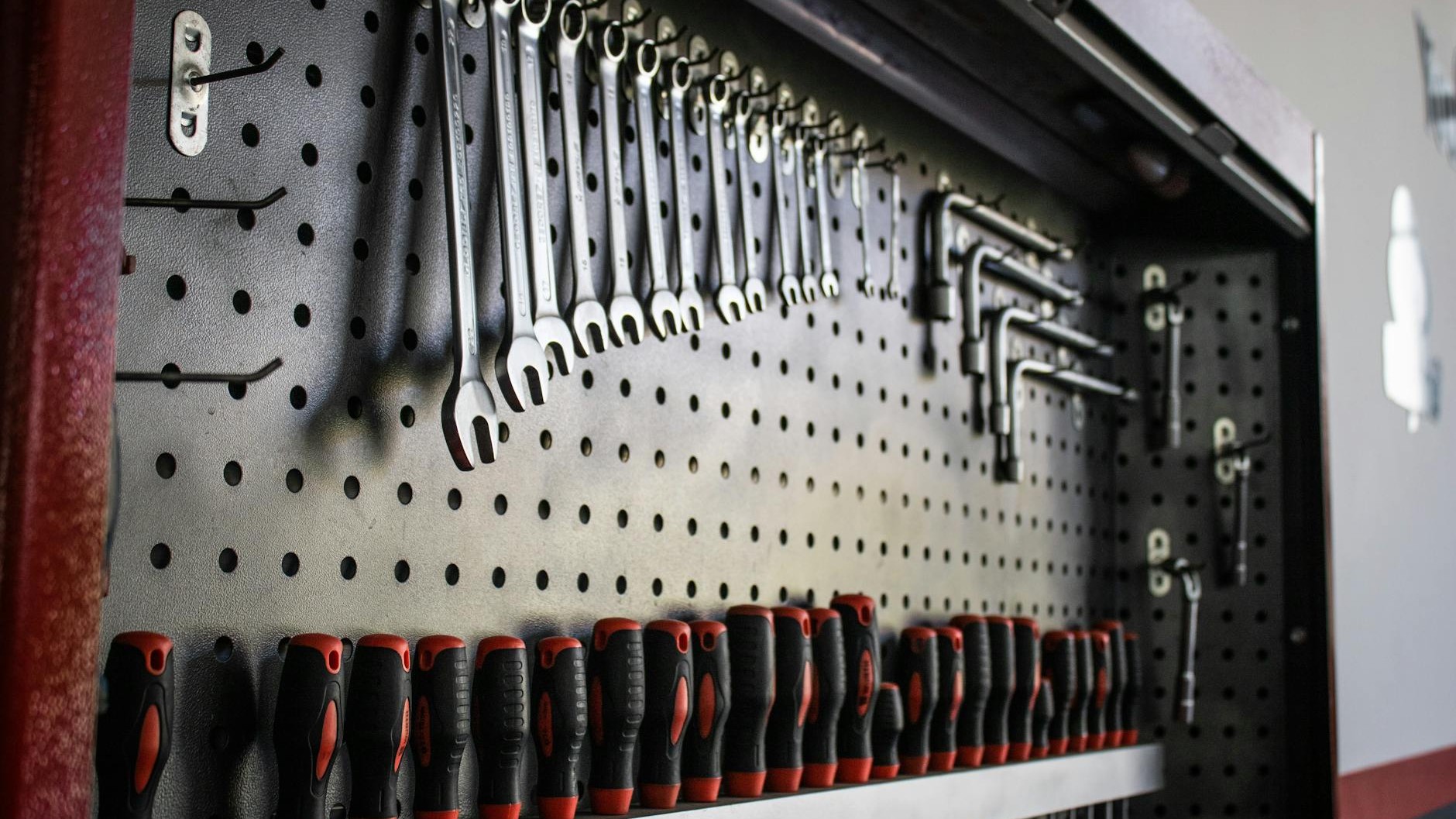
A solid wood pegboard sounds simple enough, but get the hole spacing wrong and you’ll spend more time fighting your hooks than Actually using your tools. After years of watching garages descend into organised chaos, I can tell you that one measurement separates a pegboard that works beautifully from one that frustrates you Every Single Time you reach for a spanner.
Key takeaways
- Why solid wood pegboards outperform standard hardboard in ways most people never realize
- The one spacing measurement that separates a pegboard that works from one that frustrates you daily
- The hidden mounting detail that determines whether your tools stay put or slowly creep out of position
Why solid wood beats the standard stuff
Most of us grew up with the familiar brown hardboard pegboard, those thin sheets with their neat rows of holes. They do the job, up to a point. But solid wood, even a modest 18mm pine board, holds hooks with a confidence that hardboard simply cannot match. Heavy tools, the ones that make hardboard sag and hooks creep downward over time, stay exactly where you put them. There’s also something genuinely satisfying about a natural wood surface in a working garage. It doesn’t look like an afterthought.
The timber you choose matters more than most people realise. Pine is affordable and easy to work with, though it dents if you’re rough with it. Plywood (proper birch ply, not the cheap construction stuff) gives you far greater strength for the same thickness and holds screws beautifully at the edges. For a standard garage wall of around two metres wide, a single sheet of 18mm birch ply cut to size costs a fraction of proprietary storage systems and outlasts them by decades. I’ve seen homemade wood pegboards in garages that are clearly thirty years old and still perfectly serviceable.
The one spacing that changes everything: 38mm on centre
Here is where most home-built pegboards go wrong. The standard commercial hardboard pegboard uses a 25mm (one inch) hole spacing, which sounds perfectly sensible until you try to use it with heavier timber. At 25mm centres in an 18mm board, the material between holes becomes thin enough to crack under pressure, especially if you’re hanging anything weighty. Go too wide, say 75mm, and you lose the flexibility to position hooks exactly where you need them.
The spacing that solves both problems is 38mm on centre, which means measuring 38mm from the centre of one hole to the centre of the next, in both directions. This gives you a grid that’s close enough to offer genuine flexibility in hook placement, while leaving 18 to 20mm of solid timber between holes. That’s enough to take a proper metal hook loaded with a heavy hand drill or a coil of extension cable without any stress to the wood around it.
The hole diameter matters too. A 9mm drill bit is the right size if you’re using standard pegboard hooks, which have a 6mm shank. That extra 3mm of clearance means hooks slide in easily without wobbling excessively. Drill at perfectly 90 degrees to the board face; a drill press is ideal, but clamping a drill guide to the board works just as well if you take your time. Angled holes create hooks that sit crooked, which drives you quietly mad over months of use.
Building and mounting it properly
Marking out the grid takes patience but rewards you enormously. Start by drawing a line 50mm in from each edge of your board, this keeps your outermost holes away from the edges where splitting is most likely. Then mark your 38mm grid across the entire working area using a pencil and a straight edge, or better yet, a marking gauge set to 38mm if you have one. The intersection of every horizontal and vertical line is a hole. It looks like a lot, and it is, but you only do this once.
Before drilling, secure the board firmly to a workbench with clamps and place a sacrificial piece of scrap timber underneath. This prevents the dreaded breakout on the back face as the bit exits the wood. Drill every hole at a steady, moderate speed. Rushing creates heat, heat causes tear-out, and tear-out leaves ragged holes that look shoddy and weaken the board’s edges slightly.
Mounting the finished board requires one more consideration that people often overlook: standoff spacing. Your board must sit away from the wall by at least 25mm to allow hook shanks to engage properly from behind. Batten strips of 25mm x 25mm softwood fixed horizontally to the wall, at roughly 400mm vertical intervals, then the board screwed to those battens, gives you a rigid, ventilated mounting that won’t trap moisture against a masonry wall. Use rawlbolts or frame fixings into masonry, not just ordinary screws into plastic anchors, particularly if you’re in an older house where the garage walls may be single-skin brick.
Finishing touches that make real differences
A coat of clear wood sealer or even a light sanding with 120-grit followed by a wipe of Danish oil keeps the board looking presentable and stops the timber absorbing workshop grime. It won’t need reapplying for years. Some people paint their pegboard white or pale grey to make it easier to spot tools at a glance, an entirely sensible idea, though it does hide the loveliness of the grain.
One small trick worth knowing: once you’ve arranged your tools exactly as you want them, draw an outline around each one with a black marker. This tells you instantly when something is missing from its place, which is genuinely useful when you’re mid-project and the drill bit you need has wandered. Mechanics have been doing this in professional workshops for generations, and there’s a reason it stuck around.
The honest truth is that 38mm centres won’t win any dramatic conversations, but six months after you’ve hung your board and started actually using your garage the way you always meant to, that quiet little measurement is doing all the heavy lifting. What would you add to yours first?