
Every summer, the same quiet worry creeps in just as you’re zipping up your suitcase. The tomatoes on the windowsill. The peace lily on the landing. The herb pots clustered on the kitchen step. You’ve nurtured them for months, and now you’re about to abandon them for seven days. Before you start ringing round neighbours or drafting apologetic notes for your sister-in-law, here’s the good news: two empty bottle caps, a short length of cotton string, and a bit of prep are genuinely all you need to keep most houseplants alive and happy while you’re away.
Key takeaways
- A forgotten gardening trick uses capillary action—the same physics that darkens a sugar cube in tea
- Two surprisingly different methods work for different plant arrangements and shelf situations
- Your plants might look sad when you return, but one gentle watering brings them back to life faster than you’d expect
The Science Behind the Magic (It’s Simpler Than You Think)
Both methods described below rely on the same quiet, unstoppable force: capillary action. Capillary action is the mechanism behind these self-watering systems, when water is placed near soil or a wick, it moves through tiny gaps and along surfaces, with water molecules clinging together and pulling themselves along. It’s the same reason a sugar cube slowly darkens when you dip just its corner into a cup of tea. Your plant, rather cleverly, draws only what it needs, when it needs it. The plant takes what it needs, and the soil draws water from the bottle without letting it all out at once.
The beauty of using this principle at home is that it costs essentially nothing. You don’t have to spend a fortune on specialty pots, just use materials you already have or repurpose old containers like soda bottles and water bottles for a zero-waste alternative to pricey planters. A word of genuine experience here, though: it’s always best to test your self-watering method before leaving town. If you’re going to be away for a week, set things up a week beforehand and check in regularly with your plant. A drooping leaf discovered on a Tuesday test run is far less stressful than a wilted corpse on your return from Lanzarote.
Method One: The Bottle Cap Drip System
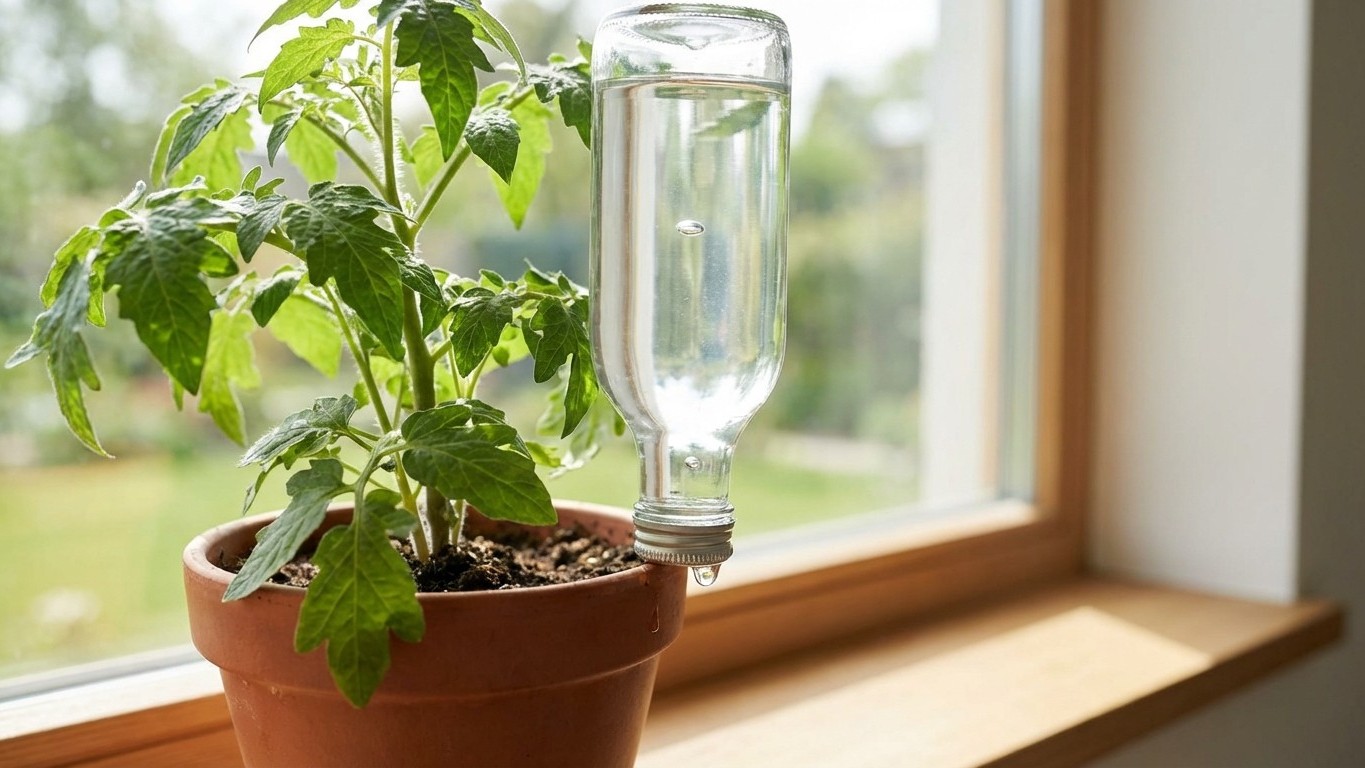
This is the most satisfying of the two methods, partly because you’re recycling and partly because it looks rather clever. Take any clean plastic bottle, a half-litre works well for smaller pots, a full litre or a standard wine bottle for thirstier specimens. Flip the cap over and place it on a firm surface. Using a hammer and small nail, punch two small holes on either side of the cap’s interior. Push the nail through and wiggle it a bit to make sure the holes are clear, but don’t make them too big or the water will pour out too fast.
Fill your bottle with water and screw the cap back on. If you’re watering a smaller pot, you don’t need to fill the bottle all the way, just enough to give your plant a good drink without flooding it. Simply flip the filled bottle upside down in your pot so the cap is touching the soil, but not covered by it — you don’t want the earth to block those tiny holes. If everything is working correctly, you’ll see air bubbles slowly rising in the bottle from one hole while the other releases water into the soil. Those bubbles are your signal that the system is working exactly as it should.
Fiddling with the flow is easy. Check back after a few hours to make sure a little water has drained away. If too much is draining, tighten the cap. If too little, loosen it slightly. For larger plants, consider a wine bottle. Wash it out and fill with water up to the neck. Place your thumb over the top, flip it over, then bury the neck a few inches into the soil, removing your thumb. The neck should be wedged firmly and sit fairly secure.
Method Two: The Cotton String Wick
The string method is ideal if your plant pots are on a shelf and an inverted bottle would topple over, or if you prefer something less visible. Place a glass or bowl of water next to your plant, then get a length of cotton string or rope. Put one end in the water and the other end in your plant’s soil. That, truthfully, is the entire method. Physics does the rest.
A few details make the difference between success and a soggy disaster. Fill a bottle or jar with water and set it next to the plant. Then cut a piece of cotton string long enough to reach from the bottom of the water container to about two inches into the soil. Cotton is the key word here, synthetic string simply doesn’t wick reliably. Cotton string is a porous material that can absorb and transport water. Placed in the soil, the plant’s roots will grow around it, and the string wicks water to the plant, providing the hydration it needs.
Fill a jar, cup or bottle with water and place it next to your pot, positioned so that the mouth of the container is higher than the base of the plant. The longer you’re going away for, the larger you’ll want this container to be. One large jam jar can often serve two or three small pots at once if you run a separate length of string to each. If the string wick is in hot direct sunlight, it will dry out before the water reaches the plant. Position your containers in a partly sunny location so they get enough light but not too much, this will also help them stay moist and reduce how much water they need.
A Few Things Worth Knowing Before You Go
Neither method is entirely without limits. Bottle watering works best for shorter periods, while with wicking you can fill a larger container for a longer trip and a smaller one for a shorter one. For absences of more than two weeks, the Royal Horticultural Society suggests that it may be preferable to arrange for a trusted neighbour, friend, or relative to water the houseplants while you’re away.
Plant type matters too. These methods suit plants that need to maintain moist soil. They aren’t ideal for succulents, which can tolerate a dry spell but not continual moisture. Orchids are another exception, don’t attempt any self-watering system with orchids, as their roots need to dry out between waterings. You’re better off leaving these plants with a friend.
One last, rather reassuring thought from the RHS: for short absences during summer, giving plants a thorough watering before going away may well be sufficient. Moving them to a cooler room or away from a bright window will help prevent them drying out. When you get back, don’t panic if your plants look a bit wilted. You’ll be amazed at how quickly they can recover after a gentle watering, just don’t be tempted to overcompensate and drench them.
Two bottle caps, a nail, a hammer, and some cotton string. The holiday anxiety around your plants can, with a little preparation, be entirely dissolved, which leaves you free to worry about the really important things, like whether you’ve packed enough suncream and remembered to cancel the milk.