
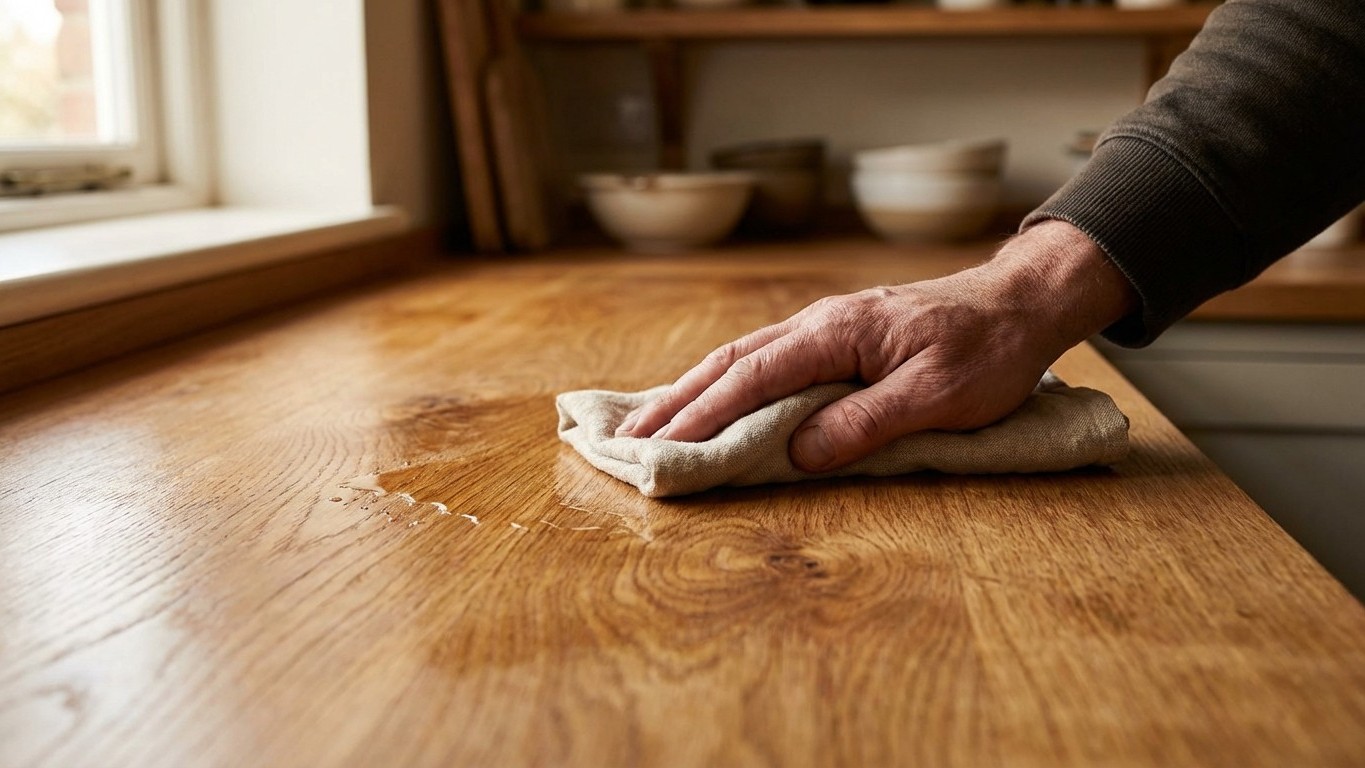
There’s a particular kind of embarrassment that comes from realising you’ve been doing something the hard way for years, completely unnecessarily. I felt it acutely the afternoon a cabinet maker friend watched me describe my monthly worktop oiling ritual and quietly said, “You know you don’t need to do that, don’t you?” He then told me about a finishing treatment so durable that most Professional woodworkers apply it once, perhaps twice in a decade, and simply get on with their lives. The secret, it turns out, isn’t about working harder, it’s about choosing the right product in the first place.
Key takeaways
- What most homeowners don’t realize about the oils they buy at DIY shops
- Why your cabinet maker friend stopped worrying about worktop maintenance years ago
- The one preparation step that determines whether your finish will actually last
Why most people end up on the monthly oiling treadmill
The problem starts at the point of purchase. Most kitchen worktop oils sold in DIY shops are based on plant-derived drying oils, linseed, tung, or various blended “Danish” oils, which are affordable, pleasant-smelling, and genuinely quite good at what they do. What the packaging rarely explains clearly is that these oils cure to a relatively soft film that sits within the wood’s surface layers. Water, heat, and the simple mechanical abrasion of daily chopping and wiping gradually thin that film until the wood looks dry and slightly grey. At that point, most of us dutifully reach for the bottle again. It’s not that the product has failed, exactly. It’s that we were using a maintenance finish rather than a foundation finish, Without quite understanding the distinction.
My cabinet maker friend, who has been fitting solid oak and walnut kitchens for the better part of thirty years — described watching homeowners come back to him two or three years after installation, baffled by how much attention their worktops demanded. His response was always the same: strip the oil back, and start again with something built for longevity.
The finish that actually lasts: what he recommended
The product category he pointed me towards is hardwax oil, and if you haven’t encountered it before, it’s worth understanding why it behaves so differently from standard finishing oils. A hardwax oil combines natural drying oils (usually linseed or sunflower-based) with hard waxes, most commonly carnauba and beeswax. The oils penetrate the wood fibres and polymerise as they cure, while the waxes form a microscopically thin but genuinely tough protective layer at the surface. The result is a finish that is far more resistant to water, mild acids (think lemon juice and vinegar, the worktop’s constant companions), and abrasion than a straight oil alone.
The application process is where most people go wrong, even with the right product. He was very firm on this point. One thin coat, worked well into the grain with a lint-free cloth or a fine abrasive pad, then left to cure fully, which means a minimum of 24 hours, ideally 48, before the surface sees any real use. The temptation to apply a thick, generous coat is understandable but counterproductive; excess product sits on the surface rather than penetrating, becomes tacky, and can Actually impede the curing of the layers beneath. Thin and patient wins every time.
Hardwax oils are available from most good timber merchants and specialist finishing suppliers, and they span quite a range of prices. The better-quality versions tend to have a higher wax content and cure harder, which is genuinely worth paying for on a surface that takes the punishment a kitchen worktop does. A tin that seems expensive upfront will almost certainly cost you less over five years than repeated bottles of budget oil.
How to prepare your worktop before you start
If your worktop has been oiled repeatedly over the years, mine certainly had, some preparation is needed before a hardwax oil can do its job properly. Old, saturated oil in the wood’s surface can prevent new product from penetrating properly. The approach my friend recommended was straightforward: sand the surface back with 120-grit sandpaper, working with the grain, then follow with 180-grit to smooth things out. Wipe away all the dust with a damp cloth and allow the wood to dry completely before you touch the finishing oil. This matters more than people expect; applying any oil finish to even slightly damp wood is a recipe for a blotchy, uneven result.
For worktops around the sink, always the most vulnerable area, he suggested paying particular attention to the end grain, which absorbs moisture far more readily than the face grain and is where most worktop failures actually begin. A second thin coat applied to the end grain sections only (around the sink cutout, at the joins, at any exposed edges) gives those areas extra protection without over-applying to the rest of the surface.
What maintenance actually looks like after that
Once a hardwax oil has fully cured, the ongoing care is genuinely minimal. Wipe spills promptly, avoid leaving wet cloths or wet dishes sitting directly on the wood for extended periods, and use a good cutting board rather than working directly on the surface. Most manufacturers suggest a light refresh coat every two to three years, or when you notice water no longer beading on the surface. That’s it. No monthly rituals, no anxious checking after every dinner party.
The thing that struck me most in that conversation was how much of what we accept as “just how things are” in home maintenance is actually the residue of using products that were never quite the right tool for the job. A solid wood worktop, properly finished with the right product once, can look beautiful for twenty years with remarkably little fuss. Which does make you wonder, what else in the house have we been over-maintaining because nobody told us there was a better way?