
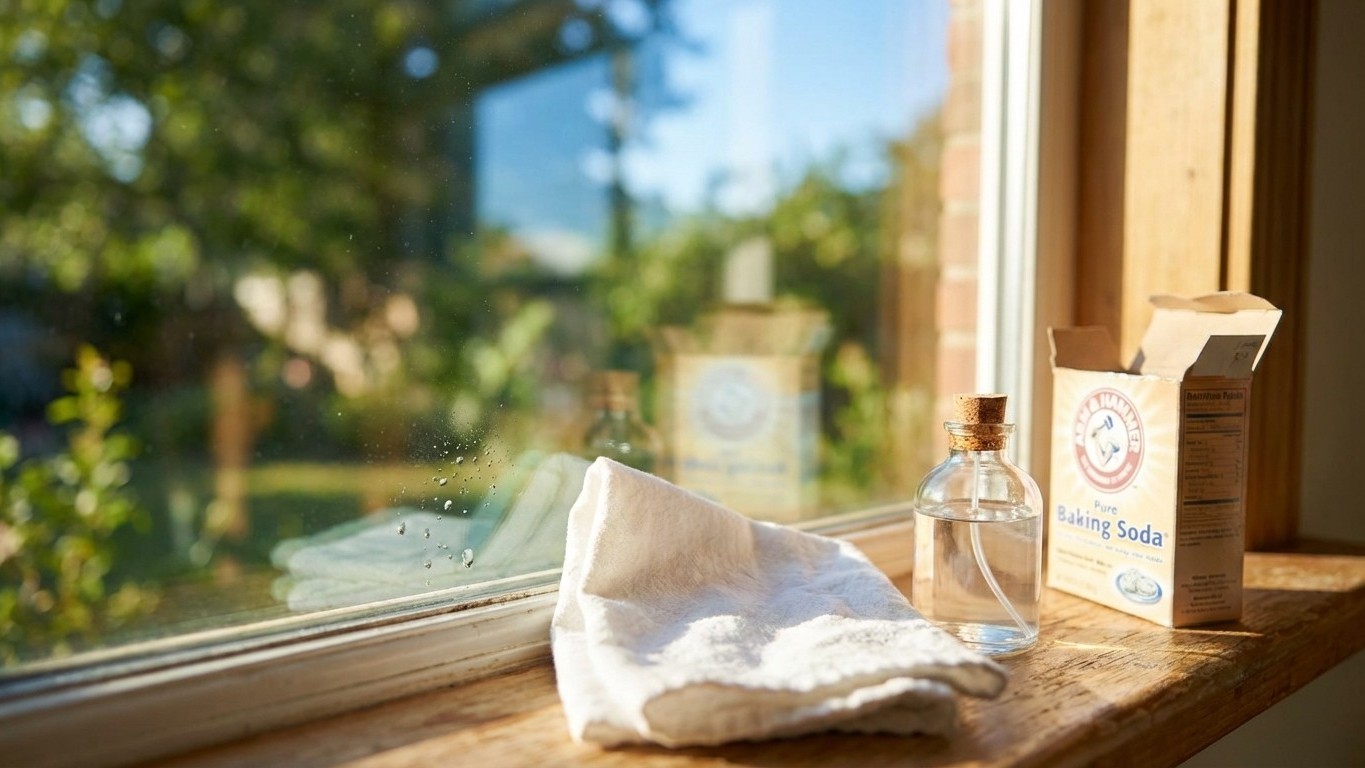
Streak-free glass is one of those small domestic victories that feels disproportionately satisfying. You stand back, look at your freshly cleaned window, and the world outside appears sharper, brighter, somehow more cheerful. The problem is that most of us have been reaching for blue spray bottles full of chemicals we can’t pronounce, only to be left with a faint haze, a chemical smell that lingers for hours, and a vague unease about what we’ve just breathed in. The good news? A handful of ingredients from your kitchen cupboard, white vinegar, bicarbonate of soda, a splash of rubbing alcohol — will do the job better, for a fraction of the cost, and without any of the nasty side effects. These natural window cleaning hacks are not just eco-friendly gestures. They genuinely work.
Why clean your windows naturally in the first place?
Conventional glass cleaners often contain ammonia, synthetic surfactants, and alcohol-based solvents that aren’t particularly kind to the air inside your home. In small, poorly ventilated rooms like bathrooms, regular use of these products contributes to a cocktail of airborne irritants. For households with young children, asthma sufferers, or anyone with sensitive airways, this is worth taking seriously. The residue left on glass surfaces can also attract fine dust particles, which is rather ironic given that cleaning is supposed to remove them.
Natural ingredients, by contrast, leave no toxic residue, biodegrade quickly, and cost next to nothing. White vinegar, for instance, dissolves mineral deposits and grease through its acetic acid content. Bicarbonate of soda is a gentle abrasive that lifts grime without scratching. Rubbing alcohol (isopropyl or surgical spirit) evaporates almost instantly, which is precisely what prevents streaks. These aren’t old wives’ tales, the chemistry is sound. For a simple and effective recipe, try this homemade glass cleaner vinegar and alcohol combination. For particularly challenging cases, you might want to explore natural cleaning hacks for very dirty windows that require more intensive approaches. Of course, having the right technique is only part of the equation – using the best cloth for streak free natural glass cleaning is equally important for achieving professional results.
There’s also the environmental picture. Plastic spray bottles of proprietary cleaners generate packaging waste at a staggering rate. Mixing your own solution in a reusable glass bottle, refilling it with ingredients bought in bulk, creates virtually no packaging waste at all. For anyone already exploring natural cleaning hacks across the rest of the home, windows and mirrors are one of the easiest places to start. If you’re specifically interested in mirrors, you can learn how to clean mirrors naturally without streaks using similar principles.
Understanding streaks, and how to stop them before they start
Most streaks don’t come from the cleaning product itself. They come from technique. Applying too much liquid is the number one culprit. When glass is saturated, the solution pools and dries unevenly, leaving those characteristic watery halos. Cleaning in direct sunlight is the second most common Mistake, the product dries before you can wipe it off, depositing whatever mineral content was in your tap water directly onto the surface.
The type of cloth matters enormously. Paper towels leave fibres behind. Old cotton rags are too absorbent and tend to redistribute grime rather than lift it. A quality microfibre cloth is the gold standard, but a sheet of crumpled newspaper (black and white pages, not glossy colour supplements) is a surprisingly effective alternative that generations of housekeepers have sworn by, the ink acts as a very mild polishing agent. For a thorough comparison of your options, the guide on the best cloth for streak free natural glass cleaning covers every scenario in detail.
A good rubber squeegee, used with overlapping horizontal strokes, eliminates the problem almost entirely on larger windows. The key is to wipe the blade dry with a lint-free cloth between each pass. It sounds fussy, but once you’ve done it twice it becomes second nature.
The core ingredients and how to use them
White vinegar, the workhorse
White wine vinegar or distilled malt vinegar (the clear variety) is the backbone of almost every natural glass cleaner recipe. Its mild acidity cuts through grease, dissolves limescale deposits left by hard water, and has a natural anti-static quality that helps repel dust after cleaning. The smell dissipates completely once dry, give it ten minutes and you won’t notice it at all, whatever anyone says to the contrary.
The basic dilution is one part vinegar to one part water for lightly soiled surfaces. For windows near a busy road, or in a kitchen where cooking fats have misted the glass, a stronger solution of two parts vinegar to one part water works better. Straight undiluted vinegar is rarely necessary and can actually be harder to buff dry, leaving its own faint residue.
Rubbing alcohol and the streak-free secret
Adding rubbing alcohol (look for isopropyl alcohol or surgical spirit at any chemist) to a vinegar solution transforms it from good to excellent. Alcohol evaporates rapidly and completely, which means the cleaning solution lifts away before mineral deposits from the water have time to settle. The classic homemade glass cleaner vinegar and alcohol recipe combines these two ingredients with a small amount of washing-up liquid or castile soap to cut through any residual grease, and the results are genuinely comparable to commercial products.
Bicarbonate of soda for stubborn patches
For heavily soiled glass, garden-facing windows caked with pollen, shower doors whitened with limescale, or frames with ingrained grime around the edges — bicarbonate of soda earns its place. A paste made from two tablespoons of bicarb mixed with just enough water to form a spreadable consistency can be applied directly to stubborn spots, left for a minute or two, then wiped away gently. The abrasive action is mild enough not to scratch standard glass, but effective enough to shift deposits that a spray alone won’t touch.
Lemon juice and castile soap
Fresh lemon juice contains citric acid, which behaves similarly to vinegar on mineral deposits, with the bonus of a genuinely pleasant scent. It’s a lovely option for bathroom mirrors, where you might want the room to smell fresh rather than faintly of a chip shop. Castile soap, a pure vegetable-oil soap available from most health food shops — can be added in tiny quantities (literally two or three drops per spray bottle) to any solution where you need a little extra grease-cutting power. More than that and you’ll spend more time rinsing than cleaning.
Recipes that actually work
The everyday window spray
Fill a 500ml spray bottle with 250ml of white vinegar and 250ml of cold water. Add three drops of castile soap if your windows are in the kitchen or near a cooker. Shake gently before each use. This is your daily driver, suitable for most windows, mirrors, and glass surfaces throughout the house.
The streak-fighter formula
Into the same size bottle, combine 150ml of white vinegar, 150ml of rubbing alcohol (70% isopropyl or surgical spirit), and 200ml of distilled or cooled boiled water. Distilled water makes a genuine difference if you live in a hard water area, it removes the mineral variable entirely. Two drops of essential oil (eucalyptus or peppermint work well) can be added if you prefer a scent, though they’re entirely optional. Shake before use. This formula is your go-to for mirrors and surfaces where streak-free results matter most. For more detail on this combination and important safety notes about mixing, the full guide on homemade glass cleaner vinegar and alcohol is worth reading before you start.
For bathroom mirrors and very shiny surfaces
Mirrors need a slightly different approach because they’re typically in smaller, warmer rooms where solutions dry faster. A spray bottle containing equal parts rubbing alcohol and distilled water, with no vinegar at all, is often the cleanest option for a bathroom mirror, fast evaporation, no smell, no streaks. The dedicated guide to clean mirrors naturally without streaks goes into the technique in detail, including how to handle steam damage and toothpaste splashes without leaving circular marks.
Step-by-step method for streak-free glass
Preparation matters as much as the solution itself. Before you spray anything, dust the glass with a dry microfibre cloth or a soft brush to remove loose debris. Spraying liquid onto a dusty surface turns dust into muddy smears, not the result we’re after.
Work from the top of the window downward. Spray a light, even mist over the surface, you want the glass damp, not running wet. Starting at the top corner, use your microfibre cloth in a Z-shaped overlapping pattern, moving steadily downward. For a squeegee, start at the top and work in horizontal overlapping strokes, wiping the blade after each one. Polish any remaining edges with a dry corner of the cloth.
Avoid cleaning in direct sunlight where possible. Early morning or overcast days are genuinely better, the glass stays cooler and the solution has time to do its work before evaporating. For large bay windows or picture windows, working in sections of roughly 60cm at a time gives you better control and reduces the chance of the product drying before you reach it.
One more thing: always clean the frame and sill before the glass. Wiping a freshly cleaned window with a cloth that’s picked up grime from the frame is a classic mistake that means starting again from scratch.
Tackling the difficult cases
Pollution residue, pollen, insect deposits, bird lime, these are a different category from ordinary domestic grime and they need a slightly more considered approach. The acetic acid in vinegar will dissolve most pollution films given a few minutes of dwell time. Spray generously, wait two or three minutes, then wipe rather than immediately buffing. For pollen season, a pre-rinse with plain water before applying the cleaning solution stops you grinding pollen into the surface. Bird deposits are best softened with a damp cloth before any product goes on — trying to scrape them dry will scratch the glass. For a comprehensive strategy covering all these scenarios, the article on natural cleaning hacks for very dirty windows addresses pollution, rain residue, and seasonal grime in detail.
Shower door limescale is a particular challenge in hard water areas. A paste of bicarbonate of soda and white vinegar (mixed carefully, they will fizz) applied to the glass and left for five minutes before gentle scrubbing with a non-scratch pad is often enough to shift even stubborn buildup. For very badly affected doors, repeat applications over a few sessions may be needed. Patience beats scrubbing force every time.
Surfaces and special cases
Wood frames, PVC, and tinted glass
White vinegar is safe on glass itself and on uPVC frames, but should be used cautiously on wooden frames, prolonged contact can dry and bleach untreated wood. Spray the glass only, keeping solution away from wood, and wipe any drips immediately. On tinted or film-coated glass (common in conservatories), avoid abrasives including bicarb pastes, and stick to the plain vinegar-and-water spray at a weak dilution. If in doubt about a surface, test in a small inconspicuous corner first.
Safe choices for allergies and children
One of the genuine advantages of these natural solutions is that they’re safe to use around children and people with chemical sensitivities. White vinegar and bicarbonate of soda are both food-grade ingredients. Rubbing alcohol should be stored away from children and used with ventilation, as with any alcohol product. If you prefer to avoid alcohol entirely, a lemon juice and distilled water solution gives good results on mirrors and is entirely non-toxic. The slightly lower streak-resistance compared to an alcohol-based formula is a worthwhile trade-off when there are young children or pets nearby.
Keeping on top of it: routine and prevention
Kitchen windows benefit from a quick wipe-down once a week, given cooking fats and steam. Bathroom mirrors need attention every few days if they’re in regular use. Living room and bedroom windows can typically be left for a month or two between thorough cleans, with a quick dust in between. The windows facing a garden or street will need more frequent attention during spring pollen season and after stormy weather.
A simple preventive habit makes a real difference: keep a small spray bottle of diluted vinegar solution and a microfibre cloth under the bathroom sink or in a kitchen drawer. A thirty-second wipe after noticing a splash or steaming takes seconds and stops light grime from baking onto the surface over days and weeks.
In autumn and winter, condensation can be a persistent problem on single-glazed windows. After wiping condensation away, a very thin rub of neat glycerin (available at any chemist) buffed into the glass creates a temporary water-repelling layer. It’s an old Victorian housekeeping trick, and it still works.
For anyone who’d like to extend the same thinking to the rest of the home, the broader collection of natural cleaning hacks covers everything from limescale on taps to grease on oven doors, all with the same principle: simple ingredients, clear method, genuinely good results.
The real pleasure of cleaning windows naturally isn’t just the sparkling result, though that’s satisfying enough. There’s something rather lovely about knowing exactly what’s in your cleaning product, that it’s a mixture you made yourself from things you can eat, that it costs almost nothing, and that when it rinses away down the drain, it leaves no trace of anything harmful. Which is, when you think about it, exactly what you were trying to achieve on the glass.