
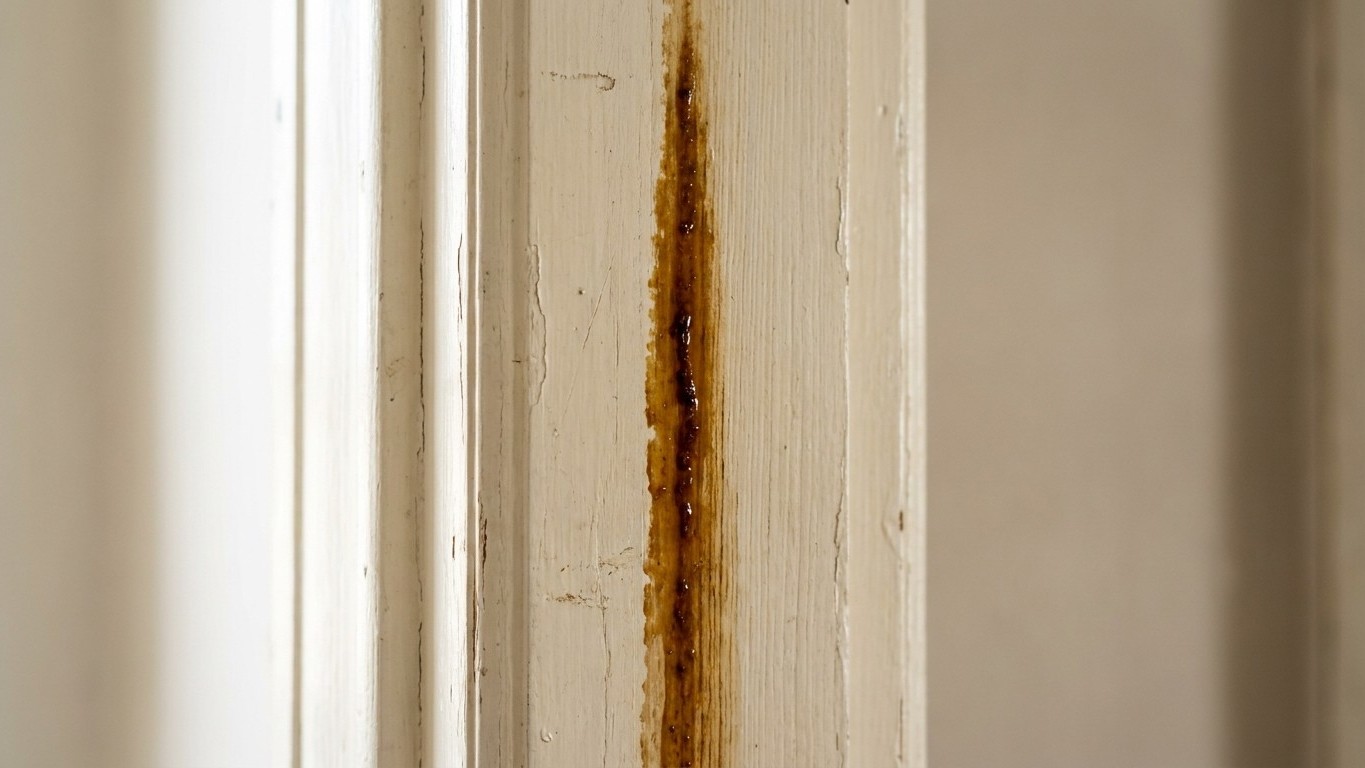
That amber-brown trail creeping down your door frame is dried aerosol residue, and it’s a classic case of good intentions gone slightly wrong. When the solvent in a spray lubricant evaporates, it doesn’t vanish cleanly. As the solvent evaporates, it leaves behind a slightly sticky residue that acts like a magnet for dust, lint, and pet hair. Given a fortnight and a bit of gravity, that residue simply migrates south, taking a faint stain with it.
I’ve heard this story more times than I can count over the years, usually from someone who reached for the nearest can under the sink at eleven o’clock at night, desperate to stop a door waking the whole household. It’s an entirely understandable reaction. The trouble is that most people don’t realise what these products are actually designed to do.
Key takeaways
- Aerosol lubricants aren’t true lubricants—they’re thin solvents designed to penetrate, not stay put
- That sticky residue becomes a dust magnet that migrates down your frame over two weeks, staining paint and varnish
- The same film harming your paintwork is also building up inside the hinge, making it grittier and more worn over time
Why the spray ran down the frame in the first place
Aerosol lubricants like WD-40 aren’t really lubricants at all in the traditional sense. They’re solvents and water displacers, formulated to be thin so they can creep into tight, rusted, seized-up spaces. WD-40 acts as a water displacer and solvent rather than a true lubricant, providing temporary squeak relief for 2-4 weeks before drying out hinge components. That thinness is precisely what makes it brilliant at penetrating a stubborn hinge pin, and precisely what makes it hopeless at staying put once you’ve sprayed it.
Every guide I’ve come across on this subject repeats the same advice, almost word for word, because the risk is so consistent. To avoid damage, you should always use the straw applicator for precision and wipe away any excess drips immediately with a clean cloth. Skip that step, as most of us do when we’re half-asleep and just want the squeaking to stop, and the excess has nowhere to go but downward, pooling in the gap between hinge leaf and frame before it finally gives in to gravity.
On top of that, older or previously varnished woodwork is particularly vulnerable. The petroleum-based ingredients in these sprays can leave stains on wood finishes or discolour paint, especially on older or more porous surfaces. If your door frame has had a few coats of gloss over the decades, or if the paint underneath was never quite fully cured, that’s exactly the sort of surface these solvents love to sink into.
The mark itself, and why it’s worse than it looks
Here’s the bit that surprises people: the streak isn’t just cosmetic laziness on the paint’s part. It’s chemistry doing exactly what it’s meant to do, just in the wrong place. Once that thin film settles into the grain of the paint or the fibres of an old varnish, cleaning it off isn’t as simple as a wipe with a damp cloth. Cleaning up these drips often requires solvents that can do further damage. You can end up trading one problem for a slightly worse one if you’re not careful with what you reach for next.
There’s a knock-on effect for the hinge itself too, which I think gets far less attention than it deserves. That same sticky film that stains your frame is also busy working against you inside the hinge barrel. This film acts like a magnet for dust, lint, and pet hair, and over time, this buildup forms an abrasive paste, which ironically accelerates wear on your hinges instead of reducing it. So the quick fix that silenced your door for a fortnight may well be sowing the seeds of a squeakier, grittier hinge down the line. It’s a bit like sweeping crumbs under the rug: satisfying for exactly as long as nobody lifts the rug.
What actually works, without the drama on your paintwork
The good news is that you don’t need anything fancy from a specialist shop to do this properly, and you certainly don’t need to give up on lubricating hinges altogether. You simply need something with more body than a thin aerosol, plus a bit of patience with a cloth.
White lithium grease is the option most tradespeople swear by for good reason. It’s a thick, durable lubricant that adheres well to metal surfaces, providing a lasting lubrication layer that fixes squeaking door hinges while resisting wear and tear. Because it’s a paste rather than a runny liquid, it simply doesn’t travel the way an aerosol does, so there’s no drip to worry about in the first place. A small dab worked into the hinge knuckle with an old cotton bud, rather than sprayed from a distance, keeps everything exactly where you put it.
If you’d rather not buy anything new, plumber’s grease is another sensible choice, and there’s a good chance you or a neighbour already has some. Plumber’s grease is very light weight as greases go and stable enough not to run off the hinge like 3-in-1 oil. Either way, the technique matters as much as the product. Slip a sheet of kitchen roll or an old tea towel behind the hinge before you apply anything, work the door back and forth a few times to distribute the lubricant properly, then wipe away every trace of excess straight away rather than leaving it to find its own way down your frame. Should you still reach for an aerosol can for a genuinely rusted or seized hinge, mask the surrounding paintwork with a bit of tape first. It takes thirty extra seconds and it’s the difference between a quiet door and a two-week mystery stain you’ll be scrubbing at come autumn.
Sources : residencesupply.com | oreateai.com