
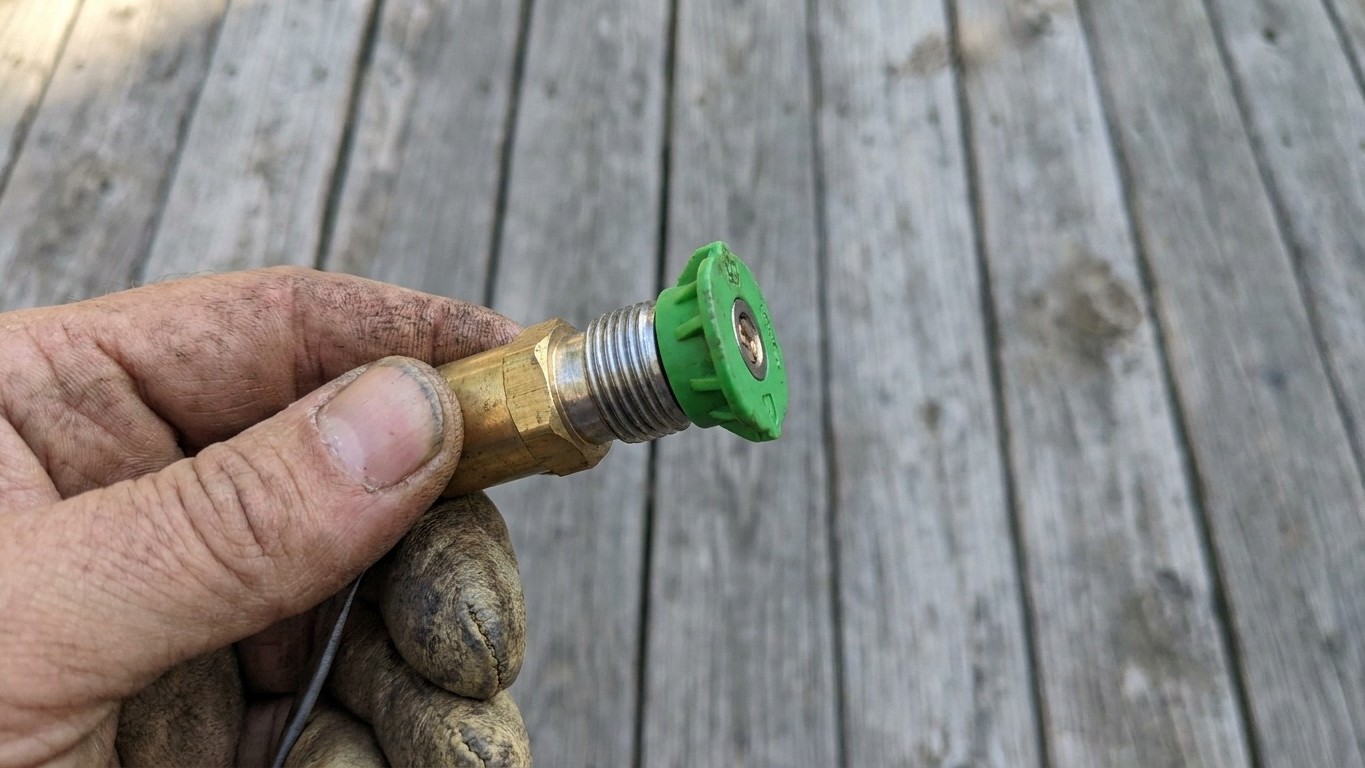
Turn any pressure washer up to full power on a tired, silver-grey pine deck and you can strip the wood raw in seconds, no matter how gently you think you’re being. The dial on the machine matters far less than most people assume. What actually decides whether your deck ends up beautifully clean or scarred with fuzzy, splintered stripes is the small plastic or brass tip clicked onto the end of the lance, the nozzle. Get that one detail wrong and even a modest domestic machine can gouge softwood; get it right and a fairly weak washer will do a lovely job.
Key takeaways
- The pressure gauge is a red herring—one wrong nozzle choice can destroy your deck even at modest PSI settings
- Color-coded nozzles control everything: find out why green beats red and yellow for weathered wood
- Distance and technique matter as much as the nozzle itself—discover the palm-test that prevents ‘tiger striping’
The tip does the work, not the pressure gauge
Pressure washer nozzles are colour-coded, and once you know the code you’ll never grab the wrong one again. The fan angle is often represented by a colour code: red at 0°, yellow at 15°, and green at 25° for general-purpose cleaning of vehicles, outdoor furniture, and decks. White nozzles widen things further still. Red is 0 degrees for pinpoint force, yellow is 15 degrees for heavy stripping, green is 25 degrees for general cleaning, and white is 40 degrees for delicate surfaces, while black is a low-pressure soap tip.
The physics is simple enough: a narrower fan angle produces a tighter, more concentrated stream, meaning higher effective pressure on the surface, while a wider fan angle spreads the water out more, making it gentler and better for covering large areas. So a machine set to a perfectly sensible 1500 PSI can still cut into your decking boards if you’ve left the red pinpoint tip on from the last time you blasted the patio slabs. That little swap is, quite genuinely, the whole story.
For grey, weathered pine, the red and yellow tips are best left in the toolbox entirely. A concentrated spray can quickly damage decking by gouging wood fibres or leaving visible marks on the surface. Several sources back this up almost word for word: avoid 15-degree and 0-degree tips on decking altogether. The green 25-degree tip is the one everyone reaches for eventually, and for good reason. Green nozzles are 25-degree nozzles, great for general cleaning applications, and decks are all easier to clean with this moderate-pressure, somewhat focused spray fan. If your deck is only mildly grubby, go wider still. For decks that only need light cleaning, a 40 degree (white) pressure washer nozzle is ideal.
Matching the tip to tired, weathered pine
Grey pine decking has usually lost its protective finish to years of British drizzle, which makes the surface fibres softer and more prone to fuzzing up under pressure. This is precisely where restraint pays off. Softwood decks require gentler handling during pressure washing due to their porous, easily damaged surfaces, so keep the pressure between 500 and 600 PSI and the nozzle at least 14 to 16 inches from the surface. Hardwood can shrug off a bit more punishment, but even then hardwoods should not exceed 1,200 to 1,500 PSI, and remain vulnerable to etching if sprayed too closely.
Distance matters almost as much as the nozzle choice, and it’s the free adjustment nobody thinks to make. Start by holding the tip about 18 inches away from the surface, then slowly move it closer until you find the sweet spot, because holding the nozzle just a few inches from the wood, even with lower PSI and a wider tip, can still cause damage. I always tell people: if you wouldn’t want the jet against your own palm from that distance, it’s too close for your decking too.
Technique counts for a lot here as well. Hold the nozzle at a slight angle rather than straight down, use slow side-to-side motions following the direction of the wood grain, and keep the wand moving at all times, since spraying too close or against the grain can cause “tiger striping” and permanent etching. That striping is the classic sign of an over-enthusiastic weekend job, those pale, streaky bands you sometimes spot on neighbours’ decking where someone lingered a second too long in one spot.
Soap first, blast second
The washing itself should really be the second step, not the first. A pre-treatment with a proper deck cleaner does most of the heavy lifting chemically, so the water jet only has to rinse rather than scrub. This initial rinse removes surface-level dirt and helps saturate the wood, allowing the cleaner to spread more evenly and penetrate better. Many washers come with a dedicated black soap nozzle for exactly this purpose, which sprays at low pressure so the detergent has time to sit and work rather than being blasted straight off again. Once the grime and green algae have had a chance to loosen, a gentle pass with the green or white tip finishes the job without any need to crank the machine up at all.
It’s worth remembering, too, that a nozzle wears out. Grit and mineral deposits in the water erode the tiny orifice over months of use, and a worn nozzle throws a wider, sloppier pattern than its colour suggests, quietly changing the pressure hitting your boards without you touching a single dial. If your green tip starts feeling suspiciously like the old yellow one used to, spraying narrower and harder than you remember, it’s probably time to replace it rather than blame your technique. At a few pounds a tip, it’s cheaper than a section of new decking, and considerably less bother than sanding out a set of stripes you never meant to put there.
Sources : housedigest.com | outdoortoolguide.com