
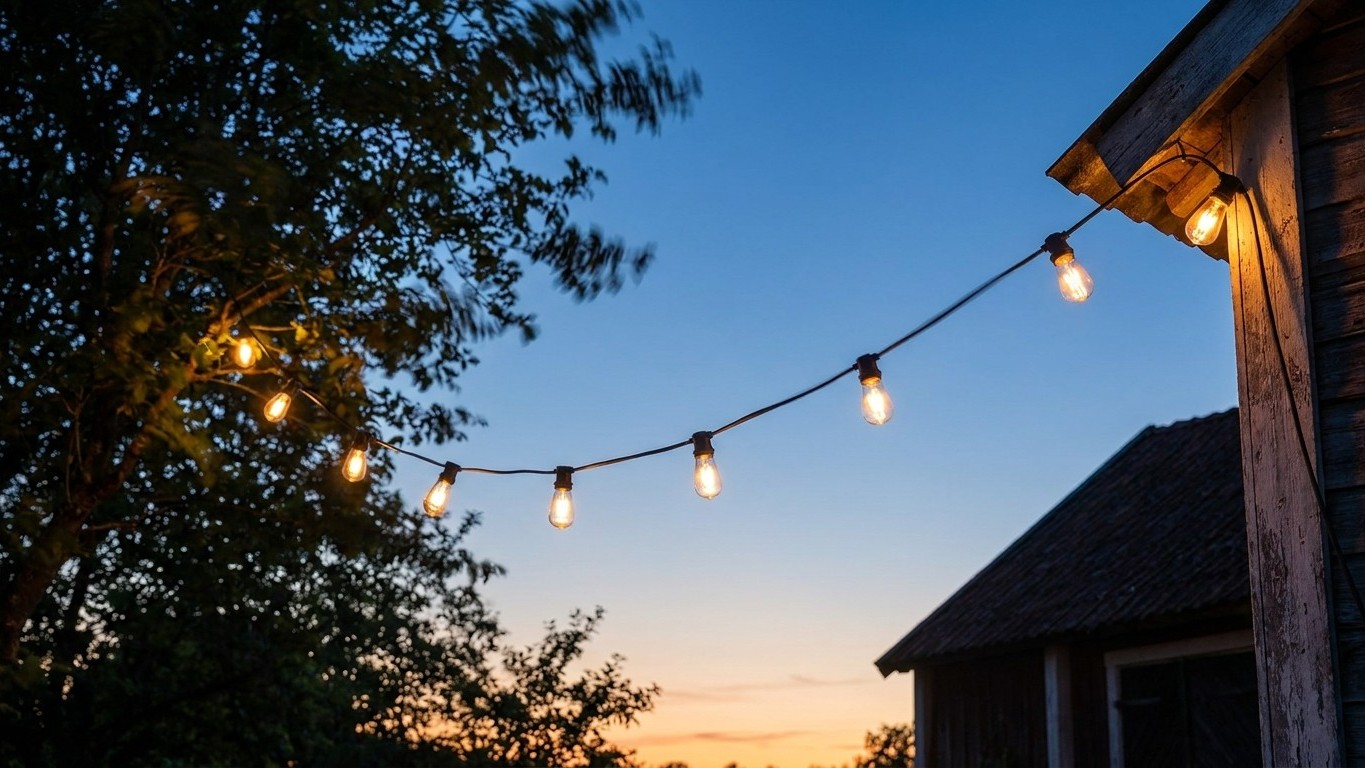
Straight lines look tidy on paper, but festoon lights have never read a ruler in their lives. String them taut from a house wall to a tree trunk and the first proper gust will show you exactly why: the cable stretches, sockets wrench sideways, and every bulb becomes a tiny pendulum fighting against a line that was never designed to be rigid. What those bulbs had really been hanging on, it turns out, was hope.
The trouble starts with basic physics rather than bad luck. A festoon cable strung dead straight has nowhere to go when it’s pushed by wind. The span between rigging points determines how much sag you get in the cable, and for runs longer than 8 to 10 metres, you’ll need either a support cable running above the festoon or intermediate support points. Without that give, every gust transfers its full force straight into the cable and the bulb holders, which is precisely how you end up with a broken fitting halfway through a dinner party. Professional riggers deliberately leave a slight sag, around a 1:50 ratio of sag to span, to account for thermal expansion and wind movement. That modest droop isn’t a design flaw. It’s the whole point.
Key takeaways
- A cable designed to carry electricity was never meant to bear its own weight when strung taut across open space
- Wind transfers maximum force into unsupported spans, but a deliberate sag and catenary wire change everything
- One windy evening exposes what every manufacturer’s manual warns about—and what most backyard installers ignore
Why the cable itself was never meant to take the strain
Here’s the bit most of us don’t think about when we’re unwinding a box of festoons for the first time: the wire inside those bulbs carries electricity, not weight. Catenary wire ensures the light cable is supported along its lit length when suspended, which avoids placing unnecessary stress on the cabling that can cause damage to festoon lights over time. Pull that same cable taut between two fixed points with nothing else supporting it, and you’re asking a power cord to do a steel cable’s job. It’ll manage for a while. Then a windy evening arrives, the tension spikes, and something gives, usually a connector or a socket, right at the moment you least want it to.
Even the manufacturers who sell heavy-duty commercial festoon systems build this warning into their instructions. For spans exceeding 5 to 8 metres, they highly recommend using a catenary or tension wire, which supports the weight of the heavy-duty rubber cable and protects the internal wiring from stress caused by wind or ice. If that’s the advice for professional-grade cabling, a domestic string strung house-to-tree with nothing underneath it is living dangerously by comparison. And if your span happens to be shorter, say under three or four metres, you might get away with it. But if festoon lights span more than 3 metres without support, or cross open space like between trees or buildings, a tensioned stainless steel cable will take the weight of the lights and prevent the cable from stretching, sagging, or snapping.
Getting the anchor points right, without ruining the tree
Trees make lovely, romantic anchor points, but they’re living things, not fence posts, and treating them badly costs you more than a wonky light display. Avoid using nails or screws in tree bark. A soft rope or bungee cord wrapped around the trunk spreads the load and won’t girdle the bark the way a taut wire or cable tie can over a season. If your span between the house and the tree is generous, don’t rely on those two points alone. For added security, anchor the mid-section with a third tree or pole. A third point breaks up that long, unforgiving straight line into two shorter, gentler curves, which is exactly what takes the sting out of a gust.
For the wire itself, skip anything metal if you can. The usual recommendation is to use PVC coated garden wire, since metal wire can become hot and melt the plastic on your festoon lights. It’s a cheap fix, a coil of coated garden wire costs very little at any hardware shop, and it does the structural job that your fairy-light cable was never built for. Clip the festoon cable to that wire every so often rather than letting it bear the whole span unsupported, and let the whole thing hang with a gentle, deliberate curve rather than a violin string.
A few finishing touches that save your evening (and your bulbs)
Once the support wire is doing the heavy lifting, there are still some small habits worth adopting. Check the rating on your bulbs before you commit to an outdoor run; for any outdoor event in the UK, festoon lighting needs to be rated to at least IP44, protected against splashing water from any direction, while fully exposed sites are safer with IP65. Britain’s weather doesn’t tend to give much notice before turning nasty, so this isn’t a detail worth skipping to save a few pounds.
Keep an eye on where the plug sits, too. Outdoor plugs will need to be covered within a waterproof box. It’s a small addition to your shopping list but it means one sudden shower doesn’t trip your whole circuit halfway through pudding. And resist the urge to pull everything drum-tight when you first put it up, thinking a taut line looks smarter. Drape the cable gently so each bulb hangs in a soft curve, which not only looks better but reduces stress on the sockets. A slightly relaxed swag, lit up at dusk, has always looked warmer than a ruler-straight line anyway. That’s the sort of wisdom your grandmother would have told you, if she’d ever tried to hang festoon lights in a British autumn.
One more thing worth remembering before you pack the ladder away: those little metal clips on top of each bulb holder aren’t decorative. For festoons which are unsupported, catenary wire used with the handy clips on top of each bulb ensures the whole length will be supported in bad weather. Use them properly and that string of lights will see you through several more windy evenings, table intact, pudding uninterrupted, without you ever needing to learn the same lesson twice.
Sources : support.festive-lights.com | lights4fun.co.uk