
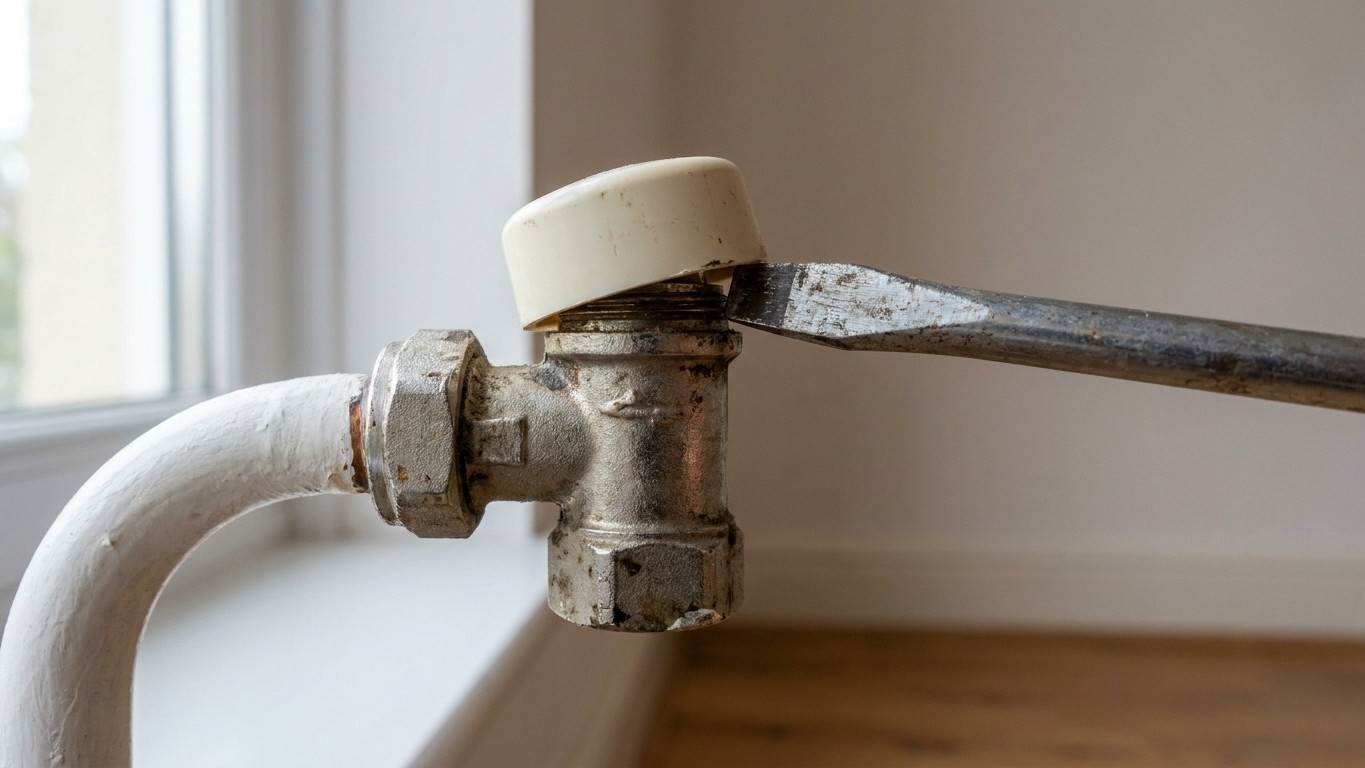
That radiator in the back bedroom hasn’t been “off” this whole time, it’s been starved. While you’ve been hunting for trapped air with a bleed key, the real culprit sits two rooms away: the lockshield valve on the radiator nearest your boiler, greedily hogging most of the hot water before it ever gets a chance to travel further down the pipe run.
Bleeding solves a different problem entirely. It releases air that’s risen to the top of a radiator, which typically shows up as a rad that’s warm at the bottom and stone cold at the top. But if an entire radiator refuses to heat up, or heats up painfully slowly compared to the ones near the front of the house, no amount of hissing and dripping from that little bleed valve will fix it. Air is lighter than water, so it rises to the top of the radiator, leading to a characteristic symptom: a radiator that’s hot at the bottom but cold at the top. A uniformly cold or sluggish radiator is telling you something completely different, namely that it isn’t getting its fair share of water flow at all.
Key takeaways
- Why bleeding radiators solves one problem while your back bedroom stays freezing despite your best efforts
- The hidden valve that’s been hoarding all your boiler’s hot water before it reaches the far end of your house
- A simple quarter-turn adjustment method that forces heat to travel fairly through your entire system
Why the radiator nearest the boiler wins every time
Hot water takes the path of least resistance, same as it always has. This problem is often due to the radiators’ distance from the boiler; those closer to the boiler tend to receive hot water first and heat up faster, leaving the ones farther away colder. Left unchecked, that first radiator on the circuit will happily gulp down most of the pump’s effort, leaving whatever trickles past to fight its way to the far end of the house.
This is precisely what the lockshield valve was designed to prevent. Every radiator has two valves: one you fiddle with daily (the thermostatic valve, or TRV, with its numbered dial), and one hidden under a plastic cap that you’re meant to leave well alone, day to day. The lockshield valve is sometimes considered as the ‘balancing valve’ because its job is to ensure each radiator in your home receives the right amount of hot water. Without that restriction on the radiators closest to the boiler, the ones further away simply never get a fair crack at the whip. Without it, the radiators closest to the boiler would heat up very quickly while those further away might struggle to get warm. By slightly restricting the flow through the radiators nearest the boiler, the lockshield valve allows hot water to circulate more evenly throughout the system.
I’ve heard this called “balancing” for decades, and it’s a lovely bit of plumbing logic once you see it: you’re not adding heat anywhere, you’re simply making the system share what it’s already got more fairly. When correctly adjusted, your heating will warm all rooms consistently, operate more efficiently to save energy and money and place less strain on your boiler and pump. Given how many households quietly overpay for heat that’s leaking out through an inefficient, unbalanced system, that’s not a small saving.
Finding that quarter-turn valve and using it properly
Before you touch anything, let the whole system cool right down completely, this only works from a cold start. Then go round every radiator in the house and open both valves fully, turning anticlockwise: open up all the valves in your house by turning them anti-clockwise. You may need your lockshield valve adjuster to open the lockshield valve, and a spanner to open any older style radiator valves if you’ve got older wheel-head types rather than modern TRVs.
Once everything’s wide open, fire the heating back up and simply watch and wait. After you’ve opened the valves up, whack the heating back on and make note of which order the radiators heat up in. Usually, you’ll find that the radiators closer to the boiler will heat up first. Jot down that running order on a scrap of paper, it’s the map you’ll work from.
Let everything cool again, then start with whichever radiator warmed up fastest, almost always the one nearest the boiler. This is where the quarter-turn comes in. Prise off the plastic cap on the lockshield valve (a flat screwdriver usually does it), and using a lockshield key or small spanner, close it fully, then reopen it by just a quarter turn. Turn the lockshield valve clockwise on this radiator until it is closed and then open it again by quarter of a turn. When the radiator is nicely warmed up, take a temperature reading at the pipework leading to one of the valves. With a cheap digital thermometer, compare the flow pipe temperature against the return pipe. Note that you may find yourself tweaking the lockshield valve back-and-forth a bit before getting the correct temperature difference (12°c) between the flow and return pipes. That 12°C gap is the sweet spot plumbers work to, it means the radiator is holding onto just enough heat before sending the water on its way.
Working your way to the back of the house
Move onto the next radiator on your list, repeating the same closed-then-quarter-turn process, then the next, working steadily through the house in the order you noted earlier. Each radiator you tighten slightly forces a little more flow down the line towards the ones that have been sitting cold for months. Once you’ve rebalanced every radiator in your home, hot water from your boiler will reach them at equal speed and your house should warm up at the same time. It’s fiddly, I won’t pretend otherwise, and you’ll likely nudge a valve back and forth a few times before it settles. But there’s something rather satisfying about watching a radiator that’s been stone cold for a whole winter finally start ticking and warming under your palm.
If you’ve been through this whole process carefully and that back-bedroom radiator is still cold, don’t keep tightening valves in frustration. Rebalancing radiators resolves most cold radiator issues, however, if rebalancing your radiators doesn’t fix the issue of cold radiators, there could be another underlying problem. Sludge build-up, a failed pump, or a stuck TRV pin can all mimic a balancing problem, and at that point it really is worth getting a heating engineer to have a look rather than spending another weekend with a spanner in hand.
Sources : 247homerescue.co.uk | geyser.co.uk