
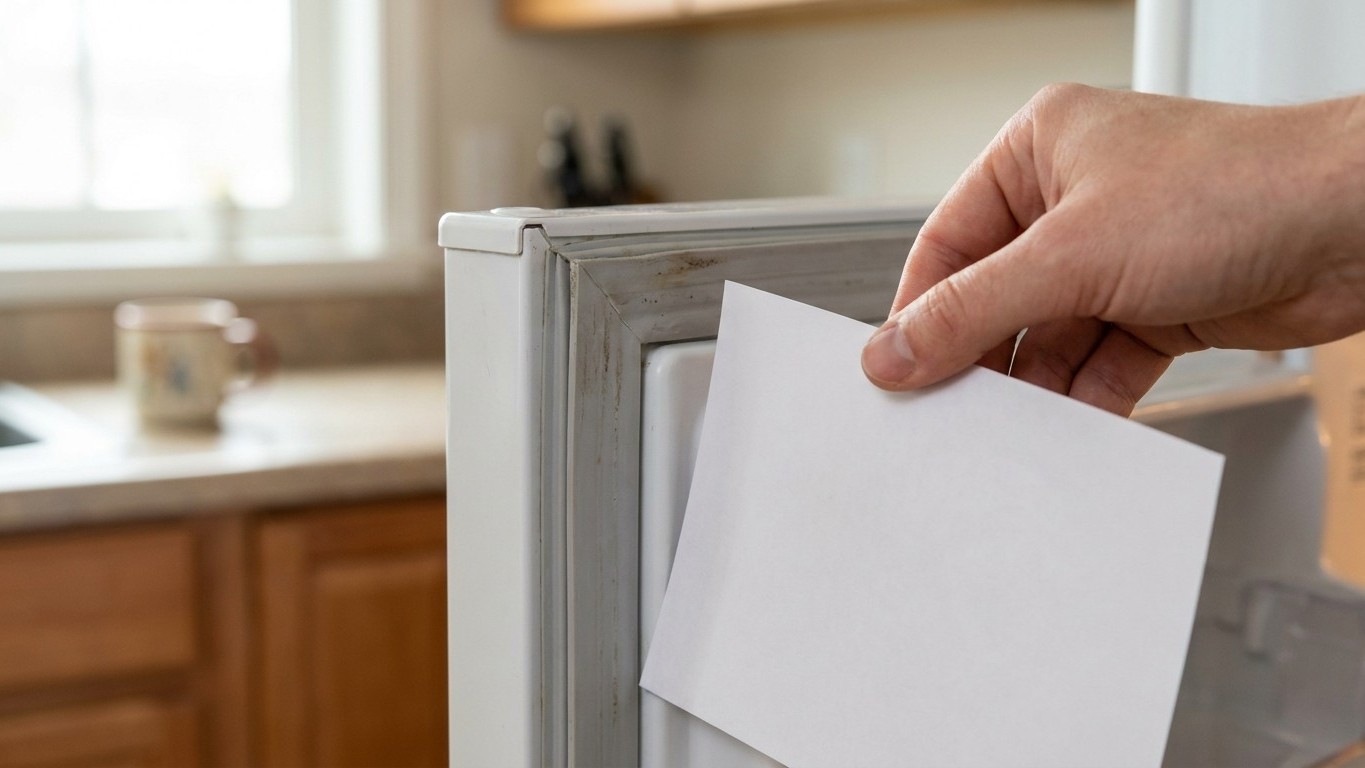
Your fridge motor humming away morning, noon and night isn’t just an annoying background noise. It’s the sound of money leaking out through a strip of rubber you’ve probably never given a second glance. When a repairman finally came round to mine last winter, he didn’t reach for a screwdriver first. He pulled a sheet of ordinary paper from his bag, shut it in the door, and asked me to tug it free. It slid out with barely any resistance at all. That’s when he explained why my fridge had been running almost non-stop for months, and why my electricity bill had crept up without me really noticing.
Key takeaways
- A tiny rubber strip around your fridge door could be silently draining your electricity bill by hundreds of pounds a year
- One repairman’s simple paper trick takes 60 seconds but exposes a problem most homeowners never spot until it’s too late
- The fix might be cheaper than you’d expect—but the cost of ignoring it keeps climbing every single day
What that slip of paper actually reveals
The trick is older than most of us, but it still works because the physics hasn’t changed. You take a piece of paper and place it inside the door, with half hanging out the top or side, then tug, to see if it stays firmly in place, indicating no issue. If it slips out with barely any tug at all, you’ve got a problem. My repairman ran the test in four or five spots around the door frame rather than just once, because a seal can be perfectly fine at the hinge and completely knackered near the handle where hands and elbows knock it every day.
The rubbery strip running around your fridge door is called the gasket, and its whole purpose is straightforward. That airtight seal is critical to keep cold air from escaping and to keep warm air from entering the fridge. When it’s compromised, even by a few millimetres, the compressor never gets the rest it’s designed for. A fridge or freezer with a faulty seal will trigger the compressor to run in order to combat the compounding effect of the cool air that escapes from the unit and the warm air that leaks in. That’s exactly what had been happening in my kitchen. The motor wasn’t broken. It was simply fighting a losing battle against a door that couldn’t quite hold its breath.
Why a tired seal costs more than you’d guess
I assumed a slightly loose gasket would make a marginal difference, the sort of thing you’d never actually see on a bill. I was wrong, and the figures surprised me. Replacing a worn seal can cut energy waste by 15 to 25 per cent per unit, which for a fridge that’s already running around the clock is not a small saving. Commercial refrigeration research puts it in even starker terms: heat leakage through gasket areas may account for up to 21 per cent of the total thermal load in some units, meaning that rubber strip is doing far more heavy lifting than its size suggests.
Home tariffs make the sums easy to picture. The cost depends heavily on the model’s efficiency and size, but based on standard UK tariffs of roughly 30p to 34p per kWh, a high-efficiency A-rated fridge might cost only around 10p per day, or £37.85 per year, to run properly. Shave even a fifth off that with a worn seal, then multiply it across every day the fault goes unnoticed, and you begin to understand why the compressor sounded so tired. One supplier’s own controlled comparison found a fridge with a damaged door seal used noticeably more electricity than an identical unit with an intact one over the same 24 hour period, confirming what most engineers already suspected: a fully working and intact door seal used 0.498kW over 24 hours, whereas a damaged seal pushed that to 0.587kW. That’s not a dramatic jump on paper, but stretched across a year, and across every fridge in Britain with a tired gasket, it adds up to a genuinely wasteful national habit.
Spotting trouble before it costs you
You don’t need a repairman’s toolkit to catch this early. Before assuming the worst, check the obvious culprits first. Sometimes the problem isn’t the gasket itself but spills and residue accumulated on it, and when food becomes stuck to the door seal it can create an unbalance when it closes. A build-up of jam, crumbs or old spills in the folds of the gasket is often the real villain, not old age. Give it a proper clean before you condemn it to the bin.
- Wipe the gasket with warm water and a splash of washing-up liquid, working into every fold
- Dry it completely, since dampness alone can stop a seal gripping properly
- Run the paper test again in several spots, top, bottom and both sides
If the paper still slides free after a good clean, that’s your answer. A weak seal doesn’t mean a broken one; the flexible gasket is pleated like a little accordion, and those pleats can get dirty and clogged, so cleaning them with a simple vinegar and water solution or dish soap is worth trying first. Only once cleaning has failed should you think about a replacement gasket, which is usually a cheap and fairly simple job for most standard fridge models, rather than a call-out for a whole new appliance.
What I’ve done differently since
My own gasket, it turned out, had a hairline split near the bottom hinge, invisible unless you ran a finger along it slowly. A new one cost far less than a single month of the electricity it had been wasting. Since then I’ve made the paper test part of my spring clean, tucked in right after I empty the salad drawer and wipe down the shelves. It takes two minutes and needs nothing more exotic than a sheet from the recycling pile. Given how quietly a worn seal drains both your food’s freshness and your bank balance, that’s a remarkably cheap bit of peace of mind for something we all rely on every single day.
Sources : reviewgk.com | tastingtable.com