
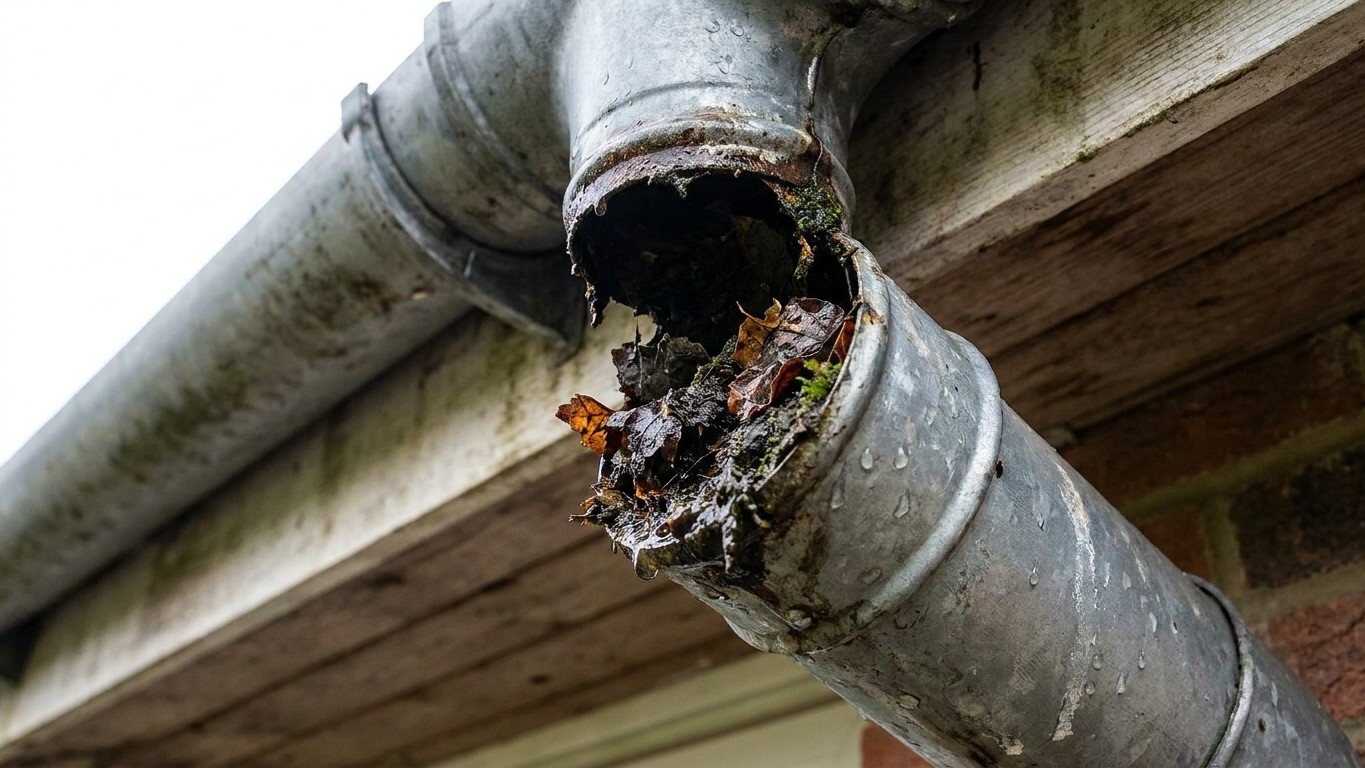
That bend tucked under the downpipe outlet, the little offset piece that nudges the pipe round a windowsill or brings it in against the wall, is doing more damage-control work than the entire length of guttering above it. Bends, offsets, and lower discharge points can trap this material and allow silt to build around it. You can spend a Saturday morning scooping leaf mulch out of every metre of guttering on the house, feel rather pleased with yourself, and still end up with a rotten soffit board by February. The bend is where the real drama happens, quietly, out of sight, usually below the point where anyone thinks to look.
Key takeaways
- The bend under your downpipe traps debris that gutters never will, and you probably haven’t cleaned it in years
- Water overflowing in one specific location isn’t a gutter problem—it’s a sign your bend is silently destroying the wood behind it
- A five-minute clearing job now could save you from replacing your entire fascia board in two seasons
Why This Particular Bend Causes All the Trouble
Water moving through a straight run of gutter behaves itself. It’s the change of direction that catches everything out. The most common causes are compacted leaf sludge, moss fragments, roof grit, and debris collecting at bends or shoe outlets. Every autumn’s worth of pine needles, mortar fragments washed off ageing roof tiles, and moss shed from north-facing slopes gets carried along by the flow until it reaches that kink in the pipe, where the water slows just enough to drop its load. Over a season or two, that becomes a plug rather than a pinch point.
The clever bit, and the bit that catches people out, is that a common sign is uneven behavior across the property: one run repeatedly overflows while another remains clear, often indicating a single restricted discharge path rather than a whole-system blockage. You clear the gutter, the overflow seems to stop for a fortnight, then it’s back the next time it rains hard. That’s the bend telling you it needs attention on its own terms, not a general once-over with a trowel.
There’s a genuine reason to take this seriously beyond tidiness. A blocked downpipe can cause damp in your home, because when water is unable to properly drain away from your roof and gutters due to a blockage, it can overflow and seep into the walls, leading to dampness and potential mould growth. And the timber sitting directly behind and beneath that overflow point, your fascia and soffit boards, takes the brunt of it season after season.
Spotting the Signs Before the Timber Gives Up
Listen during a downpour, oddly enough. You can hear gurgling or surging during rainfall as water struggles through compacted debris inside a bend long before you ever see a drip. Go outside once the rain’s easing and look for the telltale patch: concentrated overflow from one corner, dripping at a joint below the outlet, or water pooling around the pipe base. That’s your bend, not your gutter run, asking for help.
Where the water actually falls Matters More Than how much of it there is. Water spilling over the front edge commonly points to a blockage, inadequate fall or insufficient capacity, while water running behind the gutter may indicate a roof-edge issue, poor gutter positioning or damaged fascia. Front spillage from a blocked bend is annoying but recoverable. Water running down behind the gutter and onto the soffit is the version that rots timber, because that board was never designed to be rained on directly, only to sit dry beneath a gutter doing its job properly.
Left long enough, the fascia itself starts to soften, and once that happens the whole system is compromised, since if the fascia board itself is rotten, it will need replacing before the gutter can be properly supported again. What started as a five-minute job with a stick and a bucket turns into a carpentry project.
Clearing It Properly, Without Making a Mess of Your Wednesday Afternoon
Poking a hosepipe down from the top rarely shifts a properly compacted bend. The debris has usually silted around itself and set almost like clay. The tradesperson’s approach, and it’s not glamorous but it works, is to take the bend off entirely. Take out any downpipe bends at the top and bottom specifically and clear them, which will ensure the drain is fully unclogged. On a plastic system this usually means unclipping the pipe brackets and easing the fitting free; on older cast iron, it’s a heavier job involving the wall ties and the bolted joint, which is exactly why so many homeowners leave cast iron bends alone until they genuinely have to deal with them.
Do brace yourself, though. Anyone who’s actually done this will tell you the same thing: once that plug of leaf sludge finally gives way, there will be a sudden and surprisingly big outburst of water and “stuff”, usually straight down your sleeve if you’re not paying attention. A bucket underneath and an old coat are not optional extras.
While the bend is off, have a proper look at the fascia and soffit behind it. If the timber flexes under a thumbnail or feels spongy, that’s your early warning, and it’s far cheaper to treat now than to replace later. The fascia and soffit boards behind the gutter are also vulnerable to rot if they stay wet, so a coat of appropriate wood preservative on sound timber, applied while everything’s dry and accessible, is money well spent for the price of a tin of paint.
A Sensible Rhythm, Not a Once-a-Year Panic
The trade recommendation is worth taking on board rather than treating as marketing spin. At least twice a year, once in late spring after tree blossom and once in late autumn after leaf fall, is the pattern most gutter specialists work to, and it makes sense given how Differently spring and autumn debris behaves. Blossom and seed pods clog differently to sodden autumn leaves, and both eventually make their way to the same bend if nobody intervenes.
One detail that surprised me when I first heard it: a downpipe run longer than roughly ten to twelve metres often copes far better with two outlets rather than one, because a central high point so the gutter falls in both directions also halves the flow rate each outlet needs to handle. If you’ve got a bend that blocks every single year despite your best efforts, it might not be a cleaning problem at all, it might simply be one outlet doing the work of two, and no amount of autumn diligence will fix that on its own.
Sources : mhcgutters.com | bedfordwindowcleaning.co.uk