
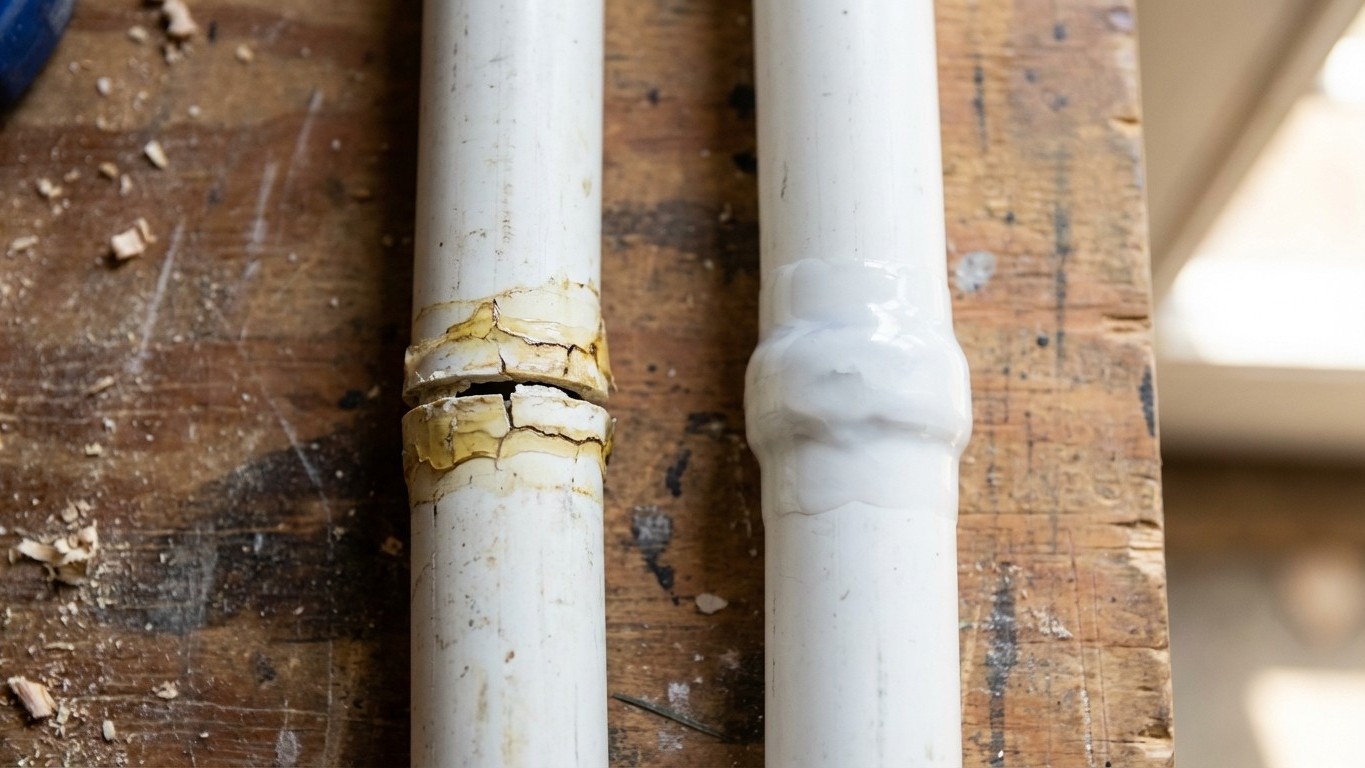
Wood glue on PVC pipe joints will not hold. Not for a day, not for a week, and if you’ve already used it, the failure may be happening right now, invisibly, before any visible drip or leak gives you warning. This isn’t a minor technicality. The chemistry of wood adhesive and PVC plastic are so fundamentally mismatched that no amount of pressure, clamping time, or optimism will compensate for the wrong product.
Key takeaways
- A common DIY mistake is silently destroying plumbing joints inside your walls right now
- The failure happens invisibly at first—water pressure opens micro-gaps that saturate wood and drywall
- There’s only one correct way to bond PVC, and it involves chemistry, not clamping pressure
Why wood glue and PVC are simply incompatible
Wood glue, whether PVA (polyvinyl acetate) or a similar formulation, works by penetrating the fibres of a porous material and bonding as it dries. Wood, card, fabric, all of these have microscopic structures that grip the adhesive as it cures. PVC (polyvinyl chloride) pipe has no such porosity. Its surface is smooth, dense, and chemically unreceptive to the adhesive compounds in standard wood glue. The glue sits on top of the pipe, never actually bonding to it. What looks like a solid joint is, in reality, a thin film of dried adhesive that will crack and separate under any meaningful water pressure.
There’s a useful analogy here: trying to stick two glass marbles together with wood glue. You could press them firmly for hours, leave them overnight, even sit something heavy on top. The moment any lateral force is applied, they slide apart. PVC behaves the same way. The surface tension of dried PVA simply cannot grip a non-porous plastic surface.
The reason this matters so urgently is that the failure mode is rarely immediate. A joint bonded with wood glue might hold under zero pressure, say, a cold water pipe with the mains turned off. The moment water flows through and pressure builds, micro-gaps open. Water finds those gaps. And because PVC pipe is often run behind walls, beneath floorboards, or under kitchen units, the leak can saturate timber joists and plasterboard for weeks before anyone notices the damp patch on a ceiling below.
What actually bonds PVC pipe correctly
The right product for joining PVC pipes is solvent cement, sometimes called PVC solvent weld adhesive. This works on an entirely different principle from mechanical adhesion. The solvent in the cement chemically softens both pipe surfaces, so when the pipe and fitting are pushed together, the two pieces of plastic fuse at a molecular level. Once cured, there is no joint in the traditional sense, just one continuous piece of plastic. That’s why, done properly, a solvent-welded PVC joint is actually stronger than the pipe itself.
Application matters as much as the product. The surfaces must be clean, dry, and free of grease. Many plumbers use a dedicated PVC primer or cleaner first, which degreases and slightly etches the surface to improve the solvent’s penetration. The cement is then applied to both the pipe end and the inside of the fitting socket, the pipe is inserted with a slight twisting motion to distribute the adhesive, and the joint is held still for around 30 seconds while the initial bond forms. Full cure time before the pipe carries water is typically 24 hours, though some faster-setting formulations cut that to around two hours in warm, dry conditions.
For anyone doing a quick repair or working in a location where solvent cement is awkward to use, push-fit fittings designed for PVC are a reliable alternative. These use rubber O-ring seals and a mechanical grip to create a watertight connection without any adhesive at all. They cost more per fitting than solvent-weld joints, but they’re demountable and genuinely forgiving for the home DIY-er working in tight spaces.
Checking and repairing joints you’re not sure about
If there’s any chance that wood glue was used on a PVC joint in your home, the honest advice is: don’t wait for a leak. Turn off the water supply to that section of pipe and inspect the joint carefully. Wood glue, when dried on PVC, often has a slightly yellow or cream colour and a matte, slightly rough texture, quite different from the faint sheen of properly cured solvent cement. You may also be able to feel a ridge or see the dried adhesive sitting on the surface of the pipe rather than flush with it.
Repairing an incorrectly bonded joint means cutting out the affected section entirely. Trying to clean back a wood-glued joint and re-bond it with solvent cement is rarely successful, because the dried PVA residue interferes with the solvent’s ability to reach and soften the plastic. A clean pipe cut, a new short length of pipe, and two solvent-weld couplings is the correct approach. It takes perhaps an hour, costs very little in materials, and gives you a genuinely permanent repair.
One thing worth knowing: not all plastics called “PVC” behave identically. CPVC (chlorinated PVC), which is used for hot water lines, requires its own specific solvent cement, standard PVC cement won’t create a reliable bond on CPVC pipe. The two types of pipe are usually colour-coded in plumbing supplies, with CPVC typically cream or off-white and standard cold-water PVC in grey, but always check the pipe markings rather than relying solely on colour. Using the wrong solvent cement on CPVC can result in a joint that appears solid but degrades over months as hot water passes through it — a slower failure, but no less damaging when it eventually lets go.