
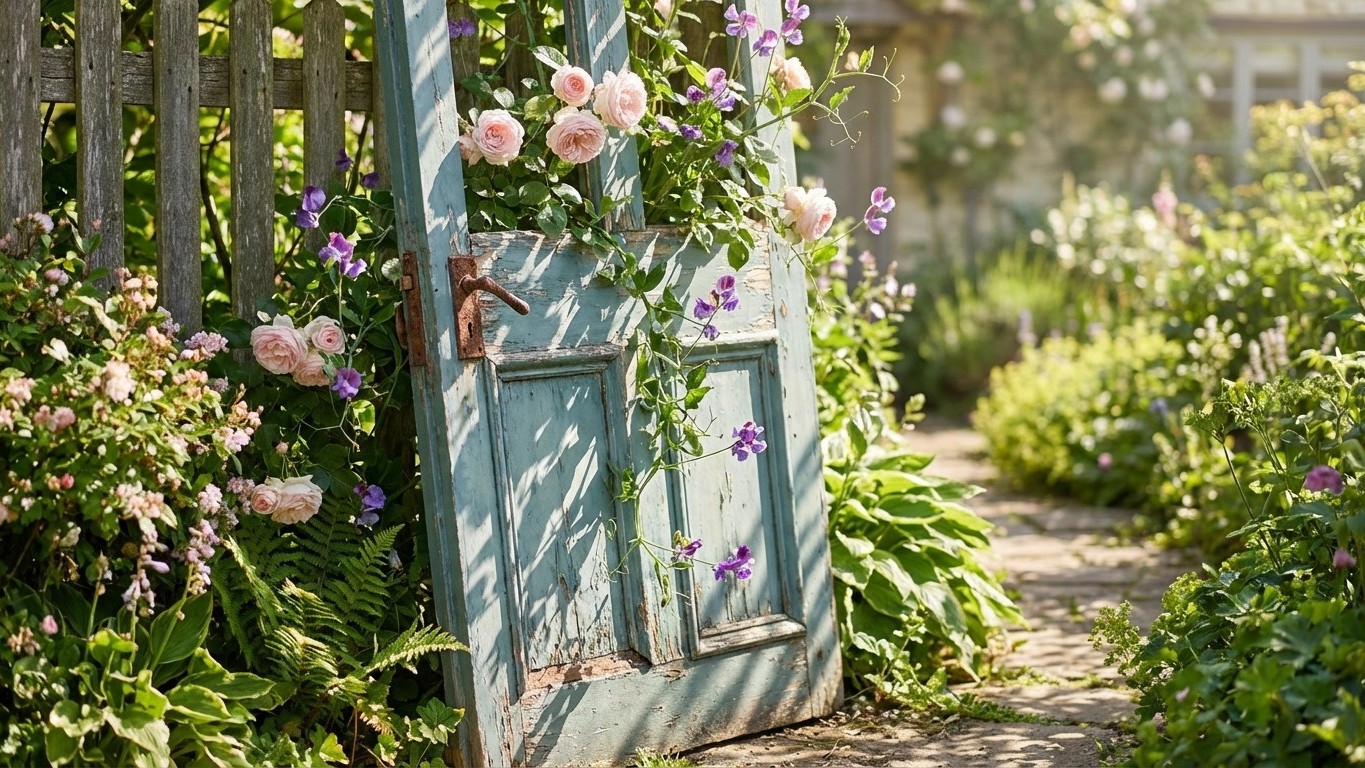
You’ve no doubt got at least one leaning against a shed wall, gathering cobwebs. That old door from the back bedroom, or the glazed panel you stripped out during last year’s renovation, the one you couldn’t quite bring yourself to send to the skip. Well, it turns out your instincts were spot on. Up and down the country, homeowners are dragging those Forgotten doors into the garden and turning them into something quite extraordinary. Professional landscapers, who’ve spent years sourcing expensive bespoke features, are quietly raising their eyebrows — not in disapproval, but in genuine admiration.
Key takeaways
- Professional landscapers are raising their eyebrows at what homeowners are creating with reclaimed doors
- One gardener won a prestigious national award by building an entire shed entirely from recycled doors
- Simple techniques turn vintage doors into trellis systems, vertical planters, and privacy screens that cost almost nothing
Why an Old Door is a Landscaper’s Secret Weapon
Old doors often carry a particular kind of vintage charm not found in modern-day prefab products. Usually made of solid wood rather than the hollow-core doors of recent decades, they can feature carvings, millwork, and other details that make them far too lovely to throw away. This is precisely what professional landscapers have long known and what the rest of us are only now cottoning on to: character cannot be manufactured cheaply, but it can absolutely be salvaged for free.
Using reclaimed wood for fencing and garden furniture adds character. Also, supports sustainability, something that feels less like a trend and more like common sense in 2026. Sustainability is set to mark one of the biggest garden trends of 2026, with more and more gardeners adapting the way they garden in favour of eco-friendly practices and using upcycled and sustainable materials wherever they can. An old door, then, is not a problem to be solved. It is raw material.
Where do you find them, if you haven’t got one lurking already? People give away free doors regularly on Facebook Marketplace when renovating their homes. The glazed ones were particularly popular during the 1980s in the UK, and people can’t wait to get rid of them. One woman’s decluttering is another gardener’s treasure.
The Trellis Trick That’s Stealing the Show
One of the best uses for an old door outside is repurposing it as a trellis for your plants to climb. This is the idea that truly stops professional landscapers in their tracks, not because it’s complicated, but because it works so brilliantly and costs virtually nothing.
This very functional role is compounded by the vintage and rustic style these old doors visually add to your outdoor space. The trick is matching the right door to the right climber. French doors work beautifully: remove all or some of the glass plates to allow plants to climb through. A louvered closet door works similarly, simply train the vines or plants to climb between the rungs of the shutters. For a solid wooden door Without panels, the fix is equally simple: add chicken wire or small cup hooks to guide the plants along the wood.
Adding trellises to your garden increases visual appeal, improves plant health, enhances air circulation to prevent diseases, maximises sun exposure, makes pruning and harvesting easier, and allows you to grow more in a smaller area by utilising vertical space. Sweet peas scrambling up a peeling blue panelled door. A clematis threading through the glass void of a 1970s kitchen door. Rose canes pinned to a solid Victorian front door propped against a sunny fence. These combinations feel effortless, and they genuinely are.
From Vertical Planters to Privacy Screens
The trellis idea is just the beginning. Turn an old door into a vertical planter by attaching pots or shelves, adding greenery to patios and gardens while saving valuable ground space. This suits compact British gardens beautifully, the sort where every square foot is precious and where a standard freestanding planter would feel clunky and take up too much room.
If you are trying to channel a shabby-chic look outdoors, create a vertical plant stand from an old wooden door. The simplest approach is to screw or nail small shelves to the door and secure plant pots to them using metal brackets. If the door has a window frame, remove the glass and suspend hanging plants from the grilles. Finish the door with a weatherproof, non-toxic paint to match your garden’s colour scheme.
Privacy screens are another application where old doors shine. Old doors can be turned into charming privacy screens: find some vintage doors at a salvage yard, paint them pastel colours, and hinge them together. They add enormous character to a garden while providing solid coverage from next door. Compare that to the cost of buying purpose-built garden screens, and the appeal becomes rather obvious.
Repurposing an old door into a rustic garden gate with minimal hardware creates a charming and welcoming entrance to any backyard or flower garden. A coat of exterior paint, a simple latch from the ironmonger, and you have a feature that would cost a small fortune if you commissioned it from a garden designer.
The Award-Winning Shed Made Entirely of Doors
Now, for the idea that left even the most experienced landscapers genuinely speechless. In one of the most impressive examples of upcycling seen in recent memory, one gardener created an entire garden shed out of recycled doors sourced from Facebook Marketplace. The result was not cobbled together and apologetic. She won the 2022 Shed of the Year award, presented by garden company Cuprinol, beating out 260 other entries, and it was the first time in the award’s 16-year history that a shed in the “budget” category took the top prize.
The idea of upcycling old doors to create a charming little potting shed has since appeared in dedicated project books, with full step-by-step guidance for those who want to try it themselves. And the inspiration rippled outward: the work inspired fellow gardeners, many of whom shared their plans to get started, saving perfectly good building materials from ending up in landfills.
A word of caution before you crack on with Sanding anything down. When working with old doors, check for lead paint, which tends to peel in an “alligator”-like pattern. Never scrape off or sand old lead paint, only paint over it. Pick up an inexpensive lead paint test kit at your hardware store, and if you are unsure of the type of paint, keep old painted items away from children. Pre-1970s doors deserve particular attention on this front. A five-minute check is far better than an afternoon’s regret.
There is something rather fitting about the fact that the humble objects we spent decades upgrading and discarding, those solid, panelled doors of Victorian terraces and 1980s semis — are now the very things that give a garden its soul. Many old doors have unique craftsmanship worth preserving. By repurposing them, homeowners embrace sustainability and style while keeping a piece of history alive. The next time you pass a skip piled with builders’ rubble, it might be worth slowing down for a closer look. Your garden’s next centrepiece could be leaning right there against the kerb.