
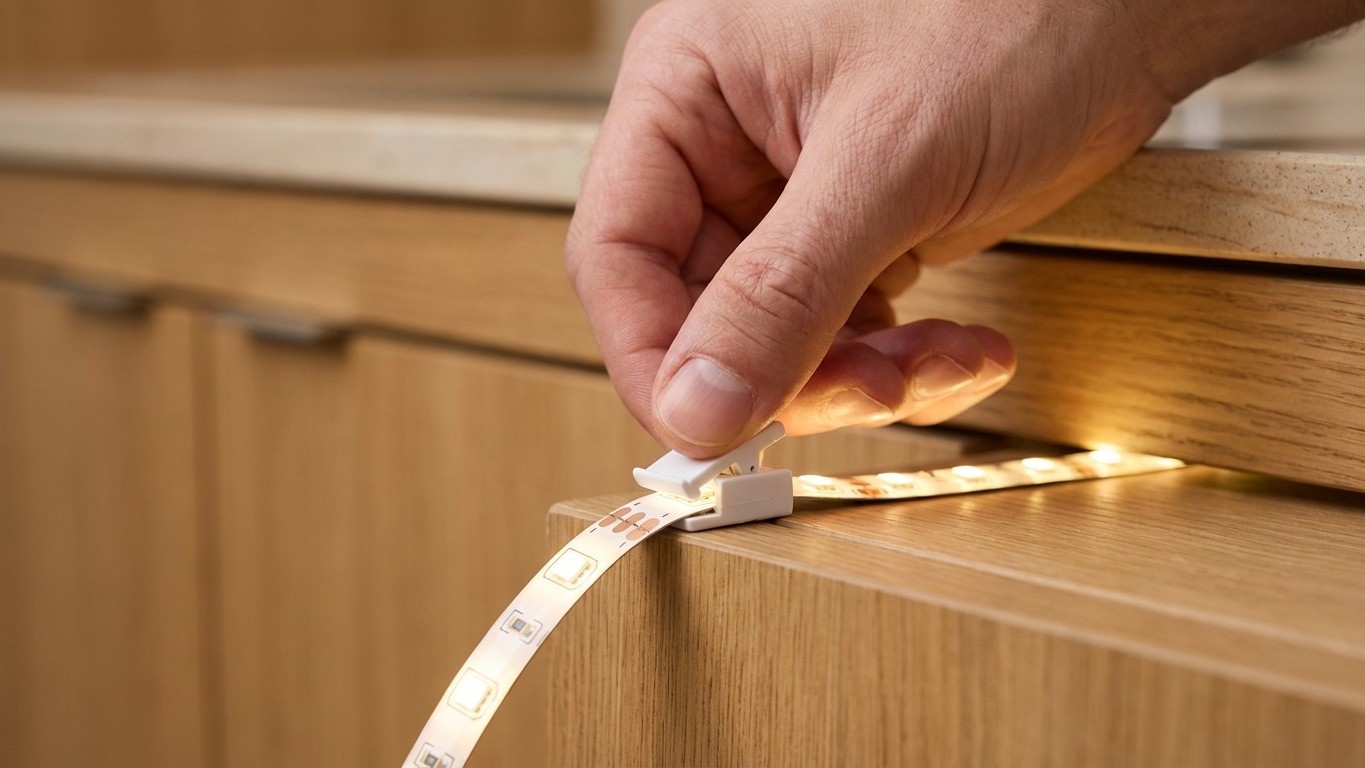
That strip of LED lights cost me nine pounds from the hardware shop. The electrician who came to sort out my kitchen lighting charged me a hundred and eighty. I watched him work for forty Minutes, mostly fiddling with a connector clip I’d been too nervous to touch myself, and I thought: I could have done that. I absolutely could have done that. And so, with a mixture of embarrassment and determination, I set about learning exactly what I’d missed, so you don’t have to make the same expensive mistake.
Let me be clear from the start: there is real electrical work that must be done by a qualified professional. Anything involving your consumer unit (what used to be called the fuse box), any work behind walls, rewiring sockets or fitting new circuits, that is firmly in the hands of a registered electrician, and I would never suggest otherwise. But low-voltage LED strip lighting, the kind sold in rolls at every DIY shop and online marketplace, operates on 12V or 24V DC power after passing through a small transformer called a driver. That voltage is no more dangerous than a torch battery. The real work, the bit most of us pay through the nose for, is simply making the connections neatly and safely.
Key takeaways
- A £180 electrician visit turned out to involve a skill anyone can learn in minutes
- UK building regulations clearly define which electrical work requires professionals—and which doesn’t
- Low-voltage LED strip lighting, dimmer switches, and light fitting replacements are manageable DIY projects for most homeowners
What LED strip lighting actually involves
A typical LED strip kit comes with the roll of lights, a driver (the transformer that steps mains voltage down to something safe), and often a connector or two. The strip itself has copper contact points at intervals, usually every few centimetres, marked with a small scissor symbol to show where you can cut it. The driver plugs into a standard 13-amp socket, or it can be hardwired into a switched fused spur, but if you’re going the hardwired route, that last step is where you’d ask an electrician. The strip-to-driver connection, though? Entirely manageable.
The connectors are the key. Solderless clip connectors, sometimes called hippo clips or snap connectors, slot directly onto the copper pads of the strip. You align the strip so the positive and negative pads match the marked terminals on the clip, press the little lever down, and that’s genuinely it. No soldering iron, no specialist tools, no qualifications required. I have seen my neighbour’s twelve-year-old do this in about four minutes. The result is a reliable, firm connection that powers the lights perfectly well.
The jobs you can safely do yourself
Installing LED strip lighting under kitchen cabinets is probably the most common domestic application, and it transforms a kitchen for very little outlay. You clean the surface, peel the adhesive backing, press the strip firmly into place, clip the connector, plug in the driver, and switch on. The whole job, done at a sensible pace with a cup of tea halfway through, takes perhaps an hour for an average kitchen run.
Replacing a like-for-like light fitting is another task many people pay for unnecessarily. If a pendant light or a ceiling rose fitting needs replacing with something of the same type (not adding a new circuit, just swapping one fitting for another at an existing connection), the wiring is straightforward: you’re dealing with a live wire (brown), a neutral (blue), and an earth (green and yellow). The connections are made into screw terminals clearly labelled inside the fitting. Switch the circuit off at the consumer unit, use a voltage tester pen (available for a few pounds) to confirm there’s no current, and work calmly. The tester pen is the bit I wish someone had told me about years ago, it takes all the anxiety out of the job.
Fitting a dimmer switch in place of an existing standard switch is similarly achievable, provided the dimmer is compatible with your LED bulbs (check the packaging, as not all dimmers work with all LEDs). The wiring configuration is printed in the dimmer’s instructions, and since you’re replacing like-for-like at an existing switch point, no new wiring is required. Again: consumer unit off, tester pen to confirm, proceed with confidence.
Knowing where the line is
The genuine boundary in home electrical work isn’t about danger in any vague sense, it’s about what UK building regulations define as “notifiable work.” Any new circuit, any work near a bathroom (within the specified zones), and anything involving the consumer unit must either be done by a registered electrician or self-certified under Part P of the Building Regulations. This isn’t bureaucratic fussiness; it’s genuinely about safety, and more practically, about your home insurance remaining valid and your house being sellable one day.
But the great number of small jobs that don’t fall into those categories? They sit in perfectly legal, perfectly manageable territory. A voltage tester pen, a small set of screwdrivers, a roll of electrical tape, and the willingness to read the instructions carefully will take you a surprisingly long way. The tools themselves cost less than twenty pounds altogether. Spread across even two or three jobs that would otherwise cost you a call-out fee each time, the saving is immediate.
My kitchen lights look lovely, by the way. I did the bathroom ones myself three months later, same strip, same connectors, same method. Forty-five minutes, including the time I spent reading the back of the packet twice to be sure. The honest truth is that a great deal of what we consider “electrical work” is really just patient, careful assembly. The electrician wasn’t doing anything magic in my kitchen. He was simply doing something I hadn’t yet given myself permission to try. Perhaps the more useful question isn’t what jobs cost to have done, but which ones we’ve been quietly talked out of attempting ourselves.