
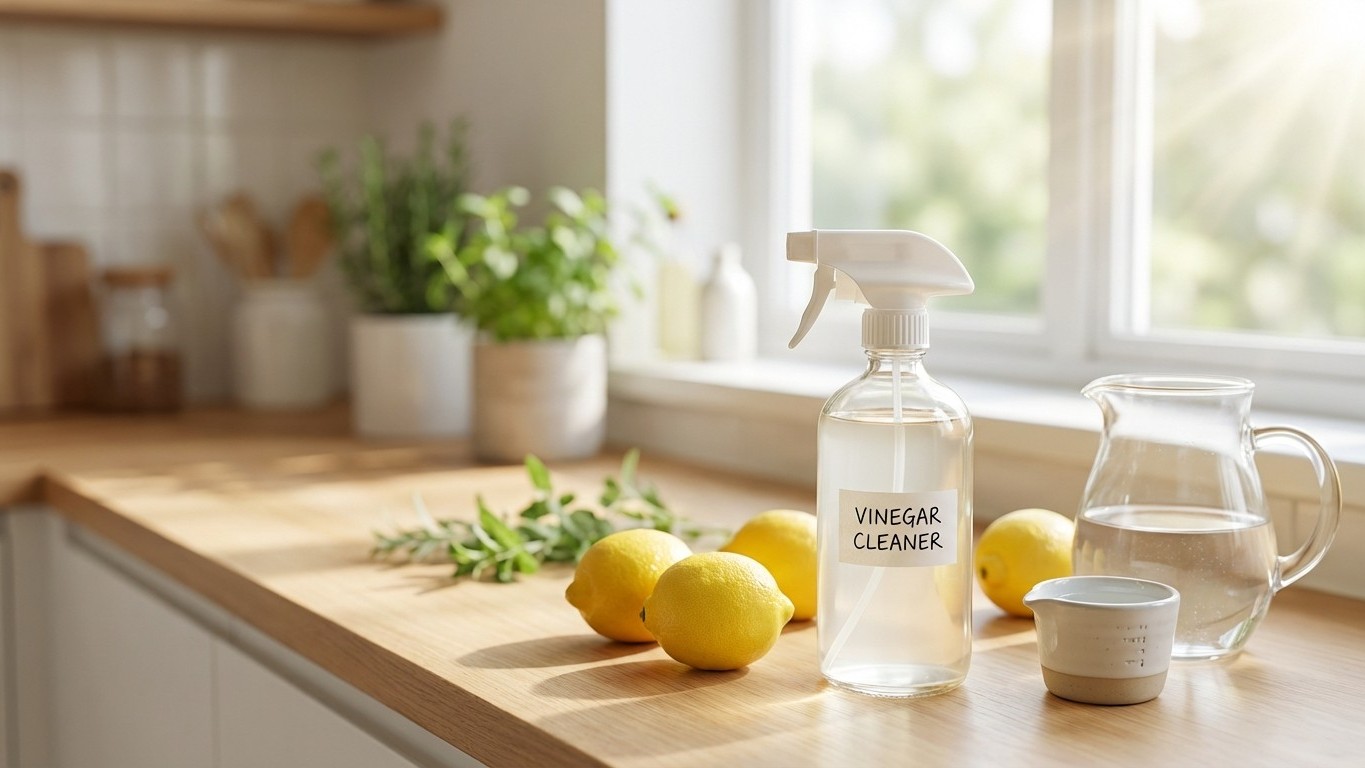
A vinegar and water spray: the small bottle that earns its keep
A good homemade Natural cleaning spray vinegar and water is one of those quiet household staples that can make the whole home feel fresher Without spending a fortune. It is simple, adaptable, and when you understand where it shines (and where it really does not), it becomes a reliable part of a green cleaning routine.
Since we are in February 2026, many households are still balancing rising costs with a desire to cut down on harsh chemicals and plastic waste. Vinegar and water fits that brief rather nicely, as long as you use the right dilution ratios and respect surface compatibility. I will walk you through exact measurements, best uses by room, what to avoid, and a few sensible “boosters” that stay on the safe side.
Why use a vinegar + water spray for natural house cleaning?
The active principles of white vinegar
White vinegar is mostly water and acetic acid. For cleaning, it is the mild acidity that does the heavy lifting. Acetic acid helps dissolve certain mineral deposits (like limescale) and can loosen soap scum. It also shifts surface pH in a way that many odour-causing microbes do not love, which is why vinegar often helps with lingering smells.
One practical note: vinegar is not a sterilising agent in the way specialist disinfectants can be. In everyday home care, that is often fine. For food-safety situations (raw chicken juices, for instance) or illness in the home, I prefer soap and hot water first, then follow your usual hygiene guidance for disinfecting.
Cleaning, degreasing, and deodorising actions
Used correctly, a vinegar and water spray is best at:
- De-limescaling taps, sinks, shower screens, and kettle exteriors (not the heating element unless your appliance manual allows it).
- Cutting through light grease films, especially when paired with a hot rinse or a microfibre cloth.
- Reducing stale odours on hard, washable surfaces, like bins, fridge shelves, and tiled floors.
It is less impressive on heavy, baked-on grease and it can struggle on porous or delicate materials. The trick is choosing the right job for the right bottle.
Which type of vinegar should you choose for cleaning?
White, clear, “household,” and food-grade: what’s the difference?
In UK shops you will commonly see clear/white vinegar sold for cooking, and stronger “cleaning” or “household” vinegar. The main difference is the concentration of acetic acid. Food-grade white vinegar is often around 5% acidity, while household versions may be higher. Higher acidity can work faster on limescale, but it also increases the risk on sensitive surfaces and can be harsher on your hands and nose.
My budget-conscious, low-fuss approach is this:
- Start with clear/white vinegar you can buy easily and affordably.
- Only consider a stronger household vinegar if you have persistent limescale and you are confident about surface compatibility, ventilation, and safe storage.
Avoid dark vinegars (malt, red wine, balsamic) for cleaning. They can stain and leave residues.
Where to buy vinegar for household cleaning
Supermarkets, discount grocers, and cash-and-carry style retailers often have the best value per litre. You may also find larger bottles online. Whatever you choose, do not decant into a drink bottle, and do not store it where a child might assume it is water. A plain label and a dedicated cupboard save a world of worry.
If you want a broader grounding in making simple cleaners from pantry basics, have a look at natural cleaning hacks, it sets the scene for what works well at home and why.
Basic recipe: vinegar + water spray (with exact measurements)
Recommended dilution ratios, plus safe variants by task
Here are three reliable dilutions for a homemade natural cleaning spray vinegar and water. Use a measuring jug, not guesswork, as consistency helps results.
- Everyday wipe-down (gentle): 250 ml white vinegar + 750 ml water (1:3) in a 1-litre bottle.
- General descaling and bathroom use (standard): 500 ml white vinegar + 500 ml water (1:1) in a 1-litre bottle.
- Targeted limescale (stronger, use with care): 750 ml white vinegar + 250 ml water (3:1) in a 1-litre bottle. Patch test and avoid sensitive surfaces.
For most homes, the 1:1 mix is the workhorse. Keep the gentler one for more frequent wiping, and only reach for the stronger mix when limescale is laughing at you.
How to use it well: spray, leave for 1 to 3 minutes (not longer on delicate finishes), then wipe with a damp cloth and dry. Drying is what stops streaks and water marks, particularly on chrome and glass.
Equipment and precautions (bottles, storage, shelf life)
You do not need fancy kit. You do need sensible kit.
- A clean trigger spray bottle (500 ml or 1 litre). Reuse an old cleaning bottle if it is thoroughly rinsed and still sprays evenly.
- A measuring jug and a small funnel.
- A label (masking tape and a pen will do): “Vinegar + water, date made.”
- Microfibre cloths, plus an old toothbrush for corners.
Storage: keep it cool, out of direct sunlight, and away from children and pets. Vinegar and water is generally stable, but the spray mechanism can clog over time if residue builds. I suggest making 500 ml at a time if you use it occasionally, or 1 litre if you are regularly cleaning bathrooms and kitchen surfaces.
Ventilation: open a window, especially with the 1:1 or stronger mixes. Your nose will thank you, and so will anyone in the next room who did not ask for eau de chip shop.
Compatible surfaces and recommended uses (room by room)
Kitchen: worktops, fridge, splashbacks, sink
In kitchens, vinegar spray is best for freshening and de-gunking everyday grime, not for raw-meat hygiene or porous stone.
- Fridge shelves and drawers: use the 1:3 mix. Empty the shelf, spray, wipe, then rinse with a cloth dampened in plain water and dry. This helps with odours and sticky spills.
- Stainless steel sinks (most types): use 1:1 for water marks. Rinse well and dry to prevent spotting. If your sink has a special coating, check the care guide first.
- Tiles and splashbacks: 1:1 works nicely on cooking splatters. Follow with a clean damp cloth to avoid haze.
- Laminate worktops: often fine with the 1:3 mix if you do not soak seams. Spray onto the cloth rather than directly onto joins.
For a broader multi-surface approach, especially if you want something with a bit more degreasing power for everyday wiping, you might prefer a general-purpose formula like the one in DIY all purpose natural cleaner recipe, then keep vinegar for limescale and odours.
Bathroom: taps, shower screens, tiles
This is where vinegar earns applause. Hard water areas can leave a chalky film, and vinegar is well suited to that.
- Chrome taps and shower fittings: spray 1:1, wait 1 minute, wipe, rinse, then dry with a cloth. Drying prevents new mineral deposits from setting.
- Shower screens (glass): 1:1, then buff dry. If you want a dedicated glass routine, see the cross-cluster note on glass further down.
- Bathroom tiles: 1:1 on the tiles themselves is usually fine. Keep it off fresh grout and sealants until fully cured (more on that below).
Soap scum sometimes needs a little persuasion. A warm damp microfibre cloth after the vinegar spray often shifts what a cold wipe leaves behind.
Windows, mirrors, handles, and light switches
For glass and shiny surfaces, less is more. A gentler mix reduces streaking.
- Mirrors and windows: use 1:3, spray lightly, wipe with a lint-free cloth, then buff dry. Over-spraying causes drips, and drips cause streaks.
- Handles and switch plates: spray onto a cloth, not directly, to avoid liquid creeping into electrics. Wipe and dry.
If your main goal is crystal-clear glass with minimal effort, it is worth reading the companion guidance that focuses on glass and mirrors. It uses the same family of ingredients, but the technique and cloth choice make a bigger difference than people expect.
Surfaces to avoid with vinegar + water spray
Unsealed wood, marble, natural stone, and fresh grout
Vinegar is acidic, and acidity can etch or dull certain materials. Some damage is subtle at first, then suddenly you cannot unsee it.
- Marble, limestone, travertine, and many natural stones: vinegar can etch the surface, leaving dull patches.
- Unsealed or waxed wood: vinegar can strip finishes, raise the grain, and leave marks.
- Some grout and stone sealers: repeated acidic cleaning can weaken certain sealers over time.
- New grout and silicone: while curing, it is more vulnerable. Follow the manufacturer’s cure time guidance and keep cleaning gentle in the meantime.
Also be cautious with rubber seals and some plastics if you are using strong vinegar frequently. A quick wipe is one thing, soaking and daily saturation is another.
Risks and sensible natural alternatives
If vinegar is not suitable, you still have options that stay budget-friendly:
- For stone worktops: warm water with a tiny drop of washing-up liquid, wiped and dried. Keep it simple.
- For wood: a barely damp cloth, then dry straight away. For finished wood, a cleaner matched to the finish is safest.
- For grout brightening (when appropriate): bicarbonate of soda can help in some situations. Use it thoughtfully and rinse well. The guide natural cleaning hacks with baking soda gives practical ideas for where it works best.
Patch testing is not fussy, it is thrift. Testing a hidden corner saves replacing a surface you never budgeted for.
Boosting effectiveness (without making a chemical soup)
When, and how, to add complementary ingredients
A vinegar and water spray is intentionally plain. That is part of its charm. Still, there are a few add-ons people ask about.
- Washing-up liquid (for grease): add 2 to 3 ml (about half a teaspoon) to a 500 ml bottle of the 1:1 mix. Swirl gently, do not shake like a cocktail, unless you enjoy foam volcanoes. This helps on greasy fingerprints and cooker-hood splatter. Rinse after use.
- Essential oils (for scent): if you choose to use them, keep it low, around 5 to 10 drops per 500 ml. They do not “disinfect” in a reliable household way, but they can make the smell more pleasant. Be aware oils can mark some surfaces and can be risky around pets, so consider skipping them.
- Lemon (for fragrance): a thin strip of lemon peel steeped in vinegar can scent it, but it also introduces organic material that can shorten shelf life. If you do this, make small batches and use within a week or two, stored in the fridge, and strain well.
My preference is to keep the vinegar spray plain and use fragrance elsewhere, like a ventilated room spray or just opening the window for ten minutes. Fresh air is still the best “ingredient,” and it costs nothing.
Safety around children and animals
Even natural cleaning safety matters. Vinegar can irritate eyes and skin, and essential oils can be a real issue for some pets.
- Store sprays up high or in a locked cupboard.
- Do not spray into the air around pets or into a confined space like a litter tray area.
- Wear washing-up gloves if you have sensitive skin, especially with 1:1 and stronger mixes.
- Label every bottle clearly, including the date and the ingredients.
Frequently asked questions about vinegar + water spray
How long does it keep?
A plain vinegar and water mix can keep for weeks to months when stored sensibly, because it is not a food for bacteria in the way sugary mixtures are. The usual failure point is the spray head, not the liquid. If the nozzle starts sputtering, rinse it in warm water and pump through a little clean water.
How do I reduce the vinegar smell?
The smell fades as it dries. To make it easier on the nose:
- Use the 1:3 mix where it is sufficient.
- Wipe with a cloth dampened in plain water after cleaning, then dry.
- Ventilate for 5 to 10 minutes.
Essential oils can mask odour, but I treat them as optional, not a requirement.
Is it a natural disinfectant?
Vinegar can reduce some microbes, but it is not a guaranteed disinfectant for all household pathogens. For routine cleaning, it is often perfectly adequate. For higher-risk cleaning (after vomiting, diarrhoea, raw meat spills, or when someone is ill), follow established hygiene guidance and use products and methods intended for disinfection, while keeping good ventilation and surface compatibility in mind.
What is the best vinegar to water ratio for an effective homemade spray?
For most homes, 1:1 (500 ml vinegar + 500 ml water) is the sweet spot for bathrooms, taps, and general descaling. For daily wiping and glass, 1:3 (250 ml vinegar + 750 ml water) is kinder to surfaces and less smelly.
Which surfaces are safe?
Sealed tiles, most bathroom ceramics, many chrome fittings, and glass usually cope well, especially when you rinse and dry. Avoid natural stone, unsealed wood, and any surface where the manufacturer warns against acidic cleaners.
Bonus: common mistakes and myths to avoid
Dangerous mixes (never combine vinegar with bleach)
This one is worth stating plainly. Never mix vinegar with bleach, and never use them one after the other without a thorough rinse in between. Mixing acids with bleach can release chlorine gas, which is hazardous. Keep them in separate cupboards if that helps you remember.
Also avoid mixing vinegar with hydrogen peroxide in the same bottle. Used separately, each has its place in some cleaning routines, but combined they can form irritating compounds. Simple is safer.
Long-term effects and caring for your spray bottle
Using strong vinegar daily on the same fittings can dull some finishes over time. If a tap or shower fitting is a special coated finish, treat it gently and test first. For everyday upkeep, alternating between a mild soap-and-water wipe and occasional vinegar for limescale is kinder.
- Nozzle care: once a month, spray a little warm water through the mechanism. If it clogs, soak the nozzle (not the whole bottle) in warm water for 10 minutes.
- Cloth care: wash microfibres without fabric conditioner, which reduces absorbency and makes streaks more likely.
- Do not over-wet seams: worktops, laminate edges, and splashback joins can swell if liquid sits there.
People sometimes think “natural” means “safe for everything.” Vinegar is natural, yes, and also perfectly capable of ruining a marble surface. Nature has never promised to be gentle.
Complementary resources and next steps
If you are building a full eco-friendly house cleaning routine, it helps to have a small set of well-chosen recipes rather than fifteen half-working concoctions. The collection natural cleaning hacks can help you round out your cupboard with simple options that suit different rooms and materials.
For a general spray you can use in more places (with fewer material worries than vinegar on stone), the DIY all purpose natural cleaner recipe is a handy companion. Then keep your homemade natural cleaning spray vinegar and water as your “limescale and freshness” specialist.
Finally, if you want to go deeper into pantry staples, revisit natural cleaning hacks for the fundamentals, and natural cleaning hacks with baking soda for where bicarbonate can be useful without scratching delicate finishes.
If you pick just one thing to do today, make two small bottles, one at 1:3 and one at 1:1, label them clearly, and choose one problem spot this week to tackle properly. Which surface in your home would you like to look less tired by Sunday, the shower screen, the taps, or the fridge shelves?