
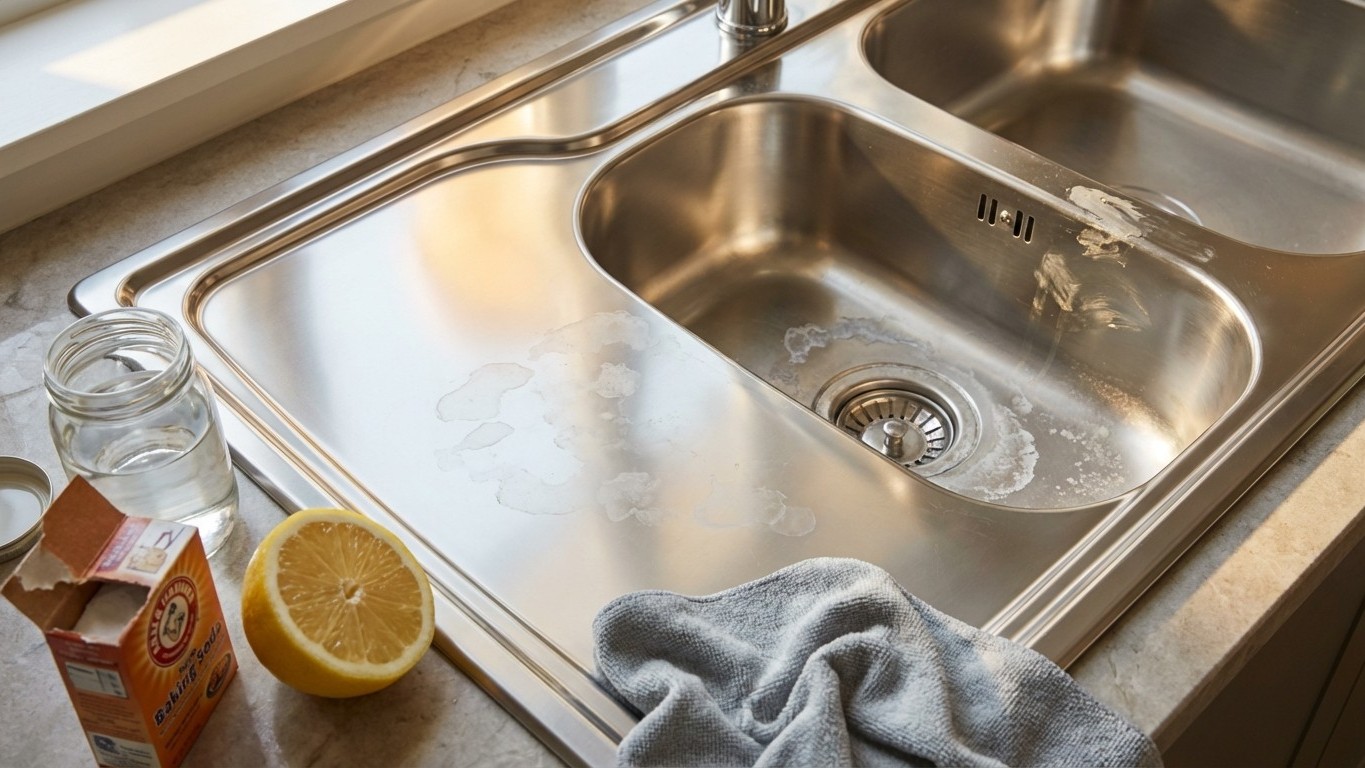
That gleaming stainless steel sink you admired in the showroom has a habit of looking rather less impressive after a few weeks of daily use. Watermarks, limescale rings, grease smears, and the occasional mysterious dull patch, your sink tells the story of every meal prepared, every pot washed, every cup rinsed. The good news? You can restore it to its original shine using nothing more than a handful of ingredients you almost certainly already have in your kitchen cupboards, and without risking a single scratch in the process.
Why Choose Natural Cleaning for a Stainless Steel Sink?
The Risks of Conventional Products on Stainless Steel
Many standard kitchen cleaners contain chlorine bleach, harsh surfactants, or fine abrasive particles. On stainless steel, these are a rather unfortunate combination. Bleach, in particular, can break down the thin protective oxide layer that gives stainless steel its “stainless” quality, leaving it vulnerable to rust and pitting over time. Abrasive powders, even those marketed as gentle, create a web of tiny scratches that scatter light in all directions, which is precisely why a sink starts to look dull and tired rather than bright and clean. Those micro-scratches also provide cosy little hiding places for bacteria and grease.
There’s another practical concern: many commercial products leave a chemical residue that requires thorough rinsing. Rinse improperly, and you’ll find yourself staring at yet another layer of streaks. It’s a frustrating cycle that costs money and achieves very little.
Why Natural Solutions Work Better Here
White vinegar, bicarbonate of soda, lemon juice, and a good microfibre cloth are genuinely effective on stainless steel, and here’s why: they work with the material rather than against it. Vinegar’s mild acidity dissolves limescale without etching the metal. Bicarbonate of soda, when used correctly (and this is the important part), provides just enough gentle cleaning action to lift grease without abrading the surface. Lemon juice does much the same as vinegar, with the pleasant bonus of leaving your kitchen smelling lovely.
Natural solutions also tend to rinse away cleanly, which matters enormously for a surface as unforgiving as polished stainless steel. No residue means no streaks, or at least, far fewer of them. For a broader look at how these natural ingredients can transform your whole kitchen, our guide to natural kitchen cleaning hacks covers everything from hobs to splashbacks.
Understanding Marks and Micro-Scratches: Causes and Prevention
Why Does Stainless Steel Mark So Easily?
Stainless steel has what engineers call a “grain”, a directional texture created during the manufacturing process, similar in principle to the grain in wood. Run your finger along the sink surface and you can usually feel it. This grain is your guide to cleaning: always work with it, never across it. Scrubbing against the grain is one of the leading causes of visible scratching, because you’re essentially dragging particles perpendicular to the surface’s natural structure.
Water itself is the other great culprit. Hard water (the norm across much of England and the Midlands) contains dissolved calcium and magnesium salts. Every time water evaporates from your sink, it leaves those salts behind as a white or chalky deposit. Over weeks and months, these build up into a stubborn film that makes the sink look perpetually dirty even when it’s technically clean.
Small Mistakes That Cause Big Problems
The green scratchy side of a washing-up sponge is probably the single most common cause of scratched sinks in British kitchens. Put it away. Steel wool pads are even worse. Similarly, avoid anything labelled “scouring powder” unless the label specifically confirms it is safe for stainless steel.
Leaving acidic foods, tomato sauce, lemon halves, vinegar-based dressings, sitting directly on the sink surface for extended periods can cause localised discolouration. A quick rinse after food prep takes approximately three seconds and saves a great deal of bother later. Equally, resist the temptation to bleach the sink when it looks stained; the short-term result rarely justifies the long-term damage to the steel.
A Complete Method: Clean Your Stainless Steel Sink Naturally, Without Marks or Scratches
Materials and 100% Natural Ingredients to Use
Before you begin, gather your supplies. You’ll want white distilled vinegar (the cheapest supermarket own-brand is perfectly fine), bicarbonate of soda (again, the baking variety from the home baking aisle, not the more expensive “cleaning” versions), a fresh lemon if you have one, a soft microfibre cloth, and a second dry microfibre cloth for buffing. A soft-bristled old toothbrush is useful for the area around the plughole and tap base. That’s genuinely all you need.
The Daily Anti-Mark Routine, Step by Step
Start with a warm rinse to shift any loose food debris. Then dampen your microfibre cloth with warm water and wipe the entire sink, always moving in the direction of the grain. This alone handles the majority of daily mess.
For a proper clean, sprinkle a small amount of bicarbonate of soda (about a teaspoon) directly onto the damp sink surface. Using your soft cloth, work it gently into the surface, again following the grain. You’ll notice it forms a mild paste with the residual water. Leave it for two to three minutes, then rinse thoroughly with warm water. The key word there is thoroughly — bicarbonate residue left on the surface will dry to a powdery white film, which rather defeats the purpose.
Once rinsed, pour a small amount of white vinegar onto your cloth (not directly onto the sink, where it might pool and sit too long) and wipe the surface in smooth, grain-following strokes. The vinegar dissolves any remaining limescale haze and neutralises the alkaline bicarbonate residue. Rinse again with clean water, then buff immediately with a completely dry microfibre cloth. That final buffing step is what separates a clean sink from a gleaming one.
Tackling Stubborn Stains: Limescale, Grease, and Food Marks
Limescale rings around the plughole and waterline respond well to a more concentrated vinegar treatment. Soak a piece of kitchen paper in undiluted white vinegar, lay it over the affected area, and leave it for fifteen to twenty minutes. Remove, rinse, and buff dry. For particularly stubborn deposits, half a lemon rubbed directly over the scale works beautifully, the citric acid gets to work immediately, and you can use the lemon half as a gentle applicator without any risk of scratching.
Greasy residue from washing up or cooking is best addressed with a few drops of washing-up liquid on a damp microfibre cloth, followed by the standard vinegar rinse. If you’d like to explore a deeper approach to degreasing natural surfaces around the kitchen, the techniques in our article on using a natural degreaser for kitchen cabinets translate very well to sink surrounds and tap fittings too.
Polishing for Shine: Natural Methods That Won’t Damage
A small amount of olive oil on a soft cloth, buffed along the grain, is one of the oldest tricks in the book for restoring lustre to a dull stainless steel sink. Use truly sparingly, a few drops only, or you risk a greasy film. The oil fills the micro-scratches that cause light to scatter, making the surface appear brighter. Baby oil works in the same way, and some people find it slightly easier to control.
Club soda (carbonated water) is another surprisingly effective polisher. Pour it over the sink, let it fizz for a moment, then buff dry. The mild carbonic acid does a fine job of lifting watermarks, and the effervescence helps shift deposits in a surprisingly satisfying way.
Bonus Tips for Long-Term Sink Care
Prevention: What to Avoid and What to Do Instead
Keep a small dry cloth hanging by the sink and make a habit of giving the basin a quick wipe after the last use of the day. It takes ten seconds. Over a week, this single habit does more to preserve your sink’s appearance than any deep-cleaning session. Water that doesn’t dry on the surface can’t leave deposits.
Cast iron pans left soaking in stainless steel sinks can transfer rust stains, not rust from your sink, but from the pan. If you do need to soak cast iron, use a separate bowl or bucket. Similarly, avoid leaving metallic scourers or steel wool near the drain where they might sit in contact with the sink surface.
Deodorising the Sink and Drain Naturally
A smelly drain is usually caused by a build-up of organic matter, food particles, soap scum, grease, lodged just below the plughole. Once a week, pour half a cup of bicarbonate of soda down the drain, follow immediately with half a cup of white vinegar, and watch it fizz. Leave for five minutes, then flush with a full kettle of boiling water. It clears mild blockages, neutralises odours, and costs pennies. A few drops of lemon juice or tea tree oil added to your regular cleaning water will also keep the sink area smelling fresh between deeper cleans.
FAQ: Practical Answers to Common Questions
Can I use bicarbonate of soda on stainless steel without scratching it? Yes, provided you use it as a paste with water, apply it with a soft cloth, and work with the grain of the steel rather than against it. The particles in bicarbonate are fine enough not to cause damage when used correctly.
What natural product removes marks from stainless steel? White vinegar is the most reliable choice for watermarks and limescale. For a dull surface that needs brightening rather than stain removal, a tiny amount of olive oil buffed along the grain works surprisingly well.
How do I restore shine to a tarnished stainless steel sink without scratching it? The vinegar wipe followed by immediate buffing with a dry microfibre cloth is your most dependable method. For extra lustre, follow with a drop or two of olive oil on a fresh cloth, buffed in the direction of the grain. The transformation can be quite dramatic on sinks that haven’t had this treatment in a while.
More Natural Cleaning Ideas for a Spotless Kitchen
A beautifully clean sink is really only one piece of the puzzle. If you’ve enjoyed getting your stainless steel sparkling with natural ingredients, you might find that the same approach works wonders elsewhere in the kitchen. Our full collection of natural cleaning hacks covers over forty recipes and techniques for every surface in the home. The oven, which tends to attract a different sort of stubborn grime entirely, has its own dedicated guide, the method for how to clean oven naturally with baking soda and vinegar is just as satisfying to follow as the sink routine described here.
There’s something genuinely pleasing about a kitchen that’s been cleaned using ingredients rather than chemicals, a quiet sort of confidence that what you’ve used around your food preparation area is safe, effective, and kinder to the surfaces you’re trying to protect. Your stainless steel sink, maintained regularly with these methods, should look better in six months than it does today. That’s a rather nice thought.