
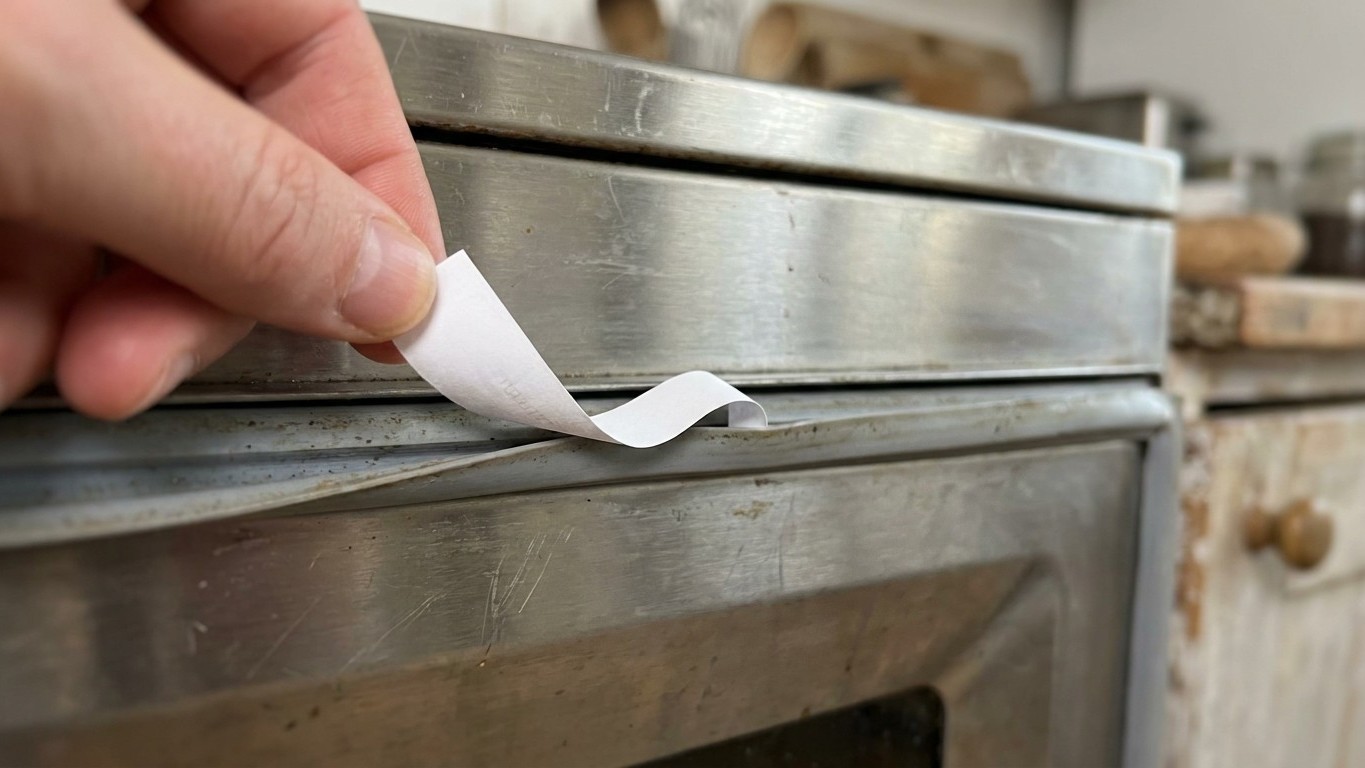
My father did it every single time, without fail. Before he turned the dial on that ancient gas cooker of ours, he’d tear a strip off yesterday’s newspaper, shut it in the oven door, and give it a firm tug. As a girl I thought it was one of his funny little rituals, up there with tapping the barometer or checking the sky before hanging washing out. It took me years, and my own draughty oven, to realise he was running a genuine diagnostic test that appliance engineers still recommend today.
Key takeaways
- A simple newspaper trick reveals whether your oven is losing heat—and costing you hundreds in wasted energy
- A failing oven seal sabotages your baking, burns cookies unevenly, and creates dangerous hot spots
- The same five-second test works on fridges and freezers, where it matters even more
What that scrap of paper is actually testing
The trick has a proper name now, the “paper test” (some call it the dollar bill test, though a strip of ordinary paper works just as well). You close the oven door with the paper trapped between the door and the frame, then pull gently. Close the oven door, trapping a piece of paper between the door and the oven frame, then try to pull the paper out. If it comes free without any fight, that tells you something important: if it slides out easily, the seal is weak at that point, so repeat the test at several points around the entire perimeter, especially at the corners and the middle of each side, because a good seal will hold the paper firmly, requiring some effort to pull free.
My father, of course, never called it a “gasket integrity assessment”. He just knew that a loose door meant a lazy oven. He wasn’t wrong. The oven door seal, also known as a gasket, creates a tight barrier between the oven cavity and the outside air, and when the seal is intact, it traps heat inside the oven, allowing for precise temperature control and efficient cooking. Once that rubbery strip around the door hardens, cracks or simply flattens out after years of heat cycles, it stops doing its job properly.
Why a gappy seal costs you more than a soggy sponge cake
This is where the science backs up the folk wisdom rather nicely. A compromised seal leads to heat loss, which means your oven has to work harder and use more energy to maintain the set temperature, increasing your utility bills. Given how energy prices have squeezed British households these past few years, that’s not a small thing, it’s the difference between an oven that preheats in ten minutes and one that limps along for twenty, burning gas or electricity the whole time.
It isn’t only about pounds and pence, either. Inconsistent cooking is another common signal of a bad seal. If cookies brown more on one side or roasts take longer than expected, the oven door may not be sealing evenly, and because heat escapes, the thermostat struggles to keep the cavity at the right temperature, which leads to unpredictable results. I think of every slightly-too-pale Victoria sponge I ever blamed on my own baking skills, when really it might have been a tired door seal quietly sabotaging the whole affair. There’s also a safety angle nobody mentions at dinner parties: a broken seal can create hot spots around the oven door, posing a burn risk to anyone nearby. Handy to know if you’ve got small children reaching for biscuit trays.
Doing the test yourself, and what to do if it fails
You don’t need anything fancy, just a strip of ordinary paper (a torn envelope will do, no need to sacrifice a fiver like the Americans do with their dollar bills). Open the door, lay the paper across the seal, close the door on it, and pull. Do this at several spots, not just one, because a seal often fails unevenly: the paper should be held firmly at all points around the door. Give particular attention to the corners and the middle of the top edge, where gaskets tend to compress first from years of the door slamming shut on a Sunday roast.
While you’ve got the door open, have a proper look at the rubber trim itself. Cracks, flattening, or a greasy build-up that won’t wipe off are all telltale signs. If the seal looks brittle, torn, worn down or compressed, it may no longer form the snug barrier your oven needs, and escaping heat, grease and food particles can sometimes leave marks around the door opening when the seal is no longer doing its job correctly. A few things worth checking off in one go:
- Visible cracks, splits or a flattened, shiny patch on the rubber
- Sticky residue that transfers onto your paper strip
- A door that feels loose or doesn’t click shut as firmly as it used to
If your oven fails the test, don’t panic and don’t call an engineer just yet. Replacement gaskets are widely available for most makes and models, and fitting one is genuinely a job for a Saturday afternoon rather than a professional. Replacing an oven door seal gasket is a straightforward DIY task that typically takes less than an hour. You’ll want the exact part for your oven, so check the model number on the sticker inside the door frame before you order anything, there’s nothing more maddening than a seal that’s a centimetre too short.
The bit my father never mentioned
Here’s the detail that would have delighted him: the same trick works on your fridge and freezer, and matters even more there, since those doors are opened dozens of times a day, every single day of the year. By preventing cold air leaks, the seal allows your refrigerator to work less strenuously, consuming less energy and lowering your utility bills, and when cold air escapes, the compressor has to run more frequently and for longer durations to compensate. A good rule of thumb, borrowed from appliance engineers rather than grandmothers, is to run the paper test on both your oven and your fridge roughly twice a year, once when the clocks change is easy to remember. My father never explained his reasoning out loud, he simply did the test, nodded to himself, and got on with the roast. It’s taken me the best part of thirty years and a great many overcooked edges to appreciate that his little ritual with the newspaper was, in fact, rather good engineering.
Sources : reviewgk.com | facebook.com