
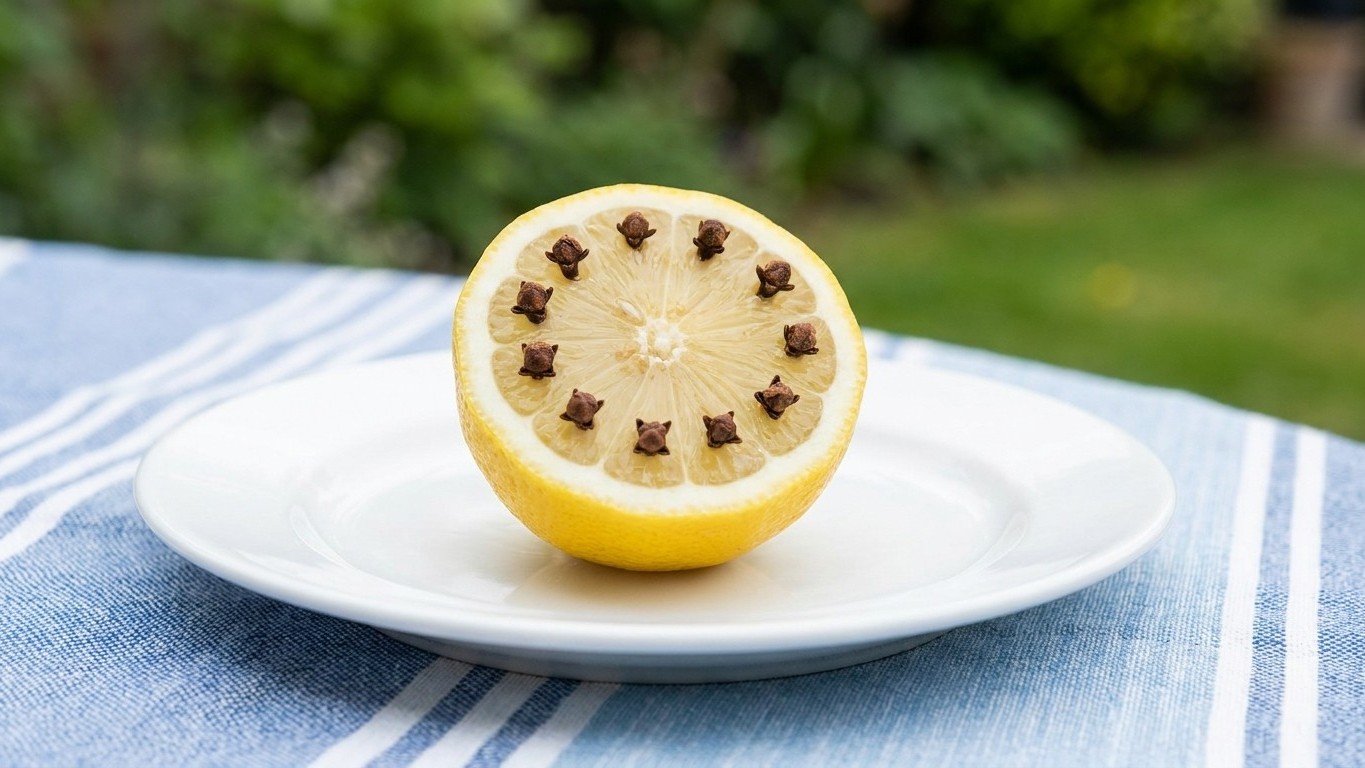
Half a lemon studded with whole cloves has been sitting on garden tables since long before anyone bottled citronella oil, and there’s a reason this fussy little pincushion of a decoration keeps reappearing every summer. The clove’s scent contains eugenol, an oil that flies, wasps and midges find genuinely repellent, and when it’s pushed into fresh citrus peel, the lemon’s own fragrance seems to carry that oil further across a table than a candle ever manages. No flame, no smoke, no faff with matches when the wind picks up. Just a lemon, a handful of cloves, and about four minutes of fiddling.
I’ll admit I started doing this purely for looks. A bowl of lemons studded with cloves looks rather lovely against a blue-and-white tablecloth, and it costs pennies compared to buying proper table decorations. It was only after a few weeks of barbecues that I noticed something odd: the wasps that usually dive-bomb anything with jam or fizzy pop in it were giving our table a wide berth, even though my citronella candle, lit dutifully at the other end, wasn’t doing much beyond making the air smell faintly of furniture polish.
Key takeaways
- One simple garden trick has been quietly outperforming expensive citronella candles for decades
- The science behind it is real, not folklore—but there’s a specific reason the pairing works better than either ingredient alone
- The setup takes four minutes and costs pennies, yet works so well you’ll wonder why you ever bought anything else
Why this works better than you’d expect
Citronella candles rely on the wax melting evenly and the wind cooperating, which in a typical British garden is asking rather a lot. Even when they burn well, the scent molecules disperse upward and outward in a fairly narrow cone, so anything sitting more than a metre or so away gets little benefit. A clove-studded lemon works Differently. The cloves are pressed directly into the flesh, so the citrus oils and the eugenol mingle constantly at room temperature, releasing a steady, low-level scent in every direction rather than a plume that depends on flame height and breeze.
There’s decent science behind clove oil specifically. Research published by the National Institutes of Health has looked at eugenol and related clove compounds as insect repellents, and they’ve consistently shown repellent activity against various fly and mosquito species in laboratory conditions. It’s not folklore dressed up as fact. Flies in particular seem to dislike the combination of citrus terpenes and clove eugenol together, which may explain why lemon alone, or cloves alone, never quite does the job as thoroughly as the pairing does.
Wasps are a slightly different story. They’re less studied in relation to clove oil specifically, but they hunt largely by smell, and strong, unfamiliar scents close to a food source tend to send them elsewhere to forage. My own theory, and I stress this is observation rather than laboratory proof, is that the lemon’s sweetness (which would normally attract a wasp investigating your fruit bowl) gets masked entirely by the sharper clove scent, so the wasp simply doesn’t register the table as a food source in the first place.
How to make one properly
Half a lemon is used rather than a whole one because the exposed flesh releases more scent, and it sits flatter on a plate or table without rolling about. Cut the lemon in half, then push whole cloves into the cut face and around the peel, spacing them roughly a centimetre apart. You want enough that the surface looks properly speckled, not just a token handful.
- One lemon halved, studded with 20 to 30 whole cloves
- Place cut-side up on a small plate or shallow dish
- Refresh with a new lemon every two to three days, as the scent does fade as the flesh dries out
- Position two or three around the table rather than just one, especially outdoors
Leftover cloves keep for years in a sealed jar, so this genuinely costs next to nothing once you’ve got a jar in the cupboard. A bag of whole cloves from any supermarket spice aisle will do a full summer’s worth of lemons with plenty to spare, which makes this considerably cheaper than replacing citronella candles every few weeks.
Where it falls short, and what to pair it with
I won’t pretend this is a miracle cure. It works well as what pest controllers would call a passive deterrent, something that makes an area less appealing rather than actively killing or trapping anything. If you’ve got a wasp nest nearby, or you’re eating something particularly sweet and sticky, a lemon and cloves alone won’t hold the line. It’s most effective as part of a layered approach: keep sugary drinks covered, don’t leave meat out longer than needed, and use the lemon as an additional line of defence rather than your only one.
It also doesn’t love direct sun for hours on end. The flesh dries and shrinks faster in full sunshine, so if your table gets baked all afternoon, you’ll want to swap the lemon out more often, perhaps daily rather than every few days. I’ve taken to keeping a couple of spares cut and studded in the fridge, ready to swap in when the first one starts looking tired.
One thing I hadn’t expected: the scent is mild enough that it doesn’t bother anyone at the table, unlike citronella, which some guests find a bit much, especially anyone who associates it strongly with camping trips or garden centre candle displays. Clove and lemon together smells more like mulled wine simmering gently than insect repellent, which makes it a far more pleasant thing to have sitting six inches from your dinner plate. It’s a small swap, but it’s the kind of quietly useful trick that earns its place in the garden shed permanently, right next to the citronella candles you’ll probably use rather less often from now on.