
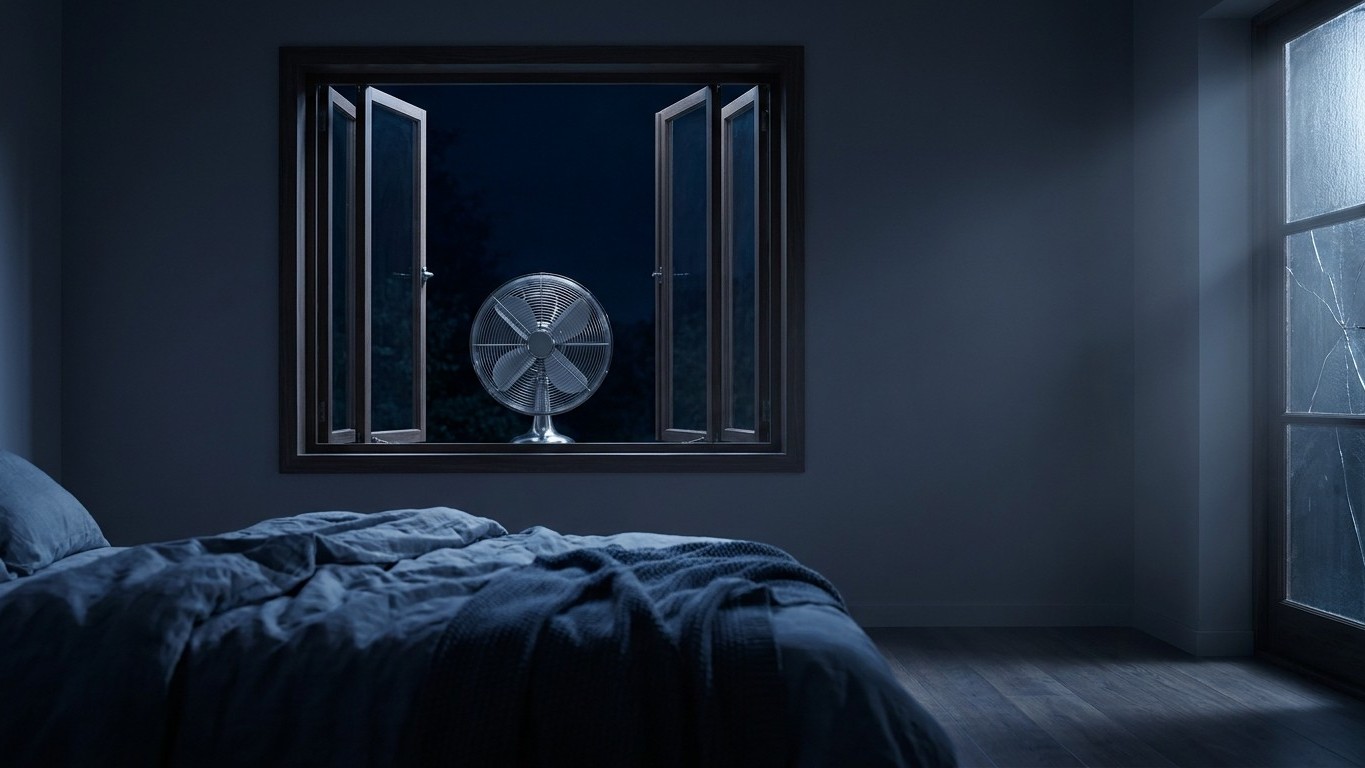
Turn your fan away from the bed and point it straight out the window, and you’ll cool a stuffy bedroom faster than any breeze blowing on your face ever could. That sounds backwards, but it comes down to simple physics: a fan aimed at you just moves warm air around, while a fan aimed outward actively pulls cooler night air in from every other opening in the house. One shifts air. The other exchanges it.
I used to be firmly in the “point it at your face” camp, convinced that the closer the breeze, the cooler I’d feel. And for about twenty minutes, that’s true. But a fan blowing directly on you doesn’t lower the temperature of the room at all. It just speeds up evaporation on your skin, which feels cooling but does nothing for the air itself. Meanwhile the room stays exactly as hot as it was, and by 2am you’re kicking off the sheets again, wondering why the “cooling” fan has stopped working.
Key takeaways
- A fan on your face only feels cooling but doesn’t lower room temperature at all
- Reversing airflow to push hot air out creates a pressure difference that pulls cooler air in from other openings
- The trick only works when outdoor air is genuinely cooler than indoor air—timing is everything
Why reversing the airflow actually works
Set a fan in the window facing outward, blades pushing room air into the garden or street, and you create what’s essentially a small extraction system. As warm indoor air gets pushed out, it has to be replaced by air from somewhere, and that somewhere is every other window, door gap or vent in the house. If you’ve got a window cracked open on the opposite side of the flat, even just a couple of inches, you’ll feel a genuine cross-breeze start pulling through within minutes. This is basic convection and pressure difference at work: extract warm air from one point, and cooler air gets drawn in from another.
The trick works best overnight for an obvious reason. Outdoor temperatures typically drop several degrees below indoor temperatures after sunset, especially once you’re a few hours past the evening peak. The UK Met Office notes that summer nights can easily sit 8-10°C cooler than the daytime high, particularly away from city centres. That gap is your fuel. A fan facing outward just accelerates the natural process of warm air escaping and cool air replacing it, rather than fighting against a room that’s already trapped its daytime heat.
There’s a second, quieter benefit too. Humidity and stale air get pulled out along with the heat. Bedrooms with a closed window and a person or two breathing all night build up moisture and carbon dioxide levels that make a room feel stuffier than the thermometer suggests. Pushing that air out and drawing fresh air in addresses both problems at once, not just the temperature.
Getting the cross-breeze set-up right
The method only works if air has somewhere to go once it’s pushed out, and somewhere to come from once it’s needed. A single window with a fan in it, all other windows and doors shut, will do very little because you’re trying to push air out of a sealed box. Open a window or door on the opposite side of the room, or ideally the opposite side of the flat or house, even a small gap. That’s the intake. The fan-filled window is the exhaust.
Ground floor flats and houses benefit most from this because ground-level air is usually a touch cooler than air trapped upstairs, where heat rises and lingers under the roof. If you’re on an upper floor, try opening a window low down somewhere else in the property (a kitchen window, a hallway window) so cooler air has an entry point that isn’t fighting its way up a stairwell against rising warm air.
Timing Matters More Than people think. Doing this at 9pm when it’s still 24°C outside won’t help much. Wait until outdoor air has actually dropped below indoor air, usually somewhere between 11pm and 1am in a typical British summer, and the exchange becomes far more effective. Some people leave the fan running on a low setting from midnight through to around 5am, then close everything up at dawn before the outside air starts warming again, effectively trapping the cool night air inside for the day ahead.
What this doesn’t fix, and where a face-full of breeze still helps
None of this replaces genuinely hot nights when outdoor temperatures barely dip, which does happen during UK heatwaves. If it’s 22°C outside at 1am, pulling that air in won’t achieve much because there’s no meaningful temperature gap to exploit. On those nights, the traditional fan-on-your-skin approach, or a bowl of ice water placed in front of the fan so it blows across the cold surface, becomes the better short-term fix, even though it’s treating symptoms rather than the room itself.
It’s also worth being honest that this method needs a security-conscious approach. Leaving windows open overnight, even just a crack, isn’t something everyone’s comfortable with, particularly ground-floor properties in urban areas. Window restrictors or narrow-opening hardware let you get a usable gap without leaving a full-sized opening, which is a reasonable compromise if security’s a concern.
One thing that surprised me when I first tried this properly: the difference isn’t subtle. Rooms that felt genuinely oppressive at 10pm, the kind where you lie there sweating and resentful, felt noticeably fresher by 1am once the fan was doing extraction duty rather than personal cooling duty. It costs nothing extra to test, since you’re using the same fan you already own, just pointed the other way and given a partner window to work with. Try it on the next warm night and judge for yourself before the peak of summer arrives.