
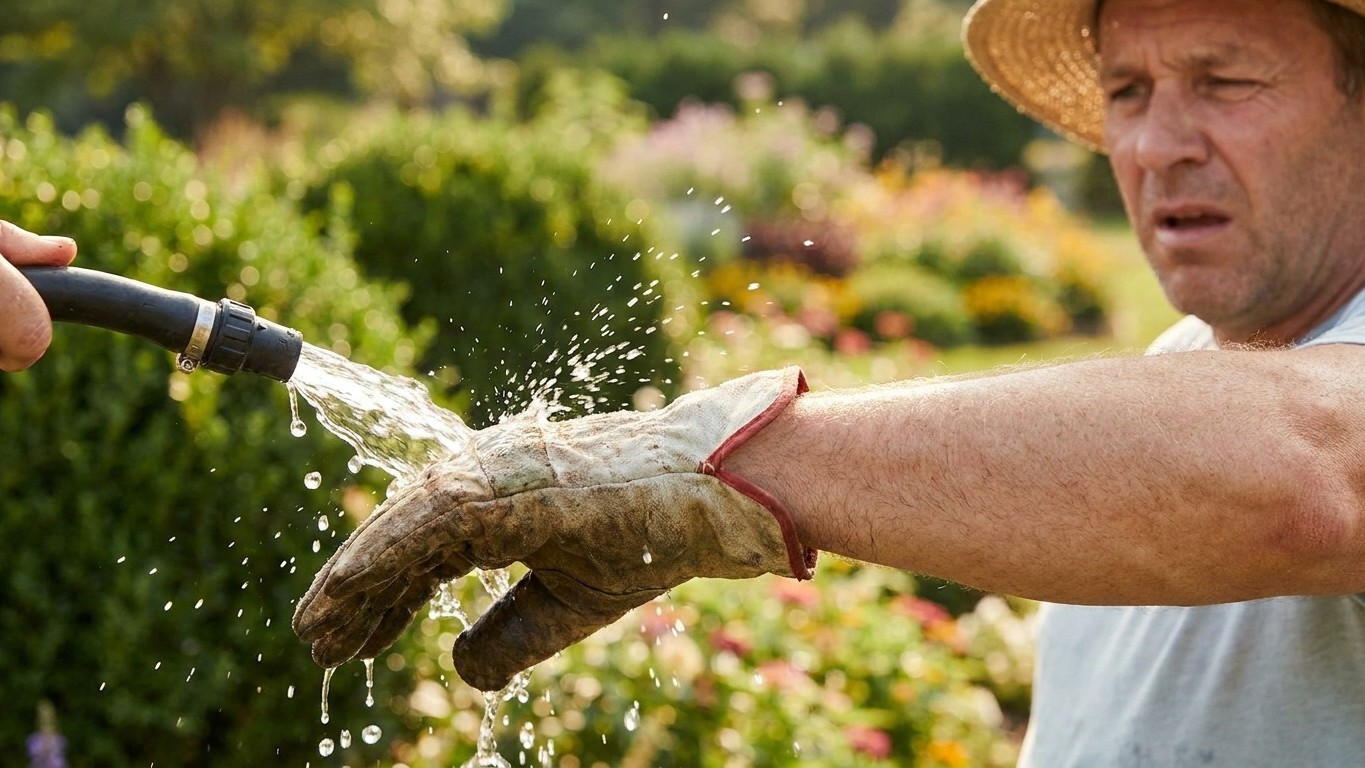
That first blast from a sun-warmed hose can run considerably hotter than what comes out of your kitchen tap, hot enough to make you gasp and drop the nozzle. I did exactly that one July afternoon, more out of habit than thought, testing the spray against my palm before turning it on the delphiniums. What came out wasn’t the cool, refreshing water I’d assumed I was giving my plants for the better part of two decades. It was properly warm, verging on scalding, and it had been sitting in that black rubber coil since I’d left it draped across the patio that morning.
The garden hose left in direct sun works rather like a solar collector, which is precisely why some outdoor shower kits use the same principle deliberately. Water sitting still inside a dark hose absorbs heat rapidly, and on a properly warm British summer day (yes, we do get them occasionally) the temperature inside that tubing can climb well past what any seedling would consider comfortable. The water that flows through afterwards, once the hot bit has passed, is usually back to something reasonable. But that first surge, the stuff that’s been stewing for hours, goes straight onto whatever’s nearest the tap.
Key takeaways
- A routine watering habit can silently stress plants for decades without you realizing what’s wrong
- Hot water doesn’t just shock roots—it also carries less oxygen that plants desperately need
- The beds that always looked tired had a reason, and it wasn’t the soil or drainage
What Happens to Roots When You Pour on Hot Water
Plant roots are not built for sudden temperature shocks. Root cells rely on turgor pressure, water pushing against cell walls, to stay rigid and functional, and a rapid change in water temperature can disrupt that balance almost instantly. Younger plants and anything in a container suffer worse, simply because their root systems are shallower and closer to the surface, with less soil mass to buffer the shock.
I’d noticed for years that certain patches of my beds looked perpetually tired, the leaves slightly curled at the edges even when the soil underneath felt damp enough. I’d blamed poor drainage, blamed the wrong compost, blamed Everything except the obvious. Looking back, those were the beds nearest the outside tap, the ones that got watered first, the ones that received the hottest water straight from a hose that had been baking since breakfast.
There’s a secondary issue too, one that’s easy to overlook. Warm water holds less dissolved oxygen than cool water, and roots need oxygen just as much as they need moisture. Pour warm water repeatedly onto the same patch of soil and you’re not just risking a temperature shock, you’re also delivering water that’s marginally less useful for supporting root respiration. Not a dramatic effect on any single occasion, but repeated day after day, summer after summer, it adds up to plants that never quite thrive the way they should.
The Simple Fix That Costs Nothing
Letting the first few seconds run onto the patio or lawn before aiming at your beds solves most of the problem immediately. I now flick the nozzle away from any plants for a count of ten or so, longer if the hose has been in full sun all day, and only then start watering properly. It’s a habit that took no effort to build and costs nothing beyond a small puddle on the paving.
Coiling the hose in shade when it’s not in use makes an even bigger difference, and it’s the change I wish I’d made years ago. A hose left under a shrub or tucked behind the shed simply doesn’t build up the same heat load, so even the first water out tends to be far closer to ambient temperature. If you’ve nowhere shaded to store it, a cheap hose reel with a cover does the job, or even an old blanket thrown over the coil.
Timing matters as much as temperature. Watering in the early morning or early evening, rather than the height of the afternoon, means you’re working with cooler air and cooler standing water in the hose to begin with, and you lose far less to evaporation before it even reaches the roots. The Royal Horticultural Society has long recommended morning or evening watering for exactly this reason, noting that water applied during the heat of the day evaporates before plants get much benefit from it at all (RHS guidance on watering your garden).
Small Adjustments That Make a Real Difference
Testing water temperature against your wrist, the way you would check a baby’s bottle, takes about two seconds and tells you everything you need to know before you point a hose at anything you care about. If it feels warm to your skin, it’s too warm for tender roots, and it’s worth letting it run a little longer before use.
Mulching around your flower beds helps regardless of water temperature, since a good layer of bark chip or compost keeps soil cooler and slows moisture loss regardless of what’s coming out of the hose. It won’t undo damage from scalding water, but it does make the soil itself more forgiving, buffering against exactly the kind of temperature swings that stress roots in the first place.
None of this requires spending a penny, which is rather the point. A watering can filled the evening before and left in a shaded spot will always give you water at a sensible temperature, and for anything particularly delicate, seedlings, cuttings, anything freshly transplanted, I now use the can rather than the hose entirely. It takes longer, admittedly, but a border full of plants that actually flourish is worth the extra ten minutes with a can in hand.
I’ve since learned that black hoses run considerably hotter than the lighter grey or green versions, sometimes by a noticeable margin on a sunny day, simply because dark surfaces absorb more solar radiation. If you’re replacing an old hose, that’s one small detail worth bearing in mind, though shade will always matter more than colour.