
Most homeowners agonise for weeks over which wood to choose for their new decking: is it composite or pressure-treated pine, softwood or hardwood? They price up every board, every joist, every tub of decking oil. And then, quietly, they overlook the one decision that can have a lasting financial consequence long after the last screw is driven home, how the decking is attached to the house, and how high it sits above the ground.
Key takeaways
- A seemingly invisible measurement — 30cm — determines whether your decking needs formal planning permission or slides through as permitted development
- How you physically connect decking to your house matters more than you’d think, and it signals something important to valuers and future buyers
- That improvement indicator quietly sitting on your council tax record could mean a significant band jump for the next owner
The 30cm rule that changes everything
In England and Wales, you generally do not need planning permission for decking if it is for domestic use, raised no more than 30cm above ground level, and does not cover more than 50% of the total garden area. Thirty centimetres. That is roughly the height of a large hardback book standing on its end. It sounds trivial, but cross that threshold and you move from “permitted development” into territory that requires a formal planning application, with fees, drawings, and a waiting period to match.
If your decking is raised more than 30cm above the original ground level, you will likely need planning permission in England and Wales, because this falls outside permitted development rights. Gardens are rarely perfectly flat, of course. A gentle slope at the back of the house can easily push one corner of a deck well above that limit before anyone has noticed. The height is measured from the original natural ground level, not from a convenient low point you’ve chosen to measure from. Local councils are aware of this ambiguity, and they do check.
There is a second spatial rule to observe alongside the height limit. Your new deck, when you add it to any sheds, extensions, or other outbuildings you already have, cannot take up more than 50% of your total garden area, and you cannot build your decking forward of the principal elevation, that is, the front wall of your house as it was originally built. These are the basic tripwires. But there is a third consideration that many guides gloss over entirely: how the structure connects to the building itself.
When bolting on becomes building on
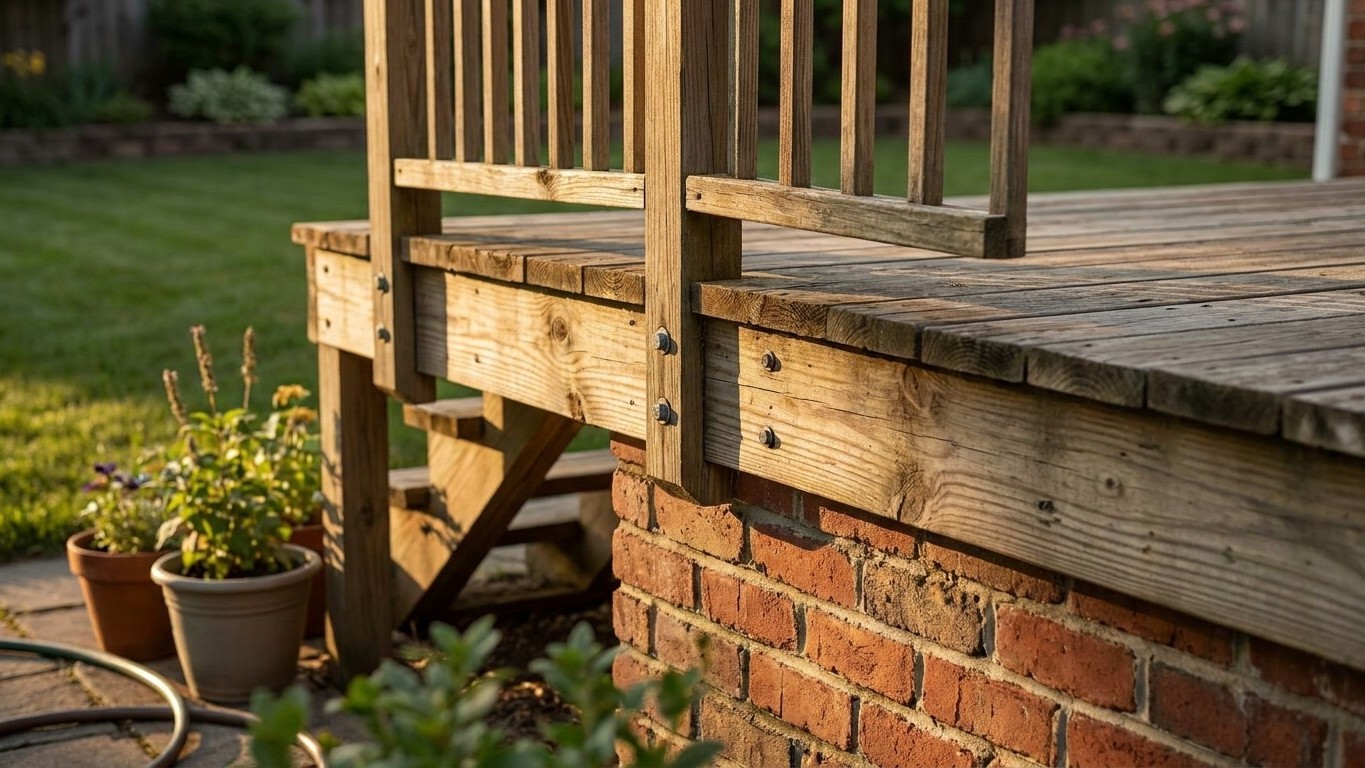
Here is where the detail in the title really bites. A deck physically bolted onto the main dwelling can sometimes be classed as an extension, which brings its own set of planning rules into play. A freestanding deck sitting beside the house is one thing. A deck that is structurally fixed to the wall, sharing load-bearing connections, ledger boards screwed directly into the fabric of the building — is, in the eyes of planners, something else altogether. If the decking forms part of a larger piece of work, such as an extension with additional decking, then there may be different or further rules which apply to the entire development, and these could mean planning permission or prior approval is required.
This distinction, freestanding versus attached, matters for building regulations too, not just planning. Timber typically has better fire performance ratings than composite boards, which may affect building regulation requirements for structures attached to buildings. An attached deck is treated differently under the rules, and building regulations should be assumed to apply to every deck structure requiring planning permission. Many homeowners believe that getting planning permission sorted is the end of the compliance conversation. It isn’t. Building regulations approval is a separate process, managed by a separate part of the council entirely.
Special protections add another layer of complexity for a significant number of UK homes. You will almost certainly need to apply for planning permission if your home is located in a Conservation Area, or within a National Park or an Area of Outstanding Natural Beauty (AONB), where development is tightly controlled to protect the natural landscape. In those cases, even a ground-level deck close to the house may require full consent. Listed buildings face the most stringent controls, typically requiring listed building consent in addition to planning permission for any garden structures.
The council tax dimension: a quiet sting in the tail
Now for the part that is rarely mentioned in decking brochures. When you carry out significant work on your home and that work either requires planning permission or building regulations approval, the council is required to tell the Valuation Office Agency (VOA). The VOA is informed by building control, so if it was a legal extension under permitted development, the VOA should have been informed and an improvement indicator would show on the tax banding.
An improvement indicator sounds innocuous. This is the asterisk that appears after the council tax band, which means that the VOA may revalue the property and change its band the next time it is sold. So while you live in the house, your band stays put. The VOA follows strict laws around valuation, meaning, legally, it cannot change the council tax band of a property that has been improved until it is sold, or there is a general revaluation of all domestic properties. That is reassuring, up to a point. The sting arrives for whoever buys the house next.
If the improvement indicator is ‘yes’, it means that the VOA is aware that the current owners have carried out some fairly major improvements to the property, such as adding an extension or converting a garage into living accommodation. For council tax banding purposes, these improvements are ignored until the property is next sold, at which point the council tax band will be reassessed and may be raised as a result. One person on a well-known money forum described their house jumping from Band E to Band G after a large extension, applied by the VOA when it changed hands. A raised deck attached to the main house, requiring formal planning permission and building regulations approval, feeds directly into this mechanism. It becomes part of the recorded improvement history of the property.
The practical implication for sellers is real. If your decking is installed without permission, then you could also fail to gain any compliance certificates, which could cause issues if you plan on selling your property in the future. And if you do have permission, the improvement indicator sits quietly on the VOA record, visible to any canny buyer who knows to look. You can find your council tax band by visiting the Valuation Office Agency website at gov.uk and entering your postcode, and you can see your own band and all your neighbours’ bands, this is useful when building a challenge. Buyers increasingly do this before exchanging contracts, and a flag on the record is a legitimate negotiating point.
What to do before the first board goes down
The sensible approach costs nothing. Check with your local planning authority before any work begins, not after, and not halfway through. For anything likely to be considered permitted development, it is always recommended to obtain a Lawful Development Certificate before commencing any works. This is a formal document from the council confirming that your project falls within permitted development rights. It protects you, it protects the next buyer, and it removes any ambiguity from the VOA’s records.
If your deck design does need planning permission, because it is raised, because it is attached to the house, or because of where you live — the process is more straightforward than many people assume. The national grant rate for minor household applications, the category your decking would fall into, was a promising 88% in early 2025. Applications are overwhelmingly approved when they are prepared carefully.
One last thing worth knowing. Planning policies are ever-changing, and even if your decking is permitted development today, the council can impose new planning constraints that remove your permitted development rights at any time in the future. A Lawful Development Certificate, obtained at the time of construction, locks in your compliance at that moment. It is, in that sense, worth far more than the modest time it takes to apply for one, and considerably cheaper than the consequences of ignoring the 30cm rule altogether.
Sources : valuationoffice.blog.gov.uk | valuationoffice.blog.gov.uk