
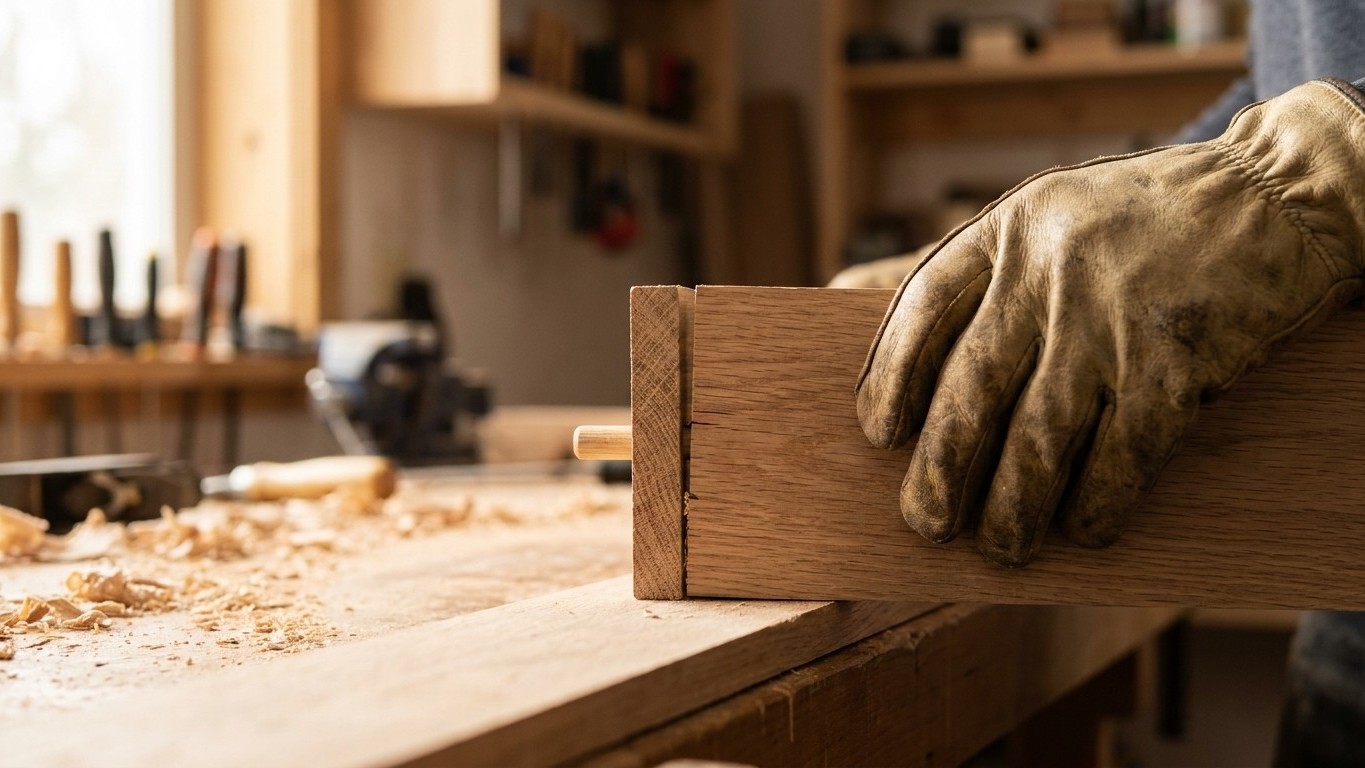
Dowel joinery looks deceptively simple. You drill a hole on each side, push in a glued peg, clamp it up, and wait. Most of us have done exactly this, and most of us have ended up with a seam that refuses to sit perfectly flat, a slight ridge on one side, a hairline gap on the other, or both. A carpenter friend watched me attempt this on a kitchen shelf last autumn, and within about thirty seconds he’d spotted three separate reasons why my joint was doomed before the glue even dried.
Key takeaways
- A single millimetre of drill drift doesn’t create a millimetre gap—it levers the entire seam apart
- The type of dowel you choose (spiral vs. straight-grooved) creates hydraulic pressure that shifts your boards during assembly
- Most woodworkers clamp the wrong direction, compressing boards end-to-end instead of pulling faces together
The alignment problem nobody talks about
The fundamental issue with hand-drilled dowel joints is that you are attempting to hit two identical targets on two separate pieces of wood, using a hand-held drill and your best guess. Even a skilled woodworker drifts by a millimetre or two when drilling freehand. The trouble is that a one-millimetre offset between your two holes doesn’t produce a one-millimetre gap, it levers the boards apart along the entire length of the seam, creating a curved or angled misalignment that gets worse the longer your boards are.
My carpenter friend, who has been doing this for the better part of thirty years, put it plainly: “The drill bit wanders, every single time. Even on a drill press it wanders slightly. By hand, you’re just hoping the errors cancel each other out.” On a short joint, say two boards 30 centimetres long, you might get lucky. On anything longer, the odds stack against you rapidly.
The depth of your holes matters too, and in a way that surprises most people. Many home joiners drill their holes too deep on one side, which means the dowel bottoms out before the faces of the boards make contact. You clamp with force, the joint feels solid, and you unwrap it the next morning to find a consistent gap running the full length. That gap is exactly as wide as the surplus depth you accidentally drilled. Aim for holes that are 1–2 millimetres deeper than half the dowel length on each side, no more.
Why your dowels themselves may be the culprit
Spiral-grooved dowels are sold in every hardware shop and, for most people, they’re the obvious choice. My carpenter friend, however, reached into his apron and held up a straight-grooved dowel alongside a spiral one. The difference is subtle but the consequence is real. Spiral grooves pull glue down into the hole as you push the dowel in, which creates a hydraulic pressure inside the blind hole. That pressure pushes back. In a rigid jig on a bench press, this is manageable. Held in your hands, it can shift the board by just enough to ruin the flush face you were after.
Straight-grooved dowels (sometimes called ribbed dowels) allow air and excess glue to escape along the length of the groove rather than compressing beneath the peg. They’re not always easy to find in smaller village hardware shops, but any decent timber merchant will stock them. If you can only find spiral dowels, don’t panic, trim a shallow flat along one side with a craft knife before assembly, which gives the trapped air somewhere to go.
Dowel diameter relative to board thickness is another thing worth getting right before you start drilling. A common rule of thumb in the trade is that your dowel should be no wider than one-third of the board thickness. So for an 18mm MDF shelf, an 8mm dowel is about the limit. Go wider and you’re weakening the wood around the hole, which leads to slight crushing and, yes, a seam that shifts.
Getting it right without spending a fortune on jigs
A proprietary dowelling jig, the kind with a metal sleeve to guide the bit, costs anywhere from about £12 to £40 depending on quality, and my carpenter friend considers it the single most worthwhile outlay for any home woodworker attempting edge-to-edge joins. The sleeve keeps the bit perpendicular to the face and, crucially, at a consistent distance from the edge of the board. This is what eliminates the twin-error problem: both holes land in precisely the same relative position.
If you’d rather not buy a jig, there is an old-fashioned method that actually works surprisingly well. Drill your first board’s holes. Push small metal pins (sold as dowel centre points, usually a couple of pounds for a pack) into each hole. Press the second board firmly against the first in exactly the position you want it, and tap gently with a mallet. The pins transfer tiny indent marks onto the second board showing you exactly where to drill. No measuring required across two surfaces, the geometry transfers itself.
Clamping technique matters more than most guides admit. Clamp across the joint, not along it. Two sash clamps running perpendicular to the seam will pull the faces together; clamping parallel to the boards just compresses them end-to-end and does very little for the flush face you’re trying to achieve. Use a wooden caul (a straight scrap piece pressed between the clamp head and your good wood) to spread the pressure and avoid denting.
One thing my carpenter friend mentioned that I hadn’t expected: glue moisture swells bare wood fibres around the hole, sometimes enough to raise the grain slightly above the face surface within the first hour of clamping. This is temporary, but if you unclamp too early, say after just an hour with PVA, and then try to sand flush immediately, you’re actually sanding the swollen fibres flat. Once the moisture dissipates over the following day, those fibres sink back down, leaving a faint depression right along your join line. Leaving the joint clamped for a full eight hours, then waiting a further 24 hours before any surface finishing, sidesteps the problem entirely.