
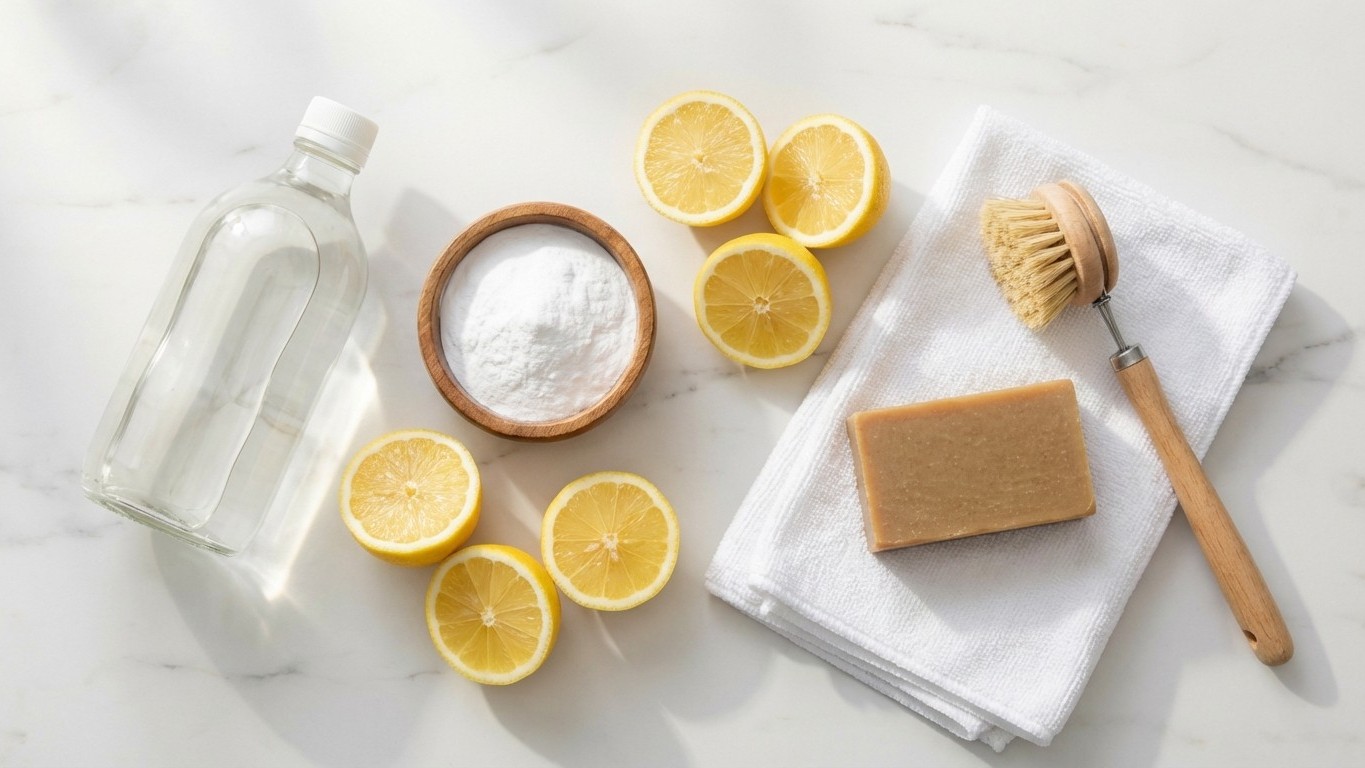
Four ingredients. That’s genuinely all you need to clean the vast majority of your home from top to bottom, without filling your cupboards with plastic bottles of mysterious chemicals or spending a small fortune every month at the supermarket. White vinegar, bicarbonate of soda, lemon, and Castile soap have been doing this job quietly and reliably for generations, and the reason they’re having something of a revival right now isn’t nostalgia, it’s that they actually work. The trick, though, is knowing which one to reach for, when to combine them, and when to keep them firmly apart.
Why natural ingredients are worth the switch
The problem with conventional cleaning products
Most supermarket cleaning sprays contain a cocktail of synthetic surfactants, preservatives, artificial fragrances and, in some cases, compounds that regulatory bodies classify as potentially harmful with repeated exposure. Bleach-based products, for instance, can release chlorine gas when accidentally mixed with ammonia-containing cleaners, a combination that happens more often in British kitchens than you might imagine, simply because product labels are dense and confusing. Even natural ingredients like vinegar require careful consideration about what not to mix vinegar with when cleaning. Beyond the safety angle, there’s the environmental cost: much of what goes down the drain after mopping your floor ends up in waterways, where certain synthetic surfactants are slow to biodegrade.
The financial argument is just as compelling. A 5-litre bottle of white vinegar costs a fraction of a branded bathroom cleaner, and a 500g box of bicarbonate of soda covers dozens of cleaning tasks. There are countless cleaning with vinegar and baking soda hacks that demonstrate just how versatile these simple ingredients can be. Once you’ve built up your small stock of natural ingredients, you’ll find the weekly shopping bill for cleaning supplies drops noticeably.
What natural ingredients bring to the table
The appeal goes beyond penny-pinching, though. Natural cleaning ingredients are largely transparent, you know exactly what they are and what they do. White vinegar is acetic acid diluted in water. Bicarbonate of soda is sodium bicarbonate. Lemon juice is citric acid with a pleasant smell. Castile soap is a plant-oil-based soap with no synthetic detergents. Other natural cleaners like hydrogen peroxide natural cleaning uses and essential oils cleaning hacks safe use offer additional eco-friendly options. Each has a specific set of properties you can understand and predict, rather than a proprietary formula you simply have to trust.
They’re also genuinely versatile. The same bottle of white vinegar that descales your kettle can freshen your washing machine, dissolve soap scum from shower tiles, and clean your windows to a streak-free shine. Lemon works similarly well for tackling limescale buildup throughout the home. That kind of multi-tasking is hard to match with specialist products. For a broader view of how these ingredients slot into a complete cleaning routine, the guide to natural cleaning hacks covering 40 recipes and methods for the whole home is a wonderful place to start, or explore specific castile soap cleaning hacks for home and cleaning hacks with lemon for limescale removal.
The four star ingredients, one by one
White vinegar: powerful, cheap, and widely misunderstood
White vinegar’s cleaning power comes from its acidity, typically around 5% acetic acid in standard household varieties. That acidity makes it excellent at dissolving mineral deposits (limescale, hard water marks), cutting through grease when used warm, and acting as a mild antimicrobial on everyday surfaces. It also neutralises alkaline odours, which is why a bowl of vinegar left overnight in a musty room genuinely does help.
The misunderstandings, however, are real and worth addressing directly. Never use white vinegar on natural stone — marble, granite, slate, and travertine are all calcium-based, meaning acid will etch and dull them over time, sometimes irreversibly. Avoid it on unsealed grout for the same reason, and keep it away from cast iron cookware and egg stains (the protein sets rather than lifts). Diluted to roughly one part vinegar to two or three parts water, it becomes a gentler all-purpose spray suitable for most hard surfaces. Used neat, it’s better reserved for stubborn limescale jobs.
For a detailed breakdown of how to get the best out of this ingredient paired with bicarbonate, the dedicated page on cleaning with vinegar and baking soda hacks covers dosages, methods and the situations where each works best.
Bicarbonate of soda: the gentle abrasive with hidden talents
Bicarbonate of soda is mildly alkaline, which makes it the chemical opposite of vinegar, and that’s rather useful. Where vinegar tackles acidic problems like limescale (a base mineral), bicarbonate tackles acidic stains and odours, including many food smells, pet odours, and the sourness that builds up in drains and fridges. Sprinkled on a damp cloth, its fine crystalline structure provides gentle abrasion that lifts grime without scratching most surfaces, making it perfect for oven doors, hob rings, and bathroom basins.
As a deodoriser, it’s almost unbeatable. An open box left in the fridge absorbs odours passively for weeks. Mixed into a paste with a little water and applied to a smelly drain before flushing with boiling water, it freshens pipes without any harsh chemicals. It also works beautifully as a fabric softener alternative in the washing machine, half a cup added to the drum softens laundry, reduces static and doesn’t leave a scent, which is particularly good for those with sensitive skin.
Lemon: the cheerful multi-tasker
Lemon juice contains citric acid, which gives it similar descaling properties to vinegar but with a more pleasant smell. The citric acid content is lower than in vinegar (roughly 5–8% in fresh lemon juice versus 5% acetic acid in vinegar), so it’s slightly gentler for delicate applications, though this also means it may need longer contact time on heavy limescale. Where lemon really shines is on cutting boards, where its antibacterial action combined with a salt scrub lifts stains and odours from wood far better than most sprays.
Lemon peel steeped in white vinegar for two weeks produces a cleaning liquid that smells far more pleasant than plain vinegar while retaining its descaling power, a simple trick that costs almost nothing. The full range of what lemon can do against hard water deposits, from kettles to shower heads, is explored in the guide to cleaning hacks with lemon for limescale.
Castile soap: the plant-based all-rounder
Originally from the Castile region of Spain, this soap is made from saponified plant oils (traditionally olive, though modern versions use coconut, hemp or jojoba as well). Unlike synthetic detergents, it biodegrades rapidly and contains no petrochemicals. A small amount goes a surprisingly long way, a teaspoon in a litre of warm water makes an effective floor cleaner; a few drops on a damp sponge cut through kitchen grease on hobs and worktops.
Castile soap is also the most surface-friendly of our four ingredients. It’s safe on wood (diluted), tiles, stone (unlike vinegar), fabric, and skin. The one place it struggles is in hard water, where it can leave a white, chalky film. Adding a small splash of white vinegar to your rinse water usually resolves this. For room-by-room guidance on using Castile soap around the home, the page on castile soap cleaning hacks for home is full of practical recipes.
Combining ingredients: what works and what really doesn’t
The vinegar and bicarbonate question
This is probably the most common question in natural cleaning, and the honest answer is a little nuanced. Mixing vinegar and bicarbonate produces a satisfying fizz, carbon dioxide gas bubbling up as the acid and base neutralise each other. The fizzing is visually convincing, but chemically speaking, the two ingredients largely cancel each other out in the process. What you’re left with is mostly water and sodium acetate, which has little cleaning power.
That said, there are specific situations where using them sequentially (not simultaneously mixed in advance) is highly effective. Sprinkling bicarbonate on a greasy oven surface, then spraying white vinegar over the top, creates a fizzing action that physically lifts grime, making it easier to wipe away. The mechanism here is more mechanical than chemical, the bubbles help dislodge dirt. For a precise look at when this combination genuinely earns its place and when it’s just theatre, the deep dive into cleaning with vinegar and baking soda hacks lays it out clearly.
Mixtures to avoid, full stop
Not all natural ingredients play nicely together, and a couple of combinations go beyond merely ineffective into genuinely hazardous territory. Castile soap and vinegar should never be mixed directly, the acid in the vinegar unsaponifies the soap, breaking it back down into its oil components and producing a greasy, curdled mess that leaves surfaces worse than before. Use them separately, with a rinse between applications.
Hydrogen peroxide (sometimes used alongside natural cleaning ingredients) and vinegar make a stronger oxidising compound when combined in the same container, safe when used on surfaces one after another with a gap, but not to be stored or mixed together. For anyone curious about where hydrogen peroxide fits into a natural cleaning kit, the detailed guide on hydrogen peroxide natural cleaning uses covers this carefully, including the safety boundaries.
Room-by-room hacks that actually make a difference
Kitchen: grease, smells and sticky surfaces
The kitchen is where natural cleaning ingredients truly earn their keep. For a greasy hob, a paste of bicarbonate and a few drops of Castile soap applied with an old toothbrush, left for ten minutes then wiped away, tackles burnt-on residue without scratching ceramic or glass. The inside of a microwave steamed with a bowl of water and lemon juice for three minutes softens splatter to the point where a simple wipe is all that’s needed. Drains that smell stale benefit enormously from a generous spoonful of bicarbonate, followed by a cup of boiling water and a splash of white vinegar, do this weekly and the problem rarely returns.
Wooden chopping boards deserve special attention. A handful of coarse salt, half a lemon used as a scrubber, left for five minutes then rinsed, lifts stains and kills surface bacteria with no harm to the wood. It’s one of those tricks that looks almost too simple to work, and yet reliably does.
Bathroom: limescale, grout and that persistent soap scum
Hard water is the bathroom’s worst enemy in most parts of the UK, and white vinegar is its best counter. Soaking a cloth in neat white vinegar and wrapping it around a limescale-encrusted tap for an hour dissolves the deposit far better than most branded products. Shower screens wiped with a diluted vinegar spray after each use rarely develop the stubborn soap scum that requires serious effort to shift later.
Grout is trickier, and here it’s worth being cautious. Undiluted vinegar used repeatedly on grout can degrade the cement over time, so bicarbonate paste applied with a toothbrush is the safer long-term approach for whitening discoloured grout lines. Rinse thoroughly afterwards. For shower heads and taps, lemon’s citric acid deserves a mention, it’s gentler than neat vinegar and leaves a pleasant smell, and the guide to cleaning hacks with lemon for limescale explains exactly how long to soak and what results to expect.
Floors, carpets and textiles
A litre of warm water with a tablespoon of Castile soap and a small splash of white vinegar (added to the rinse water, not mixed together directly) makes a floor cleaner that works on tiles, vinyl and sealed wood without leaving a sticky residue. On carpets, bicarbonate sprinkled generously, left for fifteen minutes, then hoovered up lifts odours effectively. For a fresh stain on fabric, tea, coffee, or a muddy paw print, a paste of bicarbonate and cold water applied immediately, allowed to dry fully, then brushed away deals with it before it sets.
Windows and mirrors
One part white vinegar to two parts distilled water in a spray bottle, applied with scrunched-up newspaper (a trick that genuinely dates back decades and still outperforms many microfibre cloths for streak-free results), leaves glass sparkling. The key is to avoid cleaning windows in direct sunlight, which dries the solution too quickly and leaves smears regardless of what you’re using.
Five DIY recipes to make right now
Multi-purpose vinegar and lemon spray
Fill a 500ml spray bottle with 200ml of white vinegar and 300ml of cold water. Add the juice of half a lemon or a few drops of lemon essential oil. Shake gently before each use. Suitable for worktops, tiles, sinks and hobs, but not on stone or natural marble.
Bicarbonate and Castile soap cleaning paste
Combine 120g bicarbonate of soda with enough liquid Castile soap to form a thick paste (roughly 3–4 tablespoons). Add 10 drops of tea tree essential oil if you’d like antimicrobial action. Apply with a damp sponge, scrub, then rinse thoroughly. Excellent for oven doors, bathroom basins and tile grout.
Express fabric stain remover
Mix one tablespoon of bicarbonate of soda with the juice of half a lemon to form a thin paste. Apply directly to the stain, gently work in with a soft cloth, leave for 20 minutes, then rinse with cold water. Do not use on delicate silk or wool without testing a hidden area first.
Gentle all-purpose floor cleaner
In a mop bucket, combine 4 litres of warm water with one tablespoon of liquid Castile soap. Mop the floor, then follow with a rinse mop dampened with plain water to which you’ve added a tablespoon of white vinegar. This prevents any soapy residue and leaves floors clean rather than sticky.
Anti-limescale spray for taps and showerheads
Mix equal parts white vinegar and water (or replace the vinegar with freshly squeezed lemon juice for a milder, pleasantly-scented version). Spray directly onto limescale, leave for 15–30 minutes depending on severity, then scrub with an old toothbrush and rinse. For very heavy deposits, apply neat vinegar on a wrapped cloth and leave for up to an hour.
FAQ: the questions that come up time and again
Can lemon fully replace vinegar for descaling? For light to moderate limescale, yes, lemon juice is very effective and smells far better. For heavy, built-up deposits, white vinegar’s acidity and volume tend to win. Many people use both, alternating depending on the surface and the severity of the problem.
Which surfaces should never meet white vinegar? Natural stone (marble, granite, slate), cast iron, unsealed grout, and anything with a wax finish. The acid either etches the surface, strips the finish, or in the case of cast iron, encourages rust.
Is it really safe to mix bicarbonate and vinegar? As a stored mixture, no, it’s pointless, as they neutralise each other immediately. Used sequentially on a surface for mechanical fizzing action, it can be a useful trick for dislodging grime, but don’t expect a chemical cleaning miracle from the combination.
How do I use Castile soap without leaving a residue? The main culprit is hard water. Use slightly less soap than you think you need, and always rinse with water that contains a small splash of white vinegar. This prevents the chalky film that forms when soap reacts with hard water minerals.
Are these ingredients safe around children and pets? Generally yes, with sensible precautions. Keep all cleaning solutions, even natural ones, out of reach. White vinegar and lemon juice are mildly acidic and should not go near eyes. Castile soap is gentle but not meant to be ingested. Bicarbonate in large quantities can cause digestive upset in pets if they walk through it and lick their paws, so hoover it up thoroughly after use on carpets.
Taking your natural cleaning routine further
Once you’ve got comfortable with these four ingredients in their basic forms, the possibilities genuinely expand. Infusing white vinegar with citrus peels, rosemary or lavender gives you cleaning sprays with natural fragrance and no synthetic additives. Building up a small stock of refillable spray bottles means you’re never tempted to buy a single-use plastic bottle again. Some people find that moving to a natural cleaning routine also prompts a broader look at the home, swapping disposable cleaning cloths for washable ones, for instance, or reconsidering how often certain things actually need cleaning at all.
The relationship between cleaning and wellbeing is a quietly interesting one. A home that smells of lemon and clean air rather than artificial pine or synthetic lavender tends to feel rather different to live in, and many people report that simpler routines feel less of a chore. Whether that’s psychology, chemistry, or simply the satisfaction of knowing exactly what’s in your cleaning cupboard is perhaps a question worth sitting with. Either way, these four ingredients have been doing this job for a long time, and they’re not about to stop.