
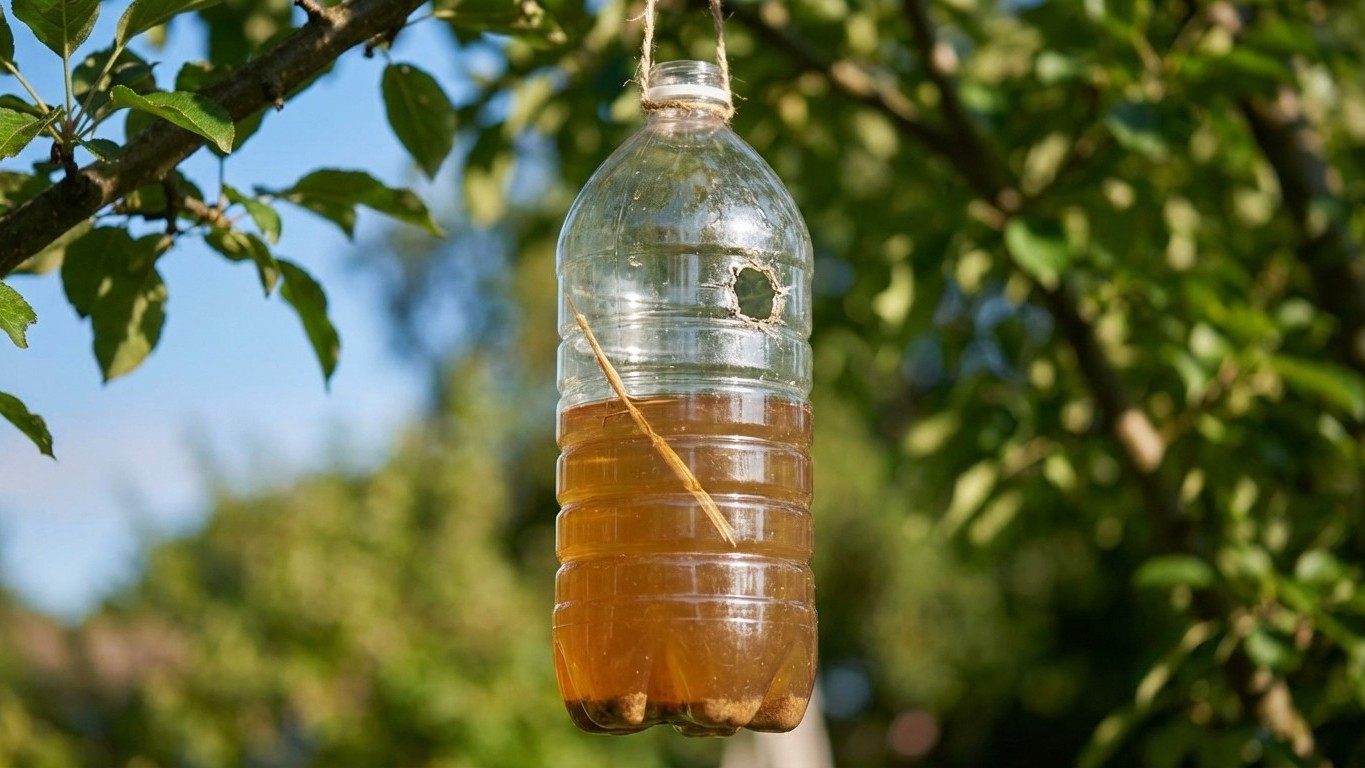
March is not a month that catches most gardeners’ attention. We’re busy turning compost, staking sweet peas, debating whether it’s truly warm enough to sow beans. But there is one task quietly performed by experienced beekeepers and sharp-eyed allotment holders that could spare your garden months of trouble: setting a spring queen trap for the Asian hornet. One small bottle, one simple bait, and a bit of string from a sunny branch. That is quite literally all it takes.
Key takeaways
- One solitary queen in March could spawn 10,000+ hornets by October—but there’s a narrow window to stop her
- The bait formula sounds like a cocktail, not pest control, yet it’s devastatingly effective at luring queens while repelling native bees
- A single two-litre bottle hung in the right spot could be the difference between a thriving garden and a hornet-infested wasteland
Why March? The Queen Is Alone, and That Is Her Weakness
Mated queens emerge from hibernation in spring, feed themselves, build a small initial nest, lay a few eggs, and feed and tend to the larvae. This is the window that matters. After hibernating over winter, the queen will emerge and seek out a sweet, carbohydrate-rich food source in order to build up energy to commence building a small embryonic nest. During construction of the nest, she is alone and vulnerable, but she will begin laying eggs to produce the future workforce.
Think about the scale of what follows if she is left unhindered. During the summer, a single yellow-legged hornet colony can produce an average of 6,000 individuals in one season. And it does not stop there. A single secondary nest in September can produce around 350 queens that disperse, potentially flying up to 50 miles, before they hibernate and the winter survivors emerge the next year to create a new nest with thousands of workers and up to 350 more queens to start the cycle again. One queen in March. Potentially tens of thousands of hornets by October. The maths are sobering.
With new queens emerging from hibernation mid-February/March, it is important to have bait stations in place before the queens can get a chance to establish themselves. Early detection of just one Asian hornet queen in the spring can potentially avoid hundreds, if not thousands, of new queens being produced later in the year ready to expand the following year.
The State of Play in Britain Right Now
This is not a distant continental problem. The Asian Hornet Action Team community has taken stock of a very active year, having had more than twice any previous peak number of nests in the UK and over a bigger area: 161 nests destroyed and more than 580 confirmed sightings, compared to 73 nests in 2023. Sightings are arriving earlier each year too. The first sightings in 2025 were a month earlier than in 2024, which was a month earlier than in 2023.
One nest can consume about 11 kilograms of insects in a single season. Asian hornets are particularly dangerous to honey bees, with a single hornet able to kill up to 50 bees daily through a hunting technique called “hawking”, hovering outside beehives to catch returning foragers. For those of us who rely on pollinators for our vegetable patches and fruit trees, that is not background noise; that is a genuine threat to next year’s harvest. The government officially designated 2025 as potentially the last realistic opportunity for eradication in the UK. Whether or not that window has now closed, the case for trapping in your own garden has never been stronger.
How to Build the Trap and Mix the Bait
The good news is that you do not need anything expensive. If you wish to construct your own trap, there are pre-made trap openings called ‘ferrules’ that can be purchased and installed in homemade traps. Alternatively, there are many patterns for 3D printing. Use of these will help prevent the capture of non-target invertebrates. A clean two-litre plastic bottle will do the job perfectly well for a basic monitoring trap. Cut a small entrance hole in the upper third, large enough for a hornet to squeeze through but not so large that bumblebees wander in freely. Push a piece of straw or a floating wick inside so any trapped insects sit above the liquid rather than drowning in it, the trap should not drown insects but provide a surface for them to stay afloat of the attractant so those that are not Asian hornets can be safely released. Paint the roof dark if you can; it is thought to guide hornets in more reliably.
Now for the bait, and this is where the old gardeners’ recipe earns its reputation. Sweet baits are highly attractive to foraging yellow-legged hornet queens in early spring. This is because queens emerging from hibernation need high-energy, sweet foods. The classic mixture, recommended by French beekeepers and widely used across Europe, is straightforward: use the “classic” mixture of one third beer, one third wine, and one third red fruit sugar syrup. The trap should be placed vertically and include some straw or another floating material to prevent drowning. Blackcurrant cordial or blackcurrant syrup is the version most often recommended, as dry white wine’s acidity and alcohol act as a strong bee repellent, bees dislike the smell. That is the clever bit. You are not just attracting hornets; you are actively putting bees off investigating the trap. Fill it only halfway, hang it at head height in a sunny sheltered spot, and you are done.
The best time to install the trap is early spring, when temperatures exceed 15°C. This is when the queens begin to emerge from hibernation. In practice, late February or early March is ideal for southern England; mid-March works well further north. Spring trapping will finish in early June, as this is the time the queens stop flying to forage for the nest as the newly emerged workers take over. So your window is roughly ten to twelve weeks, and the earlier you start, the better.
Checking Your Trap, Protecting What You Catch
A trap you never check is almost worse than no trap at all. The trap will also catch our native hornet Vespa crabro and other beneficial insects. It will therefore need regular monitoring, preferably daily, to release them. Do wear a veil when you open it, and keep the bait fresh. Most experienced trappers replace the bait every week to ten days.
If you do catch something that looks like an Asian hornet, dark, velvety body, yellow-tipped legs, a single orange band across the lower abdomen, do not panic, but do act. If you think you have caught an Asian hornet, it may be helpful to place the whole trap, unopened, into a freezer bag that you can seal tightly; place the bag containing the trap into a domestic freezer for 12 hours before opening, to avoid losing your suspect. Then photograph it carefully and report it via the free Asian Hornet Watch App. During 2024, nearly 30,000 reports were made via the mobile application. Approximately 70 of these were credible, and 24 nests were found because of those reports. Every single sighting reported is a gift to the beekeepers, ecologists, and National Bee Unit inspectors working to contain this insect.
One last thought. The Department for Environment, Food & Rural Affairs (DEFRA) is recommending monitoring be placed in all areas of the country, even where there is no Asian hornet incursion known at the time. This is in the expectation that if Asian hornets are in the area, they will be trapped and identified. You might hang your bottle in a fruit tree in Shropshire and catch nothing all season, and that, genuinely, is a good result. It means your garden is clear, or close to it. The trap is as much a listening device as a weapon. Whether it catches a queen or simply tells you the coast is clear, it is doing its job. And with spring already knocking at the door, there is no better time to give it something useful to do.