
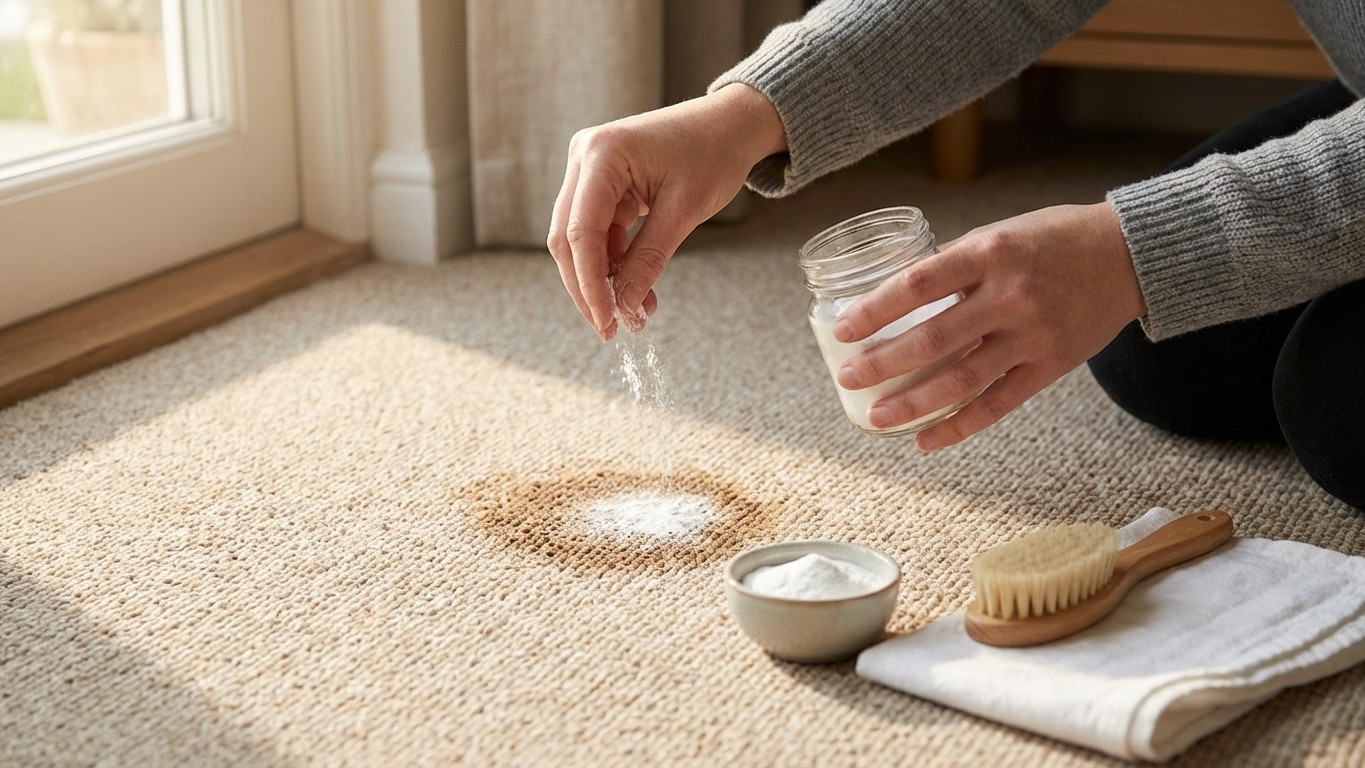
A gentle, budget-friendly way to lift carpet stains
Carpets have a talent for catching life as it happens, a tipped mug of tea, muddy paws, a dropped spoonful of curry. If you are trying to remove carpet stains naturally baking soda is one of the most dependable little helpers in the cupboard. It is inexpensive, easy to store, and kinder to sensitive households than many fragranced sprays.
I like bicarbonate of soda because it does two jobs at once: it helps loosen and lift grime, and it calms down odours that cling to fibres. That said, it is not magic, it works best with the right technique, the right amount of water, and a bit of patience. Below you will find very practical, step-by-step methods by stain type, plus sensible limits so you do not damage a treasured rug.
Why choose baking soda to remove carpet stains?
The cleaning and deodorising properties of baking soda
Bicarbonate of soda (sodium bicarbonate) is a mild alkaline powder. In plain terms, that means it can help with common household acids and sticky residues. On carpets, it tends to work in three useful ways:
- Absorption: it can soak up moisture and some oily residues when used as a dry powder.
- Gentle abrasion: the fine crystals help loosen dried-on grime when you brush or blot, without the harsh scratchiness of some powders.
- Odour control: many smells are acidic or clingy; bicarbonate helps neutralise and trap them so they vacuum away.
For fresh spills, baking soda often shines as a “save it quickly” step. For older stains, it works best when paired with a controlled, small amount of liquid so it can penetrate, then be extracted thoroughly.
Baking soda vs. chemical cleaners: effectiveness and health impact
Many carpet stain removers rely on strong surfactants, solvents, or heavy fragrance. They can work quickly, but they also leave residues that attract soil, and some people find the scents irritating, especially in homes with babies, asthma, or pets that spend their time nose-down.
Baking soda is milder and usually easier to rinse out. It is also a sensible choice when you are aiming for an eco-friendlier routine, because you can use small quantities and avoid aerosol propellants. The trade-off is that it needs proper dwell time, careful blotting, and thorough drying, otherwise you can end up with a pale patch of powder left behind or a “ghost” stain that wicks back.
Before you start: prep tips for safe, effective stain removal
Identify the stain and test the fibre
Carpet fibres vary widely. Wool, sisal, jute and other natural fibres can be more sensitive to alkalinity, overwetting, and scrubbing. Many synthetic carpets (like nylon or polypropylene) are more forgiving, but dyes can still bleed if you are too wet or too rough.
- Work out what happened: food and drink, pet accidents, grease, mud, wax, ink, and rust all behave differently.
- Check the age: fresh spills respond best. Old stains often need repeated, gentle cycles.
- Do a patch test: in a hidden corner, apply your chosen method, wait 10 minutes, blot, then let it dry fully. Look for colour change, texture change, or a tide mark.
If your carpet is labelled wool-rich or you suspect a delicate dye, keep the baking soda contact time shorter and avoid vigorous brushing. When in doubt, proceed conservatively.
What you will need (and sensible precautions)
Most of this is already at home. No fancy gadgets required.
- Bicarbonate of soda (baking soda)
- Clean, white cloths or kitchen roll (white helps you see colour transfer)
- Soft brush (an old nail brush or soft upholstery brush)
- Vacuum cleaner with a good suction head
- Spray bottle for plain water
- Small bowl and measuring spoons
- Optional: a blunt spoon for lifting solids, and a fan for drying
Safety notes for February 2026 households, where we are all a bit more mindful about indoor air: avoid dusty clouds of powder. Sprinkle close to the carpet, then work it in gently. Keep pets and children off the area until you have vacuumed and the carpet is dry, because damp fibres plus powder can be tempting to sniff or lick.
Step-by-step: remove carpet stains naturally with baking soda
The universal method (works for most fresh spills)
This is my steady, reliable routine when you are not dealing with dye-heavy stains like wine, or greasy stains like butter.
- Step 1, lift solids: use a spoon to remove any bits. Do not rub them in.
- Step 2, blot: press a clean cloth firmly to soak up as much liquid as possible. Keep swapping to a dry section.
- Step 3, lightly mist with water: use 1 to 2 teaspoons of water in total for a hand-sized stain. You want “barely damp”, not wet.
- Step 4, apply baking soda: sprinkle 1 tablespoon over a stain about the size of your palm. For larger areas, use roughly 1 tablespoon per 20 cm by 20 cm section.
- Step 5, dwell time: leave 30 to 60 minutes for a fresh stain. If it is a bit older, aim for 2 to 4 hours.
- Step 6, vacuum thoroughly: go slowly in two directions. If you still feel grit, vacuum again.
- Step 7, inspect once dry: stains can look gone while damp and reappear as they dry. Wait until fully dry before repeating.
My small piece of humour here: if you are tempted to scrub, put the brush down and make a cup of tea. Blotting is dull, but scrubbing frays fibres and spreads stains.
Protocols by stain type
Coffee and tea stains
These are often tannin-based and can brown as they dry. Speed helps.
- Blot immediately.
- Mist with water very lightly, then sprinkle 1 tablespoon baking soda per palm-sized area.
- Work the powder in with a soft brush using small circles for 10 to 15 seconds.
- Leave for 1 hour, vacuum.
- If a shadow remains, repeat once. For stubborn rings, see the “advanced” section below.
Red wine and berry juice
These are strong dyes, and baking soda helps best as an absorber and odour calmer, rather than a complete bleach-free miracle.
- Blot, blot, blot. Keep going until you stop seeing colour transfer.
- Cover with baking soda straight away, 2 tablespoons for a palm-sized stain, no water yet.
- Leave 15 minutes, vacuum.
- Now do a light mist of water, sprinkle 1 tablespoon more, and leave 1 to 2 hours.
- Vacuum thoroughly, then let it dry fully before judging.
If the stain is intense, you may need repeated cycles over a day, with full drying between. That “dry between” bit prevents wicking, where colour travels back up as the backing dries.
Grease, butter, oily food, makeup
For oils, keep things dry at first. Water can spread greasy marks.
- Lift solids with a spoon.
- Sprinkle a generous layer of baking soda, about 2 tablespoons per palm-sized area.
- Gently press the powder into the fibres with a cloth, do not rub hard.
- Leave 4 to 8 hours, overnight is often best.
- Vacuum slowly and thoroughly.
- If you still see a dark patch, repeat once more. After the second cycle, you can add a tiny mist of water before the powder if it is more “sticky residue” than “oil”.
Mud and outdoor grime
Mud is easiest when it is properly dry. Wet mud is a smear waiting to happen.
- Let it dry completely. Put a towel over it if you are worried about footprints.
- Vacuum to remove loose dirt.
- Sprinkle 1 tablespoon baking soda, brush in lightly, leave 30 minutes.
- Vacuum again.
- If a brownish mark remains, use the universal method with a tiny mist of water, then baking soda for 1 hour.
Pet accidents (urine, vomit)
These are a mix of moisture, odour, and sometimes colour. Quick action helps, and drying matters even more.
- Blot up as much as possible, pressing firmly with cloths.
- Mist lightly with water, then blot again. This dilutes without flooding.
- Cover with baking soda, 2 to 3 tablespoons for a palm-sized patch.
- Leave 4 to 8 hours, then vacuum thoroughly.
- Keep the area well ventilated until fully dry.
If odour is the main issue, you may also want to read a dedicated guide on the natural way to deodorise carpet, because smells can sit deeper than the visible stain.
Old, set-in stains
When people ask, “How do I use baking soda to remove an old carpet stain?”, the honest answer is: use it in cycles, and be patient. Old stains have had time to bond and migrate.
- Vacuum the area first to remove dust and grit.
- Lightly mist with water, think damp, not soaked.
- Apply 1 tablespoon baking soda per 20 cm by 20 cm.
- Cover with a clean, dry towel and press with your hands for 20 seconds. This helps contact.
- Leave 4 hours, vacuum.
- Let it dry fully, then repeat the next day if needed.
Dosages, dwell times, and mistakes to avoid
- Overwetting: too much water can push stains into the underlay and cause browning or mildew smells. Use teaspoons, not cups.
- Scrubbing hard: it can fuzz fibres and spread colour.
- Skipping the vacuum: powder left in the pile attracts soil and looks dull.
- Too much baking soda: a light, even layer works better than a thick cake, unless you are absorbing oil.
- Not letting it dry: judging a stain while damp is misleading, and repeating too soon risks wicking.
If the stain persists: advanced, still-natural options
Sometimes baking soda needs a sensible partner. The aim is still gentle and low-tox, with minimal residue.
- Warm water and time: repeat the old-stain cycle, but extend dwell to 8 hours and vacuum twice.
- Spot extraction with a towel press: after misting, place a folded towel over the area and stand on it carefully for 20 to 30 seconds, then apply baking soda and leave to dry. This pulls moisture up rather than pushing it down.
- Address the whole patch: a small stain can leave a clean circle. Treat a slightly wider area, feathering the edges with a light sprinkle, so it blends.
If nothing shifts after two or three gentle cycles, the stain may be in the backing or underlay, or it may be a dye change rather than “dirt”. At that point, a professional clean may be cheaper than replacing a carpet, and kinder than endless wetting.
Preventive care: keep carpets fresh without chemical products
Natural routines for carpet maintenance
A good routine reduces stain drama later. I am a great believer in doing small jobs often, it saves money and nerves.
- Vacuum twice weekly in high-traffic areas, once weekly elsewhere. Slow passes lift more grit.
- Door mats and a “shoes-off” habit cut down on outdoor grime more than any cleaner ever will.
- Monthly deodorising: sprinkle a light dusting of baking soda, about 1 to 2 tablespoons per square metre, leave 30 minutes, then vacuum. Keep it lighter on wool.
- Deal with spills immediately: blot first, then use the appropriate baking soda method.
If you enjoy building a full eco routine for floors, the broader round-up of natural carpet cleaning hacks is a handy companion, especially for drying tips and stain-specific variations.
Pairing baking soda with other natural ingredients (low-risk options)
People often want to mix everything at once. I prefer a calmer approach, because carpets dislike chemistry experiments.
- Baking soda and water: the safest pairing. Use a fine mist, not a soak.
- Baking soda and vinegar: they fizz, which looks satisfying, but the fizz is mostly the two neutralising each other. It can help loosen some residues, yet it also adds moisture and can set some stains if you are unlucky. If you use it, apply in sequence, not as a premix.
- Baking soda and mild washing-up liquid: if you choose to, use only a drop in 250 ml warm water, then blot well and finish with a baking soda dusting once the area is nearly dry. This keeps residue low.
For a fuller home-cleaning repertoire beyond carpets, you can browse natural cleaning hacks, then choose the gentlest method that suits your household.
FAQ: common questions about cleaning carpets with baking soda
Baking soda, vinegar, peroxide: what is compatible, and what needs care?
- Vinegar: fine for some deodorising and residue cutting, but use sparingly on carpets, and avoid soaking natural fibres. If you do use it, blot thoroughly and dry quickly.
- Hydrogen peroxide: it can lighten colours. In February 2026 it is still commonly sold for household use in some places, but concentrations vary, and misuse can bleach carpets. If you are committed to “100% gentle”, skip it, or only consider it with a strict patch test and great caution.
- Never mix in a bottle: baking soda and vinegar together mostly cancel out. Use them as separate steps if at all.
Does baking soda damage delicate or coloured carpets?
Most synthetic carpets tolerate baking soda well. Delicate, coloured, or natural-fibre rugs are where you slow down. Risks include:
- Colour shift if the dye is unstable, usually from too much moisture and agitation rather than the powder itself.
- Texture change if you scrub aggressively.
- Dullness if powder is not vacuumed out fully.
A patch test and a light hand prevent most problems. On wool, keep contact times shorter, use less powder, and avoid heavy wetting. If you have an heirloom rug, I would treat it like cashmere, gentle, minimal water, and no rushing.
When should you avoid baking soda on carpet?
- When the carpet is already damp underneath: flooding, leaks, or chronic damp. Powder can mask odour while moisture continues to cause trouble below.
- When the stain is rust or dye: baking soda rarely shifts rust, and strong dyes may need specialist treatment.
- When vacuuming is not possible: leaving powder behind can make the area grimy faster.
- On plant-fibre carpets like sisal: they can water-stain and warp easily. Use very dry methods and minimal misting, if any.
Keep going: build a calm, natural stain routine
Once you have practised a couple of times, the method becomes second nature: blot, tiny mist, sprinkle, wait, vacuum, dry, then repeat only if needed. If you would like a wider set of stain, drying, and routine ideas for the whole house, take a look at this collection of natural carpet cleaning hacks. Your next step is simply deciding where to start, a monthly baking soda refresh, or a little “stain kit” basket under the sink so you are ready when life, and gravity, do their thing.