
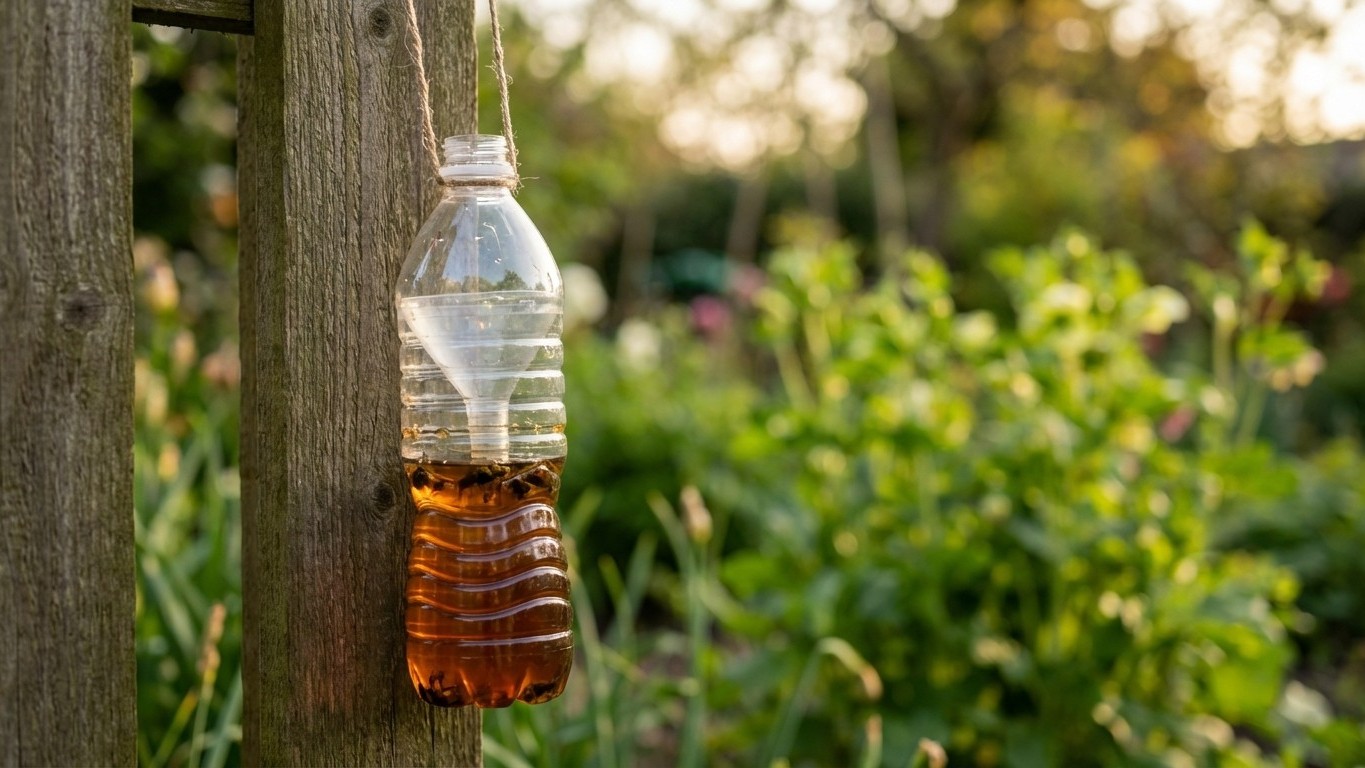
A single Asian hornet queen, caught in a homemade bottle trap during April, represents an entire colony that will never exist. Not metaphorically, quite literally. After hibernating over winter, the queen emerges and seeks out a sweet, carbohydrate-rich food source in order to build up energy to commence building a small embryonic nest. During construction, she is alone and vulnerable. Trap her now, before a single egg is laid, and the story ends there. Let her slip past, and by September you could be looking at thousands of hornets and a nest the size of a football.
Key takeaways
- One queen in spring becomes 6,000 hornets by September if left unchecked
- April is the ONLY month when a solitary queen is vulnerable enough to trap
- Second-generation hornets are already being born in Britain—the window is closing
Why April is the only month that truly matters
Asian hornets share the same life cycle as other Vespa species. Mated queens emerge from hibernation in spring, feed themselves, build a small initial nest, lay a few eggs, and feed and tend to the larvae. This brief window of solitude, before the first workers emerge, is the single most effective point in the entire yearly cycle to intervene. Each queen caught is potentially one less nest to find and destroy in the summer.
The mathematics of missing that window are sobering. A single secondary nest in September can produce around 350 queens that disperse, potentially flying up to 50 miles, before they hibernate and the winter survivors emerge the next year to create a new nest with thousands of workers and up to 350 more queens. During the summer, a single yellow-legged hornet colony can produce an average of 6,000 individuals in one season. One queen. Six thousand hornets. Think about that while you’re still deciding whether to bother making a trap.
Sweet baits are highly attractive to foraging yellow-legged hornet queens in early spring because queens emerging from hibernation need high-energy, sweet foods. That biological craving is the thing that makes your humble plastic bottle so surprisingly effective.
The urgency matters more than ever right now. 544 credible yellow-legged hornet sightings were reported in the UK in 2025, and 163 nests were found. Two of the nests destroyed in 2025 were themselves likely offspring of nests destroyed in 2023, the first evidence of a second generation of yellow-legged hornets being produced in Great Britain. In plain terms, the hornet is beginning to establish itself here. April trapping is no longer a precaution; it is a community responsibility.
How to build your bottle trap for less than the price of a cup of tea
The design is genuinely simple. Both popular designs use the same principle: a litre plastic water bottle with the top quarter removed and inverted to sit in the top. A simple roof is then attached to prevent water ingress, and the trap is placed in a warm place so the bait can be detected. The inverted neck acts as a one-way funnel, hornets fly in towards the scent, but struggle to navigate back out through the narrow opening. No tools beyond a pair of scissors and a skewer to make hanging holes are strictly necessary.
For the bait itself, beekeepers across Britain and France have tested many recipes over the years. A popular and effective mix is half a litre of dark beer plus two tablespoons of sugar, stirred together and added to the trap as required. Other options include mixes of sugar and various types of dark beer, various types of alcohol, and even simple apple juice. French beekeepers have also used a mixture of dark beer, mixed with strawberry dessert sauce and orange liqueur. The fermented, sweet smell is what draws them in, so the precise recipe matters less than getting something fragrant out there early. One small word of caution: avoid using neat honey as bait, as it can attract native honeybees, which are the very creatures we’re trying to protect.
Position your trap in a sunny spot, ideally between one and one and a half metres above the ground, roughly chest height. A fence post or low branch works perfectly. Be prepared to create a ring of Vaseline around your post to keep ants out, as they will consume the bait in days if they find the trap. Refresh the liquid every three to four weeks, or sooner if it dries out or fills up.
The critical rule that most people overlook
A bottle trap with large holes will catch anything that flies near it, and in April the countryside is waking up with native solitary bees, hoverflies, and our own European hornets. Indiscriminate trapping must be avoided. The Asian hornet is not yet established everywhere in the UK, and wet traps, especially in spring, will catch a very high proportion of native species in proportion to the very occasional Asian hornet queen.
Traps should only be used if they have the means to allow non-target invertebrates to escape and to prevent entry of the larger, native European hornet. As some beneficial insect populations in the UK are in decline, only traps that do not harm non-target invertebrates are strongly urged. Practically speaking, this means drilling small escape holes, around 5 mm, in the sides of the capture chamber so that smaller insects can find their way out, and checking the trap every day. Release all other live, native insects to preserve as many non-target species as possible. Traps should be visited and emptied regularly, ideally daily.
If you do catch something that looks like an Asian hornet, don’t open the trap outdoors. If a suspect Asian hornet is captured, it is best to enclose the whole trap in a plastic bag and place it in a freezer for 12 hours before opening. Then photograph it clearly and report it immediately using the free Asian Hornet Watch app, available for both Android and iPhone. The National Bee Unit will take things from there, your job is simply to spot and report, not to play pest controller solo.
How to identify what you’ve caught
The Asian hornet is regularly confused with our native European hornet, but a good look settles the question quickly. The yellow-legged hornet is smaller than the European hornet. Adult workers are approximately 25 mm in length, while European hornet workers tend to be approximately 30 mm. Queens may be up to 30 mm long. The yellow-legged hornet’s abdomen is mostly black except for the fourth abdominal segment, which has a yellow band. It also has yellow legs and an orange face. That combination, dark body, single yellow band near the tail end, orange face, yellow-tipped legs — is distinctive once you’ve seen it once.
Trap through April and May in easily reached local locations, then remove the traps at the end of May once all the queens have come out of hibernation and will be establishing their primary nests. Spring trapping finishes in early June, as that is the time the queens stop flying to forage for the nest as the newly emerged workers take over. After that, the dynamics change entirely: you’re no longer catching a solitary foundress; you’re dealing with an entire colony on the wing.
There is something almost counterintuitive about the whole enterprise, that a recycled plastic bottle and a splash of dark beer could make a meaningful dent in a species that spread through France at a rate of between 75 and 82 kilometres per year. But the logic holds: the hornet’s greatest vulnerability is the single queen alone in spring. The government’s National Bee Unit ran a formal spring trapping campaign across known hotspot areas in 2025, deploying hundreds of traps from early April. Each queen caught is potentially one less nest to find and destroy in the summer. Your garden fence and a half-bottle of stale beer are, in that sense, part of exactly the same strategy.
Sources : canterburybeekeepers.org.uk | nationalbeeunit.com