
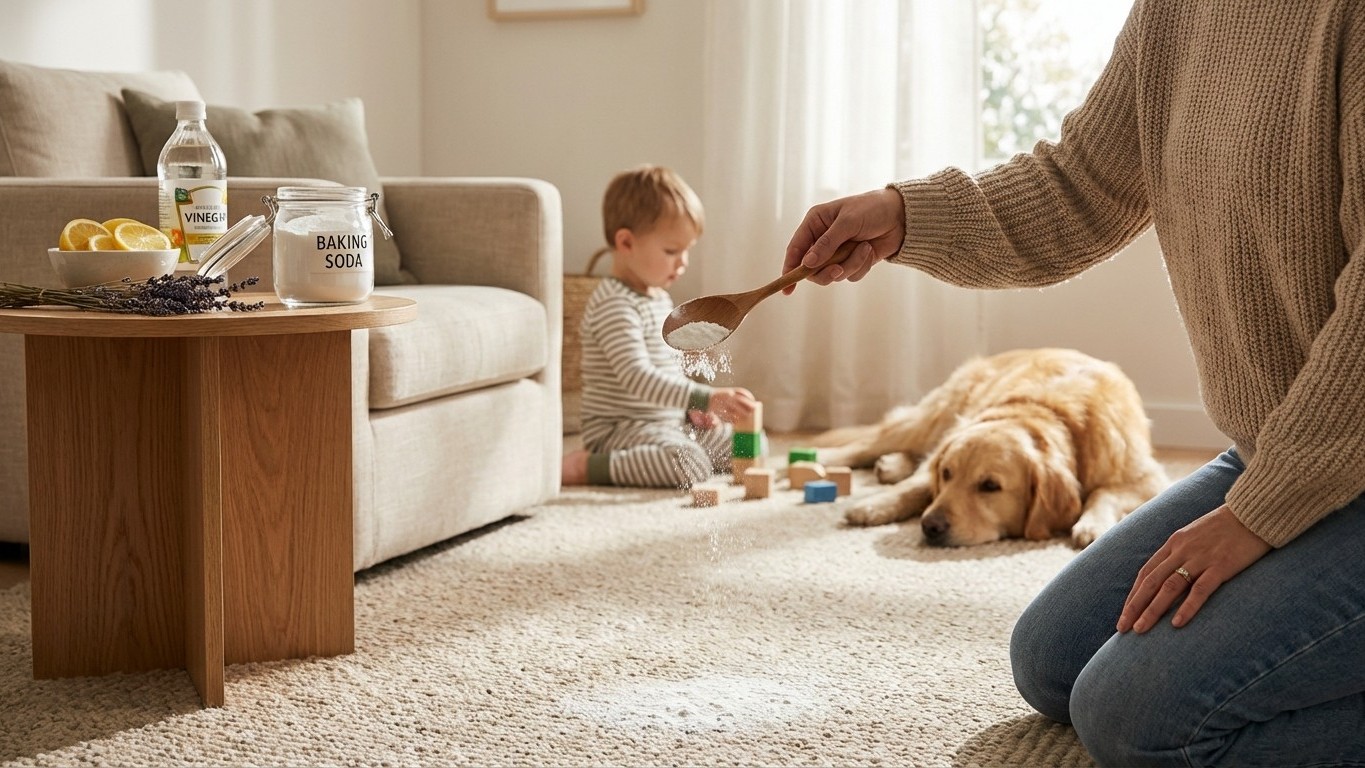
That lingering smell from your carpet, you know the one. Whether it’s where the dog had an accident three weeks ago, the damp patch near the back door that never quite dries, or the ghost of last Friday’s curry — a carpet holds onto odours with remarkable stubbornness. The good news is that your kitchen cupboard almost certainly contains everything you need to sort it out, without a single harsh chemical in sight.
Why Choose Natural Methods to Deodorise Your Carpet?
The Problem with Conventional Deodorisers
Most shop-bought carpet fresheners work by masking odours rather than eliminating them. They deposit synthetic fragrances into the fibres, which can linger for days and may trigger headaches, allergies, or respiratory irritation in sensitive individuals. Some aerosol formulas also contain propellants and preservatives that leave residue deep in the pile, and once that artificial scent fades, the original smell often returns, sometimes stronger than before, because the underlying cause was never addressed.
There is also the cost to consider. A single can of branded carpet freshener can set you back a fair amount, and if you have a large home or persistent odour problems, you can find yourself buying it every few weeks. Natural alternatives, by contrast, cost pennies.
Safety for Children, Pets, and Sensitive Households
This is where natural methods really earn their place. Children play on carpets with their hands and faces close to the fibres. Cats and dogs sleep on them, groom themselves afterwards. Older relatives may be sensitive to strong chemical fragrances. Using bicarbonate of soda, white vinegar, or a gentle sprinkling of terre de Sommières means you are not introducing anything into your home that you would not ordinarily find in a pantry or pharmacy. That is a reassurance worth having.
Understanding Where Carpet Smells Come From
Treating an odour effectively means understanding what is causing it. A musty smell requires a different approach from a pet accident, and a cooking odour calls for different chemistry again.
Pet Smells: Urine, Fur, and Accidents
Urine is the most troublesome of the three, largely because it seeps through the carpet pile and into the backing, and sometimes into the underlay beneath. As it dries, the uric acid crystals that remain can be reactivated by humidity, which is why a stain you thought you had sorted can suddenly smell again on a damp day. Pet fur also carries natural oils and dander that accumulate in carpet fibres and produce a distinctive “doggy” smell over time.
Damp and Mildew Odours
A carpet that has been wet, from a leaky window, a spilled pot, or a steamer used without adequate ventilation — and not dried quickly enough becomes a haven for mould spores. The resulting musty smell is caused by microbial activity in the fibres and backing. This is one situation where bicarbonate of soda alone may not be enough; you often need the antifungal properties of white vinegar as well, and crucially, you need to address the source of moisture.
Cooking and Food Odours
Open-plan living is wonderful until a deep-fry session sends fat particles drifting across the dining room carpet. Food smells embed themselves in wool and synthetic fibres alike. They tend to respond well to absorbent treatments, and the slightly acidic nature of some food odours means that a bicarbonate treatment (which is alkaline) can neutralise them directly rather than just masking them.
The Natural Ingredients That Actually Work
Bicarbonate of Soda: The Workhorse of Carpet Deodorising
Bicarbonate of soda (sodium bicarbonate, available from any supermarket for well under a pound per box) is an alkaline powder that neutralises acidic odour molecules on contact. For a general refresh, sprinkle it generously and evenly over the dry carpet, work it lightly into the pile with a soft brush, and leave it for at least 30 minutes. For stubborn smells, leaving it overnight gives dramatically better results. Then vacuum thoroughly. That really is all there is to it.
For pet urine specifically, blot the area dry first (never rub), then apply a generous layer of bicarbonate directly to the damp patch, pressing it gently down. Leave for several hours, then vacuum. You can follow up with a diluted white vinegar spray if the smell persists. If you want the full method for stain removal alongside odour treatment, the guide on how to remove carpet stains naturally baking soda walks through the whole process step by step.
White Vinegar: Disinfection and Neutralising Stubborn Odours
White vinegar is acidic, which makes it particularly good at breaking down the alkaline compounds found in pet urine and mildew. Mix one part white vinegar with two parts cold water in a spray bottle, mist lightly over the affected area (do not saturate, that risks spreading the problem), and allow to air dry completely. The vinegar smell dissipates as it dries, taking the original odour with it. Warm the room slightly or open a window to speed drying.
One important caution: never mix undiluted white vinegar with bicarbonate of soda as a “super cleaner.” They neutralise each other immediately and the fizzing reaction, satisfying as it looks, achieves very little. Use them separately, one after the other once each has dried.
Terre de Sommières and Natural Absorbent Powders
Terre de Sommières is a naturally occurring clay mineral, traditionally used in French households for centuries to treat carpet stains and odours. It absorbs grease and moisture while leaving fibres dry and residue-free. It works particularly well on cooking odours and greasy deposits. Apply it in the same way as bicarbonate: sprinkle, leave for several hours (or overnight), then vacuum. It is gentler than bicarbonate on delicate wool carpets and natural fibres.
Essential Oils: Which to Use and What to Avoid
A few drops of essential oil added to your bicarbonate of soda before sprinkling can leave a pleasant fragrance behind after the odour has been neutralised. Lavender, lemon, and tea tree are popular choices; tea tree in particular has antimicrobial properties that make it useful for damp or mildew smells.
A firm word of caution here, and I mean this kindly: several essential oils are toxic to cats and dogs. Tea tree, eucalyptus, citrus oils, and peppermint can all cause serious harm to pets if they come into contact with treated surfaces and then groom themselves. If you have animals in the house, either skip the essential oils entirely or use lavender at a very low concentration (two to three drops per 200g of bicarbonate) and ensure the carpet is fully dry and vacuumed before your pet has access to the room again. With children, the same caution applies, always allow the room to ventilate thoroughly before letting little ones play on a treated carpet.
Step-by-Step Methods for Every Situation
The Quick Refresh (For Lightly Smelly Carpets)
Sprinkle 150-200g of plain bicarbonate of soda over the carpet, leave for 30-60 minutes, then vacuum with a good suction setting. That is genuinely all you need for a carpet that just needs freshening up between deep cleans. Do this monthly and you may find the need for anything more intensive rarely arises.
Deep Treatment for Persistent Odours
For pet accidents, mildew, or ingrained cooking smells, work methodically. First, blot any wet areas dry. Apply bicarbonate of soda generously and leave overnight. Vacuum. Then lightly spray the area with diluted white vinegar solution and allow to air dry completely, which may take two to four hours depending on airflow. Open windows. Once dry, if a faint smell remains, repeat the bicarbonate treatment. Persistent mildew smells that survive two or three treatments suggest the moisture has penetrated to the underlay, in that case, the carpet may need to be lifted and the floor beneath treated separately.
Localised Treatment Versus Whole-Room Freshening
For a specific stain or accident area, focus your treatment precisely and avoid spreading moisture unnecessarily. For general room freshness, accumulated pet dander, cooking odours, or simply a carpet that has seen a busy winter — treat the entire carpet with a bicarbonate dusting. Both approaches work well; it is simply a question of what the situation calls for.
Preventing Odours From Coming Back
Regular airing is the single most effective preventive measure. Opening windows for even 20 minutes a day dramatically reduces the humidity that allows mildew and bacteria to thrive in carpet fibres. After cooking, encourage the kitchen exhaust fan to run a little longer rather than letting fat particles drift into adjacent rooms.
For households with pets, placing washable mats or throws over the areas where animals sleep or rest gives you something easy to launder, rather than allowing oils and dander to build up in the carpet beneath. A monthly bicarbonate treatment as a matter of routine, rather than waiting until smells become noticeable, keeps everything under control with minimal effort.
Common Questions and Mistakes to Avoid
The most frequent error is over-wetting the carpet. Whether you are using a vinegar spray or a damp cloth, applying too much liquid drives the problem deeper into the pile and backing, and a carpet that stays damp for more than a few hours risks developing a mildew smell of its own, the very thing you were trying to fix.
If you have tried two or three rounds of natural treatment and the smell persists, the issue is almost certainly in the underlay or the subfloor, not the carpet itself. At that point, lifting the carpet to inspect beneath is the only real solution. Pouring more bicarbonate on top will not reach where the problem actually lives.
As for combining ingredients: bicarbonate and vinegar separately, never together in the same application. Essential oils and pets, handle with care. And always test any treatment on a small hidden area first if your carpet is wool, antique, or has an unusual construction.
Further Reading and Related Guides
Odour removal and stain treatment go hand in hand, a fresh-smelling carpet is often one that has been kept clean of the residues that cause smells in the first place. For a broader approach, the natural carpet cleaning hacks guide covers stains, odours, and general upkeep across different floor types. If you are looking to build a sustainable cleaning routine rather than just tackling individual problems, natural carpet cleaning hacks covers routine maintenance, stain-by-stain guidance, and faster drying techniques. And for the full picture of green cleaning across your whole home, natural cleaning hacks brings together over forty tried and tested recipes room by room.
The truth about natural carpet deodorising is that it rewards consistency more than heroic one-off efforts. A box of bicarbonate, a bottle of white vinegar, and a habit of opening the windows, it is hardly a demanding regime. The carpet in your sitting room has probably been there for years and will be there for years more. Treating it gently, and naturally, seems only fair.