
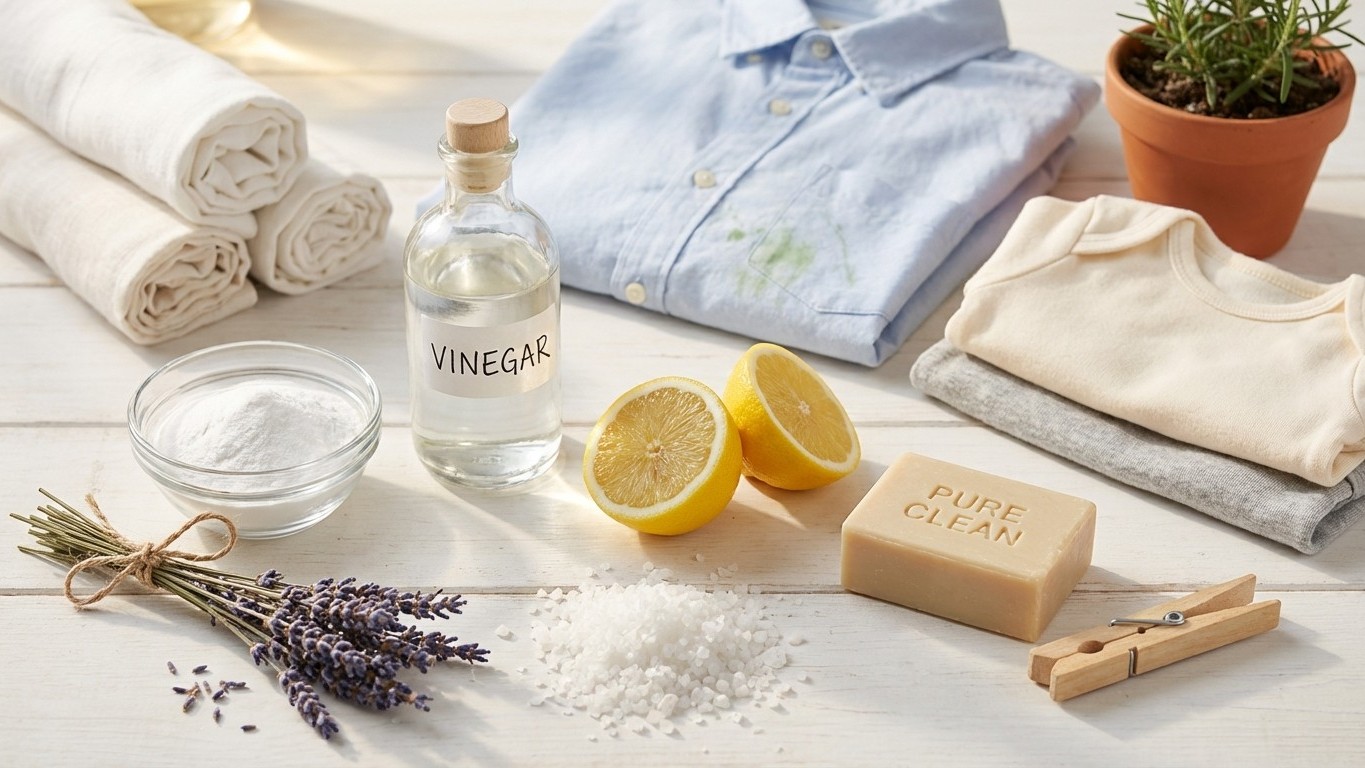
Switching your laundry routine to natural products is one of those changes that sounds complicated until you actually try it, and then you wonder why on earth you waited so long. Whether you’re battling a stubborn grass stain on school trousers, trying to restore a yellowed white shirt and learning how to whiten clothes naturally without bleach, learning how to remove sweat stains naturally, figuring out how to remove common stains naturally from clothes, exploring how to remove musty smell from clothes naturally, trying a natural fabric softener alternative, or simply tired of synthetic fragrances lingering on your bedsheets, there are time-tested, science-backed alternatives that genuinely work. This guide covers everything: the key ingredients, the techniques, the DIY recipes, and the honest warnings about what doesn’t always go to plan.
Why make the switch to natural laundry methods?
The real cost of conventional detergents
Most people don’t read the back of their laundry detergent bottle. If they did, they’d find a rather long list of ingredients that range from mildly irritating to potentially problematic for sensitive skin. Surfactants, optical brighteners, synthetic perfumes, and phosphates all do their jobs efficiently, but they also rinse down the drain into waterways, where they can disrupt aquatic ecosystems. Some phosphates, for instance, contribute to algal blooms that starve rivers of oxygen. That’s a significant consequence for a cleaner shirt.
For households with young children, eczema sufferers, or anyone with allergies, conventional detergents are a common culprit for skin reactions. The residues left in fabric after rinsing are not trivial. Some people cycle through dermatologist appointments for years before realising the problem is sitting in their washing machine drawer.
The ecological and financial case for going natural
Here’s something that tends to surprise people: the ingredients at the heart of natural laundry care, bicarbonate of soda, white vinegar, washing soda, percarbonate of soda, Marseille soap — cost very little per wash when bought in bulk. A kilogram of percarbonate of soda, for example, typically lasts months of regular use and costs a fraction of a branded biological powder. Over a year, the savings can be quite meaningful.
The packaging footprint is smaller too. Buying ingredients loose or in minimal cardboard packaging cuts down on plastic considerably. And if you’re already interested in broader natural cleaning hacks for the rest of your home, you’ll quickly notice that many of the same ingredients cross over, bicarbonate and white vinegar are useful in the kitchen, bathroom, and laundry room alike. A small pantry of multipurpose staples replaces an entire cupboard of single-use products.
The natural laundry toolkit: five ingredients worth knowing
What to keep in your laundry cupboard
Bicarbonate of soda (baking soda) is a gentle alkali that neutralises acids, which makes it excellent for odour absorption and mild stain pre-treatment. Use roughly 2 tablespoons added directly to the drum to boost a wash.
White vinegar works in the opposite direction: it’s mildly acidic, which helps dissolve mineral deposits, soften fabric naturally, and cut through detergent residue. About 100ml in the fabric softener drawer is a standard dose. It does not leave a vinegar smell on dried laundry, that’s one of the most persistent myths in this space.
Percarbonate of soda (sodium percarbonate) is the ingredient most people haven’t heard of but should. When dissolved in water above 40°C, it releases hydrogen peroxide and acts as a powerful oxygen bleach, whitening, stain-removing, and disinfecting without chlorine. Two to four tablespoons per wash is typical for general use; up to six for serious stain treatment.
Marseille soap, in either bar or flake form, is a traditional French staple with genuine cleaning power. Made from vegetable oils and saponified without synthetic additives, it’s kind to skin and effective for pre-treating oily stains. It lathers poorly in hard water areas, so it works best in combination with other ingredients or as a direct pre-treatment rather than the sole detergent.
Essential oils are optional but worthwhile for fragrance. Lavender, tea tree, and eucalyptus are popular choices; tea tree in particular has mild antibacterial properties. Add 10 to 15 drops to your homemade detergent blend, or directly to the fabric softener drawer.
Precautions and compatibility: what works on what
Not every natural ingredient suits every fabric. Percarbonate of soda should never be used on wool, silk, or dyed delicate fabrics, it will strip colour and damage protein fibres. Vinegar, while generally gentle, is best avoided on elastane and spandex over time as repeated acid exposure can degrade the stretch. Bicarbonate of soda is broadly safe, but it can leave a white residue if not rinsed thoroughly — always check the drum after the cycle if you’ve added it directly.
Temperature matters enormously with percarbonate: below 40°C, it barely activates. If you’re washing at 30°C (which is sensible for most modern fabrics), stick to other methods for stain removal and brightening.
Removing stains naturally: targeted methods by stain type
Matching the method to the stain
Grease stains respond wonderfully to Marseille soap or neat washing-up liquid rubbed directly into the fabric, left for 30 minutes, then washed as usual. The key is acting before the grease sets, a 24-hour-old chip-fat splash is manageable; a week-old one takes more patience.
Red wine is best treated immediately with cold water (never hot, which sets the stain) followed by a paste of bicarbonate of soda and water left for 15 minutes. For older stains, a soak in warm water with 3 tablespoons of percarbonate of soda for an hour before washing often works remarkably well.
Blood requires cold water exclusively, hot water cooks the protein and makes the stain permanent. Dab cold water, then apply a little diluted white vinegar or a paste of bicarbonate of soda. For stubborn dried blood, a soak in cold salted water (one tablespoon of salt per litre) for 30 minutes loosens the proteins considerably.
Grass stains contain chlorophyll and are plant-based, so they respond to enzymatic action. A paste of bicarbonate of soda mixed with a few drops of white vinegar, applied and left for 20 minutes before washing at 40°C, handles most cases. If the stain is set, a short soak in a percarbonate solution (for appropriate fabrics only) will lift it further.
For perspiration stains, a full guide on how to remove sweat stains naturally is worth consulting, the yellow halos that form around collar and underarm areas are a combination of sweat salts and aluminium compounds from antiperspirants, and they have their own chemistry.
Pre-treatment: a step-by-step approach
The golden rule is simple: treat stains before they go in the machine. Spot-treat with the appropriate agent, leave it to work (patience is the ingredient most people skip), then wash at the correct temperature. Scrubbing vigorously spreads stains and damages fibres; instead, press the treatment in gently and let the chemistry do the work.
For a general-purpose pre-treatment spray, mix 200ml of water with 2 tablespoons of white vinegar and 1 teaspoon of bicarbonate of soda in a spray bottle. Shake gently (it will fizz initially), then spritz on the stain 10 minutes before washing. This combination is safe for most colourfast fabrics and handles light marks of most types beautifully.
Reviving whites without bleach
Chlorine bleach does work, there’s no denying it. But it also weakens cotton fibres over time, produces toxic fumes when mixed with other chemicals (a genuinely dangerous mistake some people make), and is harsh on skin. The natural alternatives aren’t quite as instant, but for regular maintenance, they’re entirely adequate.
Percarbonate of soda is the workhorse here. Soak white cotton items in a solution of 4 tablespoons of percarbonate dissolved in 5 litres of warm water (at least 40°C) for one to two hours, then wash normally. For persistent yellowing, extending the soak to four hours makes a visible difference. A complete breakdown of dosages and timing is available in the dedicated guide on how to whiten clothes naturally without bleach.
Lemon juice deserves a mention, it does brighten whites, especially when clothes are line-dried in sunlight afterwards. The UV light activates the citric acid and bleaches gently. Squeeze half a lemon into the final rinse water, or add 4 tablespoons of bottled lemon juice to the drum. The effect is subtle rather than dramatic, but cumulative over regular washes.
A word of genuine caution: none of these whitening methods are suitable for silk, wool, or brightly coloured fabrics. Silk and wool are protein fibres that react badly to alkaline treatments (percarbonate is alkaline in solution), and colours can fade unexpectedly with lemon or percarbonate exposure.
Banishing laundry odours naturally
The three-ingredient approach to fresh-smelling laundry
White vinegar in the fabric softener drawer is the single most effective change most people can make for odour-free laundry. It neutralises the alkaline residues left by detergent (which are a primary cause of that musty post-wash smell), softens fibres as a side effect, and rinses away completely. 100ml per load is plenty.
Bicarbonate of soda absorbs odours rather than masking them. Two tablespoons added to the drum at the start of a wash, particularly for gym kit or bedding, makes a meaningful difference. For a fabric-safe deodorant soak, dissolve 3 tablespoons in a basin of warm water and soak garments for 30 minutes before washing.
Essential oils provide fragrance without synthetic chemicals. Tea tree (10 drops) added to the drum has mild antibacterial properties useful for sportswear; lavender is simply pleasant for bedding and linens. These won’t leave any staining on light fabrics if used in these quantities.
Tackling stubborn odour problems
Sportswear that has been washed multiple times but still smells is a very common frustration. Synthetic fabrics like polyester trap bacteria deep in their fibres, and standard detergent cycles don’t always penetrate effectively. The solution is to turn the garments inside out and soak them in a solution of white vinegar and cold water (1 part vinegar to 4 parts water) for one hour before washing. Avoid hot washes with synthetic sportswear, heat can set odours permanently into those fibres.
Clothes that have been stored too long and emerged smelling stale or musty need a different approach. The full method for dealing with this is covered in the guide on how to remove musty smell from clothes naturally — and it’s more straightforward than most people expect. The short version: a bicarbonate soak, good airing, and sunlight do more than a fragrant detergent ever could.
Caring for delicate fabrics: wool, silk, and lace
Products and recipes for the gentlest wash
Wool and silk are protein fibres, which means they react very differently to cotton or synthetics. Alkaline products, washing soda, percarbonate of soda, and standard bicarbonate of soda in high concentrations — can cause irreversible damage, shrinkage, and felting. For these fabrics, the safest natural cleaners are those with a neutral or very mildly acidic pH.
A DIY delicate wash solution: dissolve 1 teaspoon of mild liquid Marseille soap in 2 litres of lukewarm water (never above 30°C for wool, never above 35°C for silk). Add 1 tablespoon of white vinegar to slightly acidify the water and help preserve the fibre structure. Gently submerge the garment, swish softly without rubbing, leave for 10 minutes, then rinse in water of the same temperature. Temperature shocks, moving from hot to cold water, cause wool to felt instantly.
Lace and embroidered items are best handled in a mesh bag even when hand-washing, as the fine threads snag easily. A tiny amount of Marseille soap flakes dissolved in cool water is sufficient; lace rarely needs heavy cleaning, just refreshing.
Drying, ironing, and storing delicates the right way
Never wring wool, press it gently against the side of the basin to remove water, then roll it in a clean towel and press again. Reshape the garment and dry it flat on a rack away from direct heat. Radiator-dried wool becomes distorted and scratchy; it’s one of those shortcuts that costs more than it saves.
Silk can be line-dried but should be kept out of direct sunlight, which yellows it over time. Iron silk while still slightly damp, on the reverse side, with a cool iron. Linen, conversely, loves a hot steam iron, it’s practically the only fabric that actually improves with vigorous ironing.
For storage, natural fibres breathe better in cotton bags or pillowcases than in plastic boxes or bags. Cedar blocks (refreshed periodically by sanding lightly) deter moths without chemical mothballs. A sachet of dried lavender in each drawer is gentle and pleasant, though it provides only mild moth-deterrent properties rather than full protection.
DIY laundry recipes: detergent, powder, and fabric softener
A basic homemade laundry powder combines 200g of washing soda, 100g of bicarbonate of soda, and 50g of grated Marseille soap (grated finely so it dissolves well). Mix thoroughly and store in an airtight jar. Use 2 to 3 tablespoons per load. For a sensitive-skin version, replace the washing soda with bicarbonate of soda entirely (washing soda is more alkaline and can irritate very sensitive skin) and omit essential oils.
A liquid detergent can be made by dissolving 50g of Marseille soap flakes in 1 litre of just-boiled water, stirring until clear, then adding 3 tablespoons of bicarbonate of soda and 2 tablespoons of white vinegar (add the vinegar last and slowly, it will react with the bicarbonate, so give it time). Once cooled, decant into a bottle. Use 100ml per load. The shelf life is about four weeks; make small batches rather than a month’s supply.
For fabric softener, white vinegar alone is the simplest option, and genuinely effective. If you’d like a light scent, add 15 drops of essential oil to 500ml of white vinegar in a bottle, shake before each use, and add 100ml to the softener drawer. The full comparison of natural softening options, including washing soda crystals and their limits, is explored in the dedicated article on finding a natural fabric softener alternative that actually works.
Common questions and honest answers
The most persistent myth about natural laundry methods is that they don’t clean as well as conventional detergents. The honest answer is: it depends. For lightly soiled everyday laundry, they perform comparably. For heavily soiled work clothes or badly stained items, they often need more effort, pre-treatment, longer soaks, or higher temperatures. They’re not a lazy swap; they reward attention and preparation.
Can you use vinegar and bicarbonate of soda together in the same wash? Technically, yes, but the fizzing reaction they produce neutralises much of both ingredients’ cleaning power before they even reach your clothes. They’re more effective used separately: bicarbonate in the drum at the start, vinegar in the softener drawer for the rinse.
Will natural detergents damage the washing machine? Quite the opposite. Hard water leaves limescale deposits in machines, and white vinegar in the rinse cycle helps dissolve these gradually. Running an empty hot wash with percarbonate of soda monthly is an excellent maintenance habit that descales and disinfects the drum simultaneously.
What about very hard water areas? This is a genuine challenge. Hard water reduces the effectiveness of soap-based detergents significantly (you’ll notice a scummy residue). Adding an extra tablespoon of washing soda to each wash softens the water and improves cleaning power. Or simply lean more heavily on percarbonate of soda, which is less affected by water hardness than soap.
The shift to natural laundry care is rarely all-or-nothing. Most people find it easier to replace one product at a time, starting with the fabric softener (swap it for vinegar overnight, genuinely effortless), then experimenting with homemade powder, then tackling stain pre-treatment. The learning curve is gentle, the costs are low, and the satisfaction of a clean basket of laundry that smells of nothing more than fresh air is, frankly, rather lovely. Once you’ve made the connection between what goes in your machine and what ends up in your water supply, it becomes quite hard to go back to the old ways.