
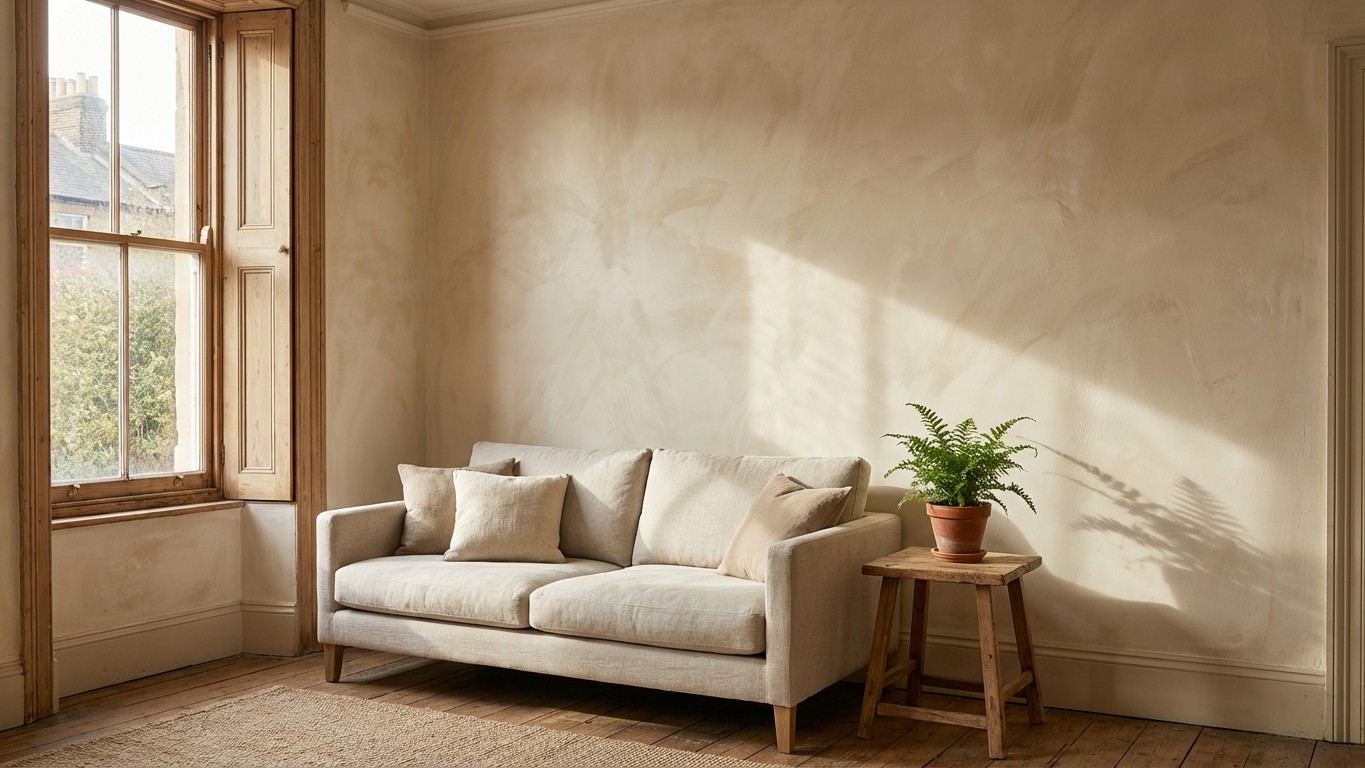
There’s a quiet Revolution happening on the walls of British living rooms. Not a loud one, not the sort that demands bold wallpaper or a startling shade of teal, but a slow, deeply satisfying shift away from the flat, uniform painted wall that has dominated our homes for decades. The finish making all the noise? Limewash. And if you haven’t looked at your magnolia emulsion with a slightly critical eye yet, you might be about to.
Key takeaways
- An ancient finish forgotten for decades is quietly revolutionizing how British homes look and feel
- Unlike flat paint, this material absorbs light differently and changes throughout the day—here’s what that actually means
- It’s practical for older UK homes, forgiving of imperfections, and surprisingly accessible as a DIY project
The oldest trick in the book, quite literally
Although limewash feels like a fresh discovery, it is far from new. These materials have been used for centuries in residential and civic architecture across many cultures. Limewash has a long history, dating back thousands of years, with origins traceable to ancient civilisations like Egypt and Greece, where it was used as a protective and decorative coating for buildings. The Romans used it, the Tudors used it, and for a long stretch of the 20th century, somewhere between the invention of vinyl emulsion and the arrival of Farrow & Ball — we largely forgot about it. That forgetting, it turns out, was a mistake.
Unlike modern paints that form a plastic-like film on walls, limewash is a beautifully simple, natural material made from limestone that has been crushed and burned, and when mixed with water and natural pigments, it penetrates the surface of the wall, becoming an integral part of it. The result is something no tin of emulsion can replicate: plaster and limewash walls introduce subtle movement that changes with light and shadow throughout the day, adding a sense of life to the interior so that walls feel less like a backdrop and more like an active part of the architecture.
Why flat paint is losing its grip in 2026
Flat paint became popular for its clean, uniform appearance and ease of application. However, as interiors have shifted toward warmth and materiality, its limitations have become more noticeable. Painted walls can feel static and visually flat, particularly in neutral palettes, and they reflect light evenly, which can strip a space of depth and character. That last point is worth sitting with. Many of us have spent years chasing the perfect white or the ideal greige, only to end up with a room that looks fine in photographs but feels curiously empty to actually live in.
In 2026, interiors are embracing immersive material environments, monolithic plaster, layered woods, textured walls and tactile surfaces. Texture is replacing pattern as the primary visual language. Flat, flawless walls are giving way to texture, with homeowners and designers alike embracing finishes that add depth and interest even in neutral colour schemes. Limewash, clay plaster, and microcement are all gaining popularity for their soft movement and tactile appeal. The living room, perhaps more than any other room in the house, is where this shift is felt most keenly. It’s the space we actually inhabit — and we’ve started to want walls that inhabit it with us.
UK homeowners are becoming more selective, often asking one important question first: will this still work in five years? Several changes are driving this mindset. Energy costs have made people more conscious of light, warmth, and atmosphere. Flexible working has blurred the line between home and workspace. A wall finish that shifts gently through the day, from pale and airy in morning light to warm and cocoon-like by lamplight, suddenly feels less like a luxury and more like something rather sensible.
What limewash actually does to a room
Light is central to the appeal of these finishes. Unlike paint, which reflects light uniformly, plaster and limewash absorb and diffuse it, creating gentle variation across the wall surface, enhancing architectural form and adding depth even in simple spaces. Think of it like the difference between a cotton sheet and a linen one, both are white, but one has a life and a texture the other simply doesn’t possess.
For British homes specifically, there are practical advantages that go beyond the aesthetic. Limewash is naturally breathable, making it perfect for UK homes, especially older properties, as it allows walls to breathe, preventing trapped moisture that can lead to damp and peeling. Anyone who has lived in a Victorian terrace or an Edwardian semi will know exactly how significant that is. If you have walls that aren’t perfectly smooth, limewash can help to disguise imperfections, with the textured finish hiding cracks, bumps, or uneven surfaces, making your walls look beautifully rustic rather than flawed. it’s rather forgiving, which, in an older British home, is no small thing.
These finishes work particularly well in living rooms and bedrooms, where subtle variation catches the light and makes a space feel warmer and more inviting. Textured walls also age well, hiding minor marks better than smooth painted surfaces. That’s the sort of practical wisdom that any household with children or pets will appreciate enormously.
Getting the look, without losing your head (or your savings)
Texture is returning, but not through heavy materials. Limewash-style effects and brushed finishes are being used to add movement to walls, and these finishes suit feature areas rather than whole homes. Starting with a single chimney breast or one main wall is a perfectly sound approach, it costs less, carries less risk, and often has more visual impact than treating every surface at once.
Unlike regular paint, which is rolled on in a flat, uniform layer, limewash is applied in multiple thin coats using broad brushstrokes. This process creates subtle variations in tone and opacity, allowing the finish to have a natural, organic movement that is unique to each surface. Modern limewash products available in UK DIY shops and specialist paint suppliers have made this increasingly accessible as a weekend project. The technique does require a little practice, criss-cross strokes, not the steady back-and-forth of ordinary emulsion — but the learning curve is genuinely gentle.
Soft neutrals, earth tones, and mineral-inspired colours work especially well, as these hues enhance depth without drawing attention to inconsistency. Warm-tone limewash, featuring hues like creamy beige, earthy taupe, and soft terracotta, enhances this effect, bringing a cosy, inviting atmosphere to interiors and making them ideal for homeowners looking to add personality and warmth to their spaces. Pair those walls with linen sofas, raw wood, and candlelight in the evening, and you’ll wonder why you ever settled for matt white in the first place.
One small but important note: test before committing to a large space, as limewash typically dries lighter. It is also a perfect technique for walls that have imperfections, it adds to the charm. Avoid using this technique in spaces such as bathrooms and kitchens unless it’s properly sealed.
There’s something quietly radical about a generation of homeowners turning to a finish that predates the industrial Revolution, not out of nostalgia, but out of a genuine hunger for walls that feel alive. The ultimate goal of contemporary interior design is no longer perfection but authenticity. Whether that leads you to limewash, clay plaster, or Venetian finish is almost beside the point. The real question is simply this: does your living room feel like somewhere you actually want to be?
Sources : my-inspo.com | victoriousinteriors.com