
Adhesive strips are genuinely clever little things. They hold picture frames, coat hooks, and kitchen organisers without a single nail hole, and for most of us, they feel like a perfectly reasonable solution for a bathroom mirror too. The problem is that a bathroom is one of the worst possible environments for adhesive strips, and a mirror is one of the heaviest things most people ever hang with them.
Key takeaways
- A glass fitter reveals the one accident he sees most often in bathrooms
- Warm steam does invisible damage that standard adhesive strips cannot resist
- Your mirror might already be failing—and there’s a simple test to check right now
Why the bathroom is the enemy of adhesive strips
Every shower you take fills the air with warm, moist vapour. That steam settles on every surface, including the wall behind your mirror, and it works silently on adhesive strips in ways you simply cannot see. Most standard adhesive strips, even the better-known heavy-duty varieties, use a foam backing with a pressure-sensitive glue. That foam absorbs moisture over time, and when it does, the bond between the strip and the wall gradually weakens. On a dry wall in a bedroom, a strip rated for two kilograms might hold reliably for years. In a steamy bathroom, that same strip can lose a significant portion of its holding strength within months.
Ceramic tiles make things worse. Adhesive strips grip best on smooth, flat, non-porous surfaces, and while tiles look smooth, the glaze can be subtly uneven, and the grout lines create edges that allow moisture to creep underneath the foam. A strip that feels firmly bonded when you press it on a dry Monday morning may already be lifting slightly at the corners by the following Saturday, though you would never know it from the front.
What a glass fitter explained about mirror weight
A glass fitter who visited a neighbour of mine to replace a cracked bathroom mirror was quite candid about what he sees regularly. He said that the single most common cause of bathroom mirror accidents he attends is adhesive strips failing, and it rarely happens gradually. Mirrors do not slide slowly down the wall giving you time to react. The strips hold, hold, hold, and then release all at once. A standard bathroom mirror measuring roughly 50 by 70 centimetres, which is a fairly modest size, can weigh anywhere from three to six kilograms depending on thickness. A frameless mirror with bevelled edges can be heavier still. That weight dropping unexpectedly, often onto a sink, a glass shelf, or a tiled floor, creates dangerous shards.
Glass fitters fix mirrors using two methods, and almost never use adhesive strips for anything substantial. The first method is mirror adhesive, a solvent-based or silicone-based compound applied in blobs directly to the back of the mirror. It creates a chemical bond with the wall rather than a mechanical one, and it is not affected by steam in the same way. The second method is mirror clips or plates, small metal brackets screwed into the wall that physically support the mirror’s weight regardless of any adhesive. Many Professional installations combine both for belt-and-braces security.
How to check whether your mirror is at risk right now
You do not need to take the mirror down to get a rough sense of how secure it is. Run the flat of your hand slowly along each edge of the mirror, pressing very gently inward. A well-secured mirror should feel absolutely solid, with zero movement or flex. Any give at all, any sensation of the mirror shifting even a fraction of a millimetre, means the bond has already begun to fail and the mirror needs attention today, not next weekend.
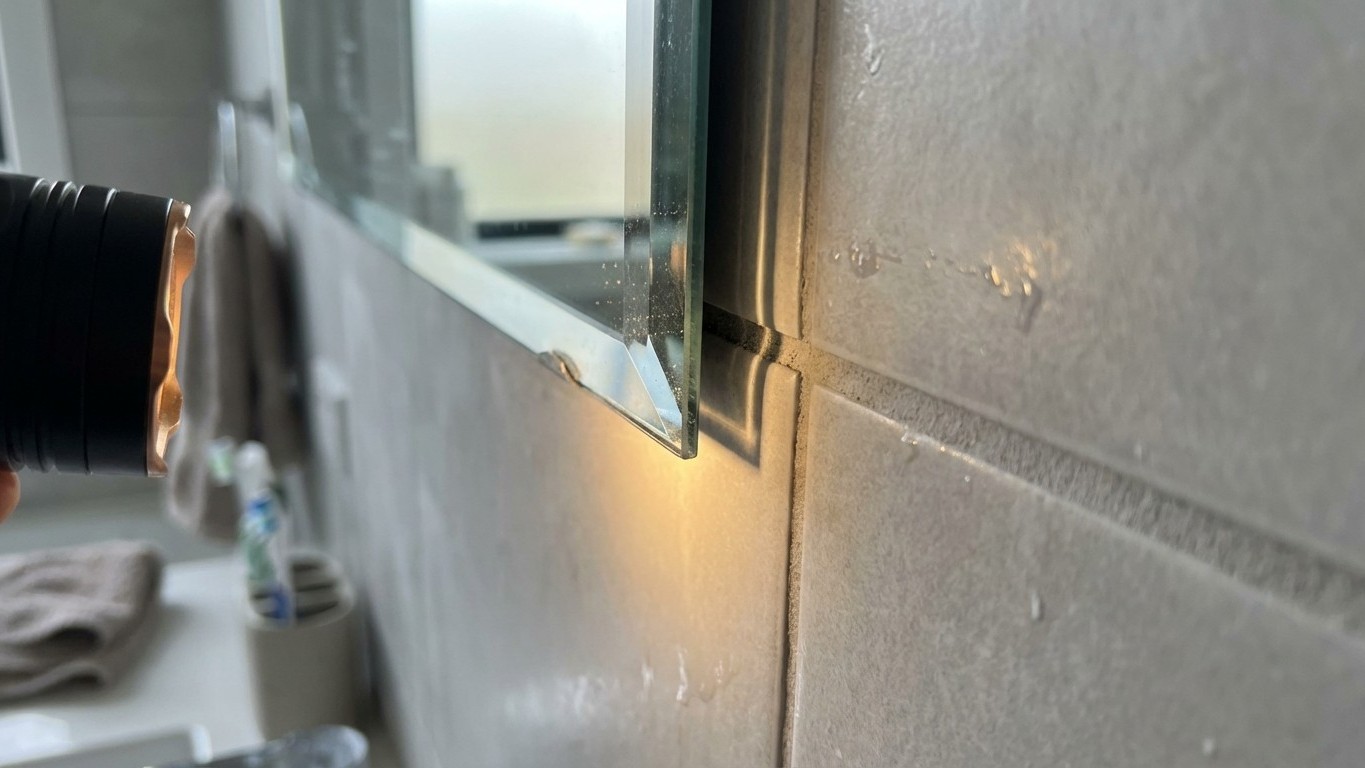
Also look at the gap between the mirror and the wall along the top edge. Hold a torch at a low angle and look for a slight shadow or unevenness. If the strips have begun to peel, the top of the mirror will have pulled fractionally away from the wall before the bottom follows. This is the warning sign most people miss entirely because they are looking at the reflective surface rather than the edges.
For a mirror under about 1.5 kilograms on a dry, non-tiled wall, high-quality adhesive strips designed specifically for wet areas can be a reasonable short-term solution, though they still require checking every few months. For anything heavier, or anything on tiles, the honest answer is that screws and proper fixings are the only genuinely reliable option.
Replacing the fixings without making a drama of it
Getting mirror clips fitted properly is far less expensive than many people expect. A handyman or a glazier will typically do the job in under an hour, and the cost of the clips themselves from any hardware shop is modest. Drilling into tiles does require a tile drill bit rather than a standard masonry bit, but it is a straightforward job for anyone reasonably competent with a drill. The bit needs to run slowly with gentle pressure, and the tile should never be struck with a hammer drill setting.
If your mirror is a frameless type glued directly to the wall with mirror adhesive and you want to remove it, do be cautious. Removing a glued mirror requires a length of piano wire or strong fishing line drawn carefully behind the glass in a sawing motion. Attempting to lever it off with a scraper can crack the mirror and, worse, send chips flying. Some builders’ merchants sell specific mirror-removal tools for a few pounds, and it is money well spent.
One thing worth knowing: older mirrors sometimes have a thin protective backing applied to the silvered rear surface. Silicone-based mirror adhesive must be used rather than solvent-based products on these, because the solvents can attack the silver coating and leave permanent dark patches or black spots creeping in from the edges. This silvering damage, sometimes called black edging or foxing, is irreversible, and it is a surprisingly common mistake even among people who consider themselves reasonably handy.